






Corgi Pileup Deep Dive
What the Community Thinks About Corgi Pileup
Corgi Pileup divides reviewers. Game Night's team praised it as an approachable, charming introduction to ladder climbing trick-taking, highlighting the artwork and casual feel that makes it accessible to new players. The Dice Tower's Tom Vasel dismissed it harshly, rating it low and calling it terrible. A GameHead lineup reviewer ranked Corgi Pileup last among several of the publisher's releases, finding it the least exciting title in that debut slate, though acknowledging its appeal to players drawn primarily by the cute aesthetic. The consensus suggests Corgi Pileup works best as an entry point to trick-taking for casual audiences and thematic enthusiasts, but may leave strategy-focused players wanting more depth.
Core Mechanics That Define Corgi Pileup
Trick-Taking
Corgi Pileup uses trick-taking as its foundation, though with an unusual twist. Players play cards in turn following standard trick-taking rules, but what sets it apart is that only the final trick of each round matters for scoring. Earlier tricks are simply played and discarded. This mechanic creates an interesting reversal of typical trick-taking strategy. Instead of winning tricks to accumulate points throughout play, players focus their energy on managing their hand to ensure they have the right card, or lack thereof, for the single scoring trick at the end of each round.
Ladder Climbing
The ladder climbing mechanic defines moment-to-moment play. Each player must either play a card equal to or higher than the highest card currently on the table, or play their lowest card. This forces difficult decisions: play a high card to win a trick and risk depleting the hand of the card needed for final scoring, or play the lowest card to preserve options while signaling weakness and losing the trick. Game Night's players noted that this mechanic feels restrictive compared to traditional trick-taking, where more cards remain playable at any given moment. The game's special cards further manipulate these constraints, adding layers to an already tense decision space.
The Corgi Pileup Experience
Charming Thematic Design
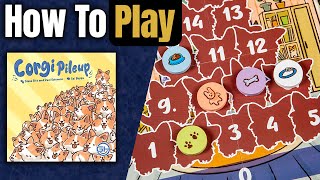
The game's most consistent praise centers on its artwork. Game Night's team repeatedly called the game cute and noted that the playful corgi theme, the scoring track designed as a corgi pileup, and the card illustrations give the game genuine personality. Reviewers who love dog-themed games or prioritize aesthetic appeal find this thematic cohesion compelling. The artwork becomes more than decoration; for many players it is the game's primary draw.
Tension in the Final Trick
Game Night's playthrough showed genuine tension as players approached end-of-round scoring. Because only the last card matters, pressure intensifies on the final trick. Players strategically hold low cards hoping others will be forced to play their mid-range options. Game Night's participants described moments of suspense as cards were played and scores climbed toward the losing threshold. This creates a push-your-luck element where every final trick becomes a miniature high-stakes moment, even though the overall game remains casual and light.
What Makes Corgi Pileup Stand Out
Approachability for New Trick-Taking Players
Game Night explicitly praised Corgi Pileup as a great introduction to the concept of ladder climbing trick-taking games like Scout. The simpler hand size in the base game, the single scoring trick per round, and the straightforward win condition make it more digestible than ladder climbing variants that require constant tactical calculation. The game teaches the core mechanic without overwhelming new players, making it useful as a gateway before introducing more complex trick-taking systems.
Accessible Variants for Different Preferences
The inclusion of the Underdog Variant and a strategic variant offers flexibility. The Underdog Variant flips the scoring entirely, where the lowest score above zero wins instead of the highest, fundamentally shifting strategy. The strategic variant increases hand size, giving players more options and agency at each decision point. Game Night's players noted that these variants address common concerns about control; players wanting deeper strategic choices gain more tools to manipulate outcomes.
Potential Drawbacks
Limited Strategic Control in Base Game
Game Night's players expressed frustration with how often they felt reactive rather than proactive. With a small hand and mandatory climb-or-lowest-card rules, options narrow quickly. Players noted they might win only one or two tricks in a game because the ladder climbing constraint forced their hand repeatedly. This limitation isn't necessarily a flaw, but it reduces the satisfying moments that strategy players seek in trick-taking. Reviewers focused on control found the base game too restricted, though the strategic variant addresses this concern partially.
Ranking Below Other GameHead Releases
The reviewer who ranked the GameHead titles placed Corgi Pileup last. While acknowledging the artwork, they found other titles in the lineup, including an auction bidding game and a Japanese-style trick-taking game with a twist, more engaging mechanically. This suggests that Corgi Pileup, while charming, may not satisfy players looking for novel or complex systems. Its strength lies in casual accessibility rather than innovative mechanics.
If You Enjoy Corgi Pileup
Players drawn to Corgi Pileup's charm and ladder climbing core should explore Scout, a more complex ladder climbing game that offers deeper strategic options. For those captivated by the cute aesthetic and bidding elements, Trinket Trove, mentioned positively by reviewers covering the same GameHead lineup, provides a different type of decision making around bidding for collectible cards while pursuing set combinations. Both games appeal to the same sensibilities as Corgi Pileup while offering increased depth or different mechanical challenges.
What Reviewers Are Saying
"That's why I like this as an introductory, for sure, to ladder climbing trick taking. And then you'll be like, I want more strategy. That's a good point, and this is something that you could play before doing even like Scout, or one of the more complicated kind of ladder climbing games. I think this is a great introduction to the concept of that."
— Game Night
"I think it's really cute. I like how it looks. I want to feel like I have a little more control, or strategy even, with it being as casual as it is when I'm playing a trick-taking game. The thing that I like about trick-taking is feeling like I know how to manipulate what's happening. And this, because it's got ladder climbing in it, I felt a little less in control of my own strategy."
— Game Night
"This feels kind of like a trick-taking game, but it's really not. You're building this pile of corgis, 15 corgis, and you're kind of stacking them up. You want to be close as you can to 15 points without going over."
— Watch Review