


Winter Thunder: The Battle of the Bulge Deep Dive
What the Community Thinks About Winter Thunder: The Battle of the Bulge
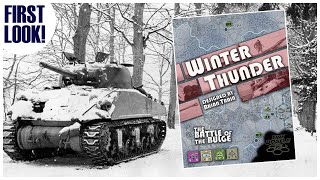
Reviewers see Winter Thunder: The Battle of the Bulge as a compact operational wargame that delivers far more action than its box suggests. Brian Train designed the 2015 title for Tiny Battle Publishing, which is known for small footprint games at affordable prices. In their first look, Zilla Blitz described the game as one that packs a lot of punch in a small package, with 176 counters, a 17 by 22 inch map, and a campaign that can be played in a single evening. The reviewer also noted that the game is a streamlined and updated descendant of Automist, another Brian Train design.
The consensus favors the rules and the combat design. The rulebook was judged clear, well organized, and modest in complexity, with the combat system as the one part that took extra time to absorb. In the Bulge Off 23 tournament, Winter Thunder reached a play-in matchup against The Last Gamble, where it lost a close audience vote that swung back and forth for several days. The channel's commentary on that result suggested that smaller, quicker-to-table games were drawing real enthusiasm.
Core Mechanics That Define Winter Thunder: The Battle of the Bulge
Area Movement
Movement in Winter Thunder is governed by terrain and road networks, and the game has no zones of control. Units can slide past enemy formations, but the reviewer stressed that this does not make an advance easy. Forested terrain bars motorized units from entering, and they cannot attack into forest unless they are moving along a road, which pushes the player toward infantry for the difficult ground. Strategic movement rewards units that stay on roads and avoid adjacency to the enemy, letting them cover large distances quickly. Improved positions along the Westwall benefit only the Germans, and roadblock counters let the American side slow the German advance. Reviewers described the playing surface in hexes, so the terrain and movement charts printed on the board are the key references for these constraints.
Chit-Pulling
Each turn in Winter Thunder begins with housekeeping and reinforcements, followed by an operations phase driven by a chit cup published as part of the Tiny Battle Publishing package. Every headquarters on the map has a corresponding chit placed in the cup. Each pull lets the side whose chit appears activate the units within that headquarters' command range, so activations swing back and forth between the two sides in ways neither player can fully plan. Zilla Blitz noted that headquarters act differently depending on which chit is drawn, which keeps the operational picture shifting.
Combat runs through the Mission Matrix, which the reviewer compared to rock paper scissors. The attacker chooses frontal attack, infiltration, balanced attack, or Blitz, and Blitz is available only when armor is involved. The defender chooses from six postures, including delay, stand fast, and withdraw. The two choices cross-reference a box with four results, where red outcomes apply to the attacker, blue outcomes apply to the defender, and the lower numbers govern advance and retreat. Casualty checks combine combat factors, terrain, and the resulting modifier, and they are resolved with a ten-sided die that the game does not include.
The Winter Thunder: The Battle of the Bulge Experience
A Small Box With Big Momentum
Reviewers consistently describe the game as an evening-length experience. The campaign runs ten two-day turns from December 16 through early January, and the Home for Christmas scenario shortens play to six turns, which the reviewer estimated at an hour and a half to two hours. The 176 counters and the modest map give the game a light physical footprint, yet the reviewer felt that the layers of command, movement, and combat produce a lot of action. The sense of a brisk, complete campaign in a small package is central to how viewers talk about the game.
Guesswork Along the Front Line
The Mission Matrix and the chit cup create a constant sense of uncertainty that echoes the German offensive itself. Attackers must decide whether to push a balanced assault, infiltrate, or commit armor to a Blitz, while defenders must guess whether to hold, delay, or fall back. The German armor is designed to punch through American and Allied lines, and exploitation counters let a tagged armored unit move and attack again after the first round of combat. Zilla Blitz described this as a second wave that rewards a successful breakthrough and leaves the armor exposed if the first blow fails.
What Makes Winter Thunder: The Battle of the Bulge Stand Out
An Innovative Mission Matrix Combat System
The reviewer said that the combat system felt unlike anything seen before in a World War II hex game. The attacker and defender each commit to a hidden type of action, and the resulting box determines casualties and movement in one step. This is the feature reviewers point to most often when explaining why the game feels distinctive, and it is the reason Zilla Blitz looked forward to playing it to see how the guessing game unfolds.
Setup-Friendly Design With Substantial Game Feel
Reviewers praised the map for printing unit designations directly on the starting positions, which makes setup smoother. Combined with a rulebook of roughly six and a half pages in two well organized columns, the game is easy to start. Tiny Battle Publishing's compact approach means the physical package is modest, yet the reviewer still found the counter set, weather, reinforcement tracks, and first-turn German advantages enough to create a substantial game experience.
Potential Drawbacks
A Novel Combat System That Demands Careful Reading
Reviewers found the rules clear, but the combat section required rereading. Zilla Blitz spent roughly half an hour to 45 minutes on the rulebook, going back over the combat section a couple of times before the Mission Matrix made sense. The reviewer described the moment of stopping to realize the system was different as part of the appeal, yet it also means new players should expect to invest time in the combat rules before the first game flows smoothly. The ten-sided die required for casualty checks is also not included, so players must supply their own.
No Solitaire Bot and Unclear Solo Rules
Winter Thunder does not include a solitaire bot, so solo play means controlling both sides. The rulebook suggests a modification in which the player picks the attacking chit and then randomly determines the defending chit, but the reviewer was unsure how this would work with the Mission Matrix in practice. Zilla Blitz rated the solo experience around five to five and a half out of ten and noted that players will need to make their own adjustments to the combat system to make solo play satisfying.
If You Enjoy Winter Thunder: The Battle of the Bulge
- Automist (original by Brian Train): Zilla Blitz identified Automist as the original version of Winter Thunder, with the newer game offering streamlining, updating, and modifications. Fans of the design lineage will recognize the same compact approach to combat and command.
- The Last Gamble: The Last Gamble was paired directly with Winter Thunder in the Bulge Off 23 play-in round. Both are small footprint games that cover the entire Battle of the Bulge campaign, and the channel's commentary grouped them together as quick, easy-to-table options that viewers described as really fun to play.
- Fast Action Battles: Fast Action Battles from GMT Games is the only block-based game in the Bulge Off 23 field, and the channel selected it for its very innovative gameplay. Winter Thunder and Fast Action Battles were not paired head to head, but both represent the unconventional, lighter systems that the tournament highlighted.
What Reviewers Are Saying
"I had to stop for a second and say, wait a second, this is different. I haven't really seen something quite like this before. I think it's a really cool system."
— Zilla Blitz
"This one again uses a small footprint, some pretty innovative mechanics, and a number of people said they really like it. This is going to be one of the first games of my exploration of Battle of the Bulge games."
— Zilla Blitz
"It does say something. I wonder how candidates, a smaller footprint candidates are going to go, because I think there is something to be said for games that play fast, play quick, and easy to get to the table."
— Zilla Blitz