




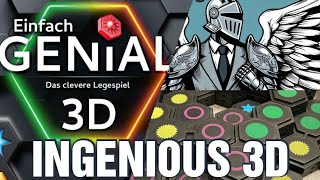



Einfach Genial 3D Deep Dive
What the Community Thinks About Einfach Genial 3D
Einfach Genial 3D represents a thoughtful evolution of a classic design rather than a dramatic reinvention. The board gaming community views this three-dimensional take on Reiner Knizia's Ingenious as a genuine upgrade to an already respected game. Reviewers consistently praise the vertical dimension for injecting fresh strategic possibilities into a familiar structure, while remaining faithful to the design's core identity. The game successfully walks a line between honoring its predecessor and standing as its own compelling experience.
Core Mechanics That Define Einfach Genial 3D
Stacked Tile Placement
The signature innovation of Einfach Genial 3D is the ability to place tiles on top of existing tiles rather than only on empty spaces. This seemingly simple change fundamentally transforms the strategic landscape. Players must place domino-like tiles (hexagons connected in pairs) onto a shared hex grid, but now they can layer these tiles upward to create a three-dimensional terrain. This creates immediate benefits: the board footprint becomes much smaller than the original Ingenious, which means players run out of empty spaces far more quickly. Reviewers note that this compression forces strategic decisions much earlier in the game, preventing the original's tendency to sprawl outward indefinitely.
The Knizia Scoring System
Like Ingenious before it, Einfach Genial 3D employs Knizia's innovative scoring approach: players track points across all six colors, but only their lowest score counts as their final score. This creates intense pressure to balance development across every color family, since falling dangerously behind in even one category becomes catastrophic. Players cannot simply dominate two or three colors; they must attend to every dimension of the puzzle. The stacking mechanic interacts powerfully with this system, because covering up existing tiles means strategically removing color symbols from certain lines, which forces opponents to reconsider their scoring plans and their own worst-performing color.
The Einfach Genial 3D Experience
Tactical Tension and Blocking
The vertical layer introduces a depth of tactical opportunity that reviewers find compelling. Since the board is more densely packed than the original, opportunities to block opponents and cover up their scoring opportunities emerge far more frequently. Reviewers describe a tighter, more dynamic board state that unfolds turn by turn. The stacking mechanic means every placement carries more weight: you are not simply extending a line, you are deciding what symbols stay visible and what gets buried. This creates moments of satisfying strategic tension as players balance their own scoring ambitions against defensive blocking.
Beautiful Physical Presence
The physical implementation reinforces the appeal of stacking mechanics. The tiles themselves lock firmly into place through their plastic design, a satisfying detail that keeps pieces from sliding or tilting. Reviewers specifically mention loving the aesthetic of watching a three-dimensional terrain emerge: cliffs, peaks, and layered geography create visual drama. One reviewer described themselves as a sucker for stacking games precisely because of this terrain-building quality, where the physical board becomes a landscape rather than a flat playing space. This tactile, visual pleasure of construction makes each game memorable.
What Makes Einfach Genial 3D Stand Out
A True Evolution of a Beloved Game
Unlike many game reissuings that simply refresh artwork, Einfach Genial 3D meaningfully reimagines its source material. Reviewers who knew the original Ingenious recognize this as genuine improvement rather than unnecessary tinkering. The 3D mechanic was not grafted on arbitrarily; it solves concrete problems with the original design. The spread-thin quality that sometimes made the original feel loose or lacking in tension disappears entirely. One reviewer stated they could no longer imagine returning to the original now that the 3D version exists, despite having loved Ingenious for years. This speaks to how thoroughly the stacking mechanic enhances rather than detracts.
Accessibility Without Sacrificing Depth
Einfach Genial 3D maintains the family-friendly accessibility of the original while deepening the strategic puzzle. The rules remain simple and quick to teach: place a tile, score based on lines. Yet the interaction between the Knizia scoring system, the compression of the board, and the layering opportunities creates surprising complexity in practice. This elegant balance appeals to reviewers who appreciate games that can be enjoyed casually by family members while still offering satisfying strategic play for serious enthusiasts. The game works because it does not overcomplicate the foundation; it simply gives that foundation a new dimension.
Potential Drawbacks
Departure From Pure Area Control
The addition of the third dimension changes the flavor of the original game in ways some players may notice. The original Ingenious had a particular quality of planning your tile placement to leave good outs and avoid bad positions through careful line management. With stacking, the metagame shifts toward what you cover up and what remains exposed. Some players who loved the original's tile-laying puzzle might find the blocking and burying aspects of 3D play shift the game in a direction that feels less like elegant area control and more like tactical blocking. This is not a flaw so much as a meaningful change in emphasis that deserves acknowledgment.
Component Compromise on Tile Racks
While the hex tiles themselves boast excellent production quality with their locking plastic design, the tile racks that hold player tiles fall short. Reviewers note that these racks are simple cardboard foldovers, a step down from the plastic racks included with the original Ingenious. This is a minor quality-of-life issue, but one worth noting for players sensitive to production values. The base gameplay remains unaffected, yet the experience of holding and displaying your tiles feels less refined than it might have been with better rack design.
If You Enjoy Einfach Genial 3D
Players who love Einfach Genial 3D should seek out the original Ingenious, which established this line of elegant abstract play. Though Einfach Genial 3D has superseded it, Ingenious remains a wonderful game in its own right, particularly for players who appreciate pure area control and tile laying without the blocking emphasis. The comparison games Genial and Genial Junior also explore the Knizia scoring system in different ways, though neither adds the three-dimensional layer that makes Einfach Genial 3D distinctive. For those drawn to the stacking and terrain-building aspects, games like Taluva offer similar satisfactions through different mechanics. The key is seeking games that value elegant systems, geometric puzzle-solving, and the tension of balancing multiple competing objectives simultaneously.
What Reviewers Are Saying
"This one is much tighter, meaning that you are forced from a pretty early stage in the game to start having to overlap those tiles, which for me it just really does increase the fun factor and the interest factor as you've got a more dynamic board state with different opportunities to block and so on."
— Chairman of the Board
"I just think this game does everything the original does, but with a bit more interest and even more fun. And that's no discouraging comment on the original because I really like the original too. But this one, now it's out there. I can never see myself going back to play the original because not only the novelty factor, but the actual decision space and the actual interest in the gameplay is actually heightened quite a bit."
— Chairman of the Board
"I'm just a sucker for stacking games. I love the look of terrain like this of like cliffs and peaks and all that kind of stuff. This is a like to try game because I'm not sure if I'm going to if the enjoyment of stacking things up and making this terrain is going to compensate for maybe less blocking, maybe less meanness."
— Getting Games