




Go Ahead Punk! Deep Dive
What the Community Thinks About Go Ahead Punk!
Board Stupid reviewers approached Go Ahead Punk! with enthusiasm tempered by realistic assessment. The game succeeds impressively at capturing a specific cinematic aesthetic and theme, earning recognition as a shortlisted finalist for best American-style board game at UK Games Expo 2024. At the same time, playtesters report that the experience divides sharply between moments of genuine tension and extended periods that feel mechanically grinding. The consensus is that this game serves a specific audience effectively, particularly those drawn to the 1970s cop movie aesthetic and willing to embrace high randomness and slower pacing.
Core Mechanics That Define Go Ahead Punk!
Hidden Movement
One player controls the Stinger (sniper), secretly recording their position on a private log while three cops navigate a 156-location San Francisco board to hunt them down. Unlike games where contact requires landing directly on an opponent, Go Ahead Punk! detects the Stinger if a cop passes through their space, creating a more sensitive tracking dynamic. Reviewers note this generates interesting complications during play. The Stinger must constantly track which exact path cops might be taking, while cops gain clues from the Stinger's strategic location choices and travel patterns.
Resource Management and Deck Mechanics
The Stinger draws cards from their personal deck to find hit assignments (the three targets they must eliminate to proceed). Cops similarly draw equipment (muscle cars, helicopters, weapons) and intel cards, but face inventory constraints reminiscent of old-school Resident Evil games. Players can only carry a limited number of items, meaning some turns involve discarding valuable equipment to make space, or drawing cards that offer little tactical benefit. Reviewers found this system interesting conceptually but frustrating in practice, particularly when dead-weight equipment appeared repeatedly while necessary targets remained buried in the deck.
The Go Ahead Punk! Experience
Cinematic Tension and High-Stakes Moments
Board Stupid reviewers consistently highlighted the game's ability to create memorable, movie-like moments. When the escape phase begins (after the Stinger completes three hits), tension ramps significantly. The Stinger is forced to flee to one of only four port locations at the board edges and cannot use fast transport routes, shifting all advantage to the pursuing cops. This phase delivers genuine drama and urgency. Beyond mechanics, the thematic presentation triggers repeated period-appropriate quotations and references throughout play, with reviewers noting players involuntarily call out Dirty Harry-style lines as the game unfolds.
Pacing and the Slow Burn Problem
Reviewers identified a critical pacing issue, particularly in the game's first act. Unlike other hidden movement titles (Sniper Elite, Mind Management, Letters from Whitechapel) where the hunted player faces immediate pressure, Go Ahead Punk! begins with a slow accumulation phase. The Stinger draws cards looking for hit assignments, and if those cards are buried in the deck, many turns pass with minimal progress. Cops similarly feel impotent early on, moving across a massive board without clear direction. The game doesn't establish momentum or create consistent tension. Instead, it fluctuates between quiet periods and sudden explosive action. Reviewers described this as requiring patience and acceptance of downtime, which conflicts with modern hobby gaming expectations for pacing consistency.
What Makes Go Ahead Punk! Stand Out
Exceptional Thematic and Production Quality
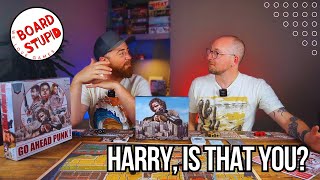
The 1970s San Francisco aesthetic is not merely window dressing; it informs every visual and mechanical decision. Board design evokes classic cop movie surveillance maps. Card artwork and location names consistently reinforce the period. Production components exceed typical indie publisher standards, with double-thick player boards, custom dice featuring thematic iconography, and a visual language that reviewers described as exceptionally cohesive. This level of commitment to theme is rare for a first-time publisher and contributed significantly to the game's recognition at gaming conventions.
American-Style Randomness and Volatile Outcomes
Go Ahead Punk! deliberately embraces American-style board game design, prioritizing random swings and dramatic moments over balanced, streamlined mechanics. This distinguishes it from most comparable hidden movement titles, which trend toward European design sensibilities. Objective discovery, equipment availability, and combat resolution all depend on chance. Some players find this exciting and cinematic; others experience it as frustrating when a strong strategic position evaporates due to a sequence of poor dice rolls or empty card draws.
Scalable Difficulty and Adjustable Balance
The game includes four difficulty levels that modify the card lineup, allowing groups to adjust how easily the Sniper or cops can achieve victory. This flexibility addresses the baseline balance point (which publishers cite as approximately 60/40 favoring cops in standard play) and enables casual players to handicap experienced hidden movement specialists.
Potential Drawbacks
Card Draw Friction and Extended Downtime
The reliance on card draws to trigger meaningful Stinger actions creates extended gaps where turns feel repetitive. Reviewers experienced multiple consecutive turns without pulling target cards, leading to circular movement patterns and minimal decision space. This rhythm break damages engagement and extends play time unpredictably.
Large Board, Diffuse Pressure, and Limited Impact
With 156 locations, the Stinger enjoys vast movement options and can easily evade three cops. Individual cop turns frequently don't generate meaningful tactical progress or perceived pressure on the Stinger. Reviewers reported a frustrating cycle of detection-evasion-waiting, where turns rarely felt consequential or fun. The game scales particularly poorly at four players; when each participant controls only a single cop, that player often finds themselves moving reactively rather than executing strategy.
Rules Complexity and Interaction Stickiness
The rulebook requires multiple readings to fully internalize, and several mechanical interactions generate clarification questions during play. Reviewers needed to reference the rules multiple times across different sessions. Some ambiguities forced groups to establish house rules, suggesting the written guidance could be more intuitive for a first-time publisher.
Dice-Heavy Combat and Quick Elimination
Once the Stinger is detected, combat resolution depends almost entirely on dice rolls and weapon quality. A single round of poor rolls can eliminate the Stinger despite an hour of careful play, which some players experience as deflating and arbitrary rather than climactic.
If You Enjoy Go Ahead Punk!
Players prioritizing hidden movement experiences should consider alternatives like Mind Management (for streamlined design and symmetrical tension) or Sniper Elite (for clear pressure dynamics and a similar sniper theme). Go Ahead Punk! appeals most strongly to those who value thematic immersion over mechanical elegance, accept randomness as a core feature, and enjoy 1970s cop cinema aesthetics. The game works best at two or three players and suits groups willing to embrace slower pacing in exchange for cinematic moments and period-specific flavor. Fans of American-style board game design, uncomfortable with European minimalism, will find this title speaks to their design philosophy. For everyone else, reviewers suggest exploring other entries in the hidden movement genre that prioritize sustained pressure and consistent decision impact.
What Reviewers Are Saying
"Go-ahead Punk is a hidden movement game set in 70s San Francisco so it's got a flavor of all kind of kind of classic cop movies from the 70s."
— Board Stupid
"I typically didn't find my turns to be particularly impactful and when I'm playing a game if I'm the hunter I want to feel like I'm putting pressure on you."
— Board Stupid
"It's one of those games that's going to trigger lots of quotes throughout the evening of play."
— Board Stupid