




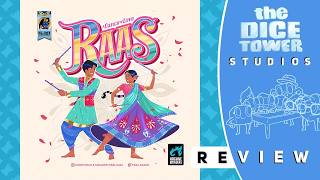







Raas: A Dance of Love Deep Dive
What the Community Thinks About Raas: A Dance of Love
Reviewers across multiple channels have embraced Raas: A Dance of Love as a standout release, with remarkably consistent praise for both its mechanical depth and thematic integration. The consensus is decidedly positive: this is a game that delivers on its promise of bringing Gujarati folk dance culture to the table while maintaining engaging, thoughtful gameplay. Reviewers appreciate that the game functions well at all player counts from one to six, though some preferences emerge about which mode works best at higher player counts. Tom Vassel from The Dice Tower gave it a 9 out of 10, while Chris Yay awarded it 8.5 out of 10, and when Chris reviewed it again in a weekly roundup, Chris still held it in high regard as a game with "lots of good stuff" and "a seal of excellence."
Core Mechanics That Define Raas: A Dance of Love
Simultaneous Dice Drafting
Raas puts players into a shared decision space each round by having everyone simultaneously select from a central pool of spinning discs, each offering a different combination of colored die and action. Players commit to their choices without seeing what others will pick, then execute their selections in a predetermined order. This mechanic creates interesting tension: you're balancing what you want the die for against what action it provides. Reviewers consistently noted that the simultaneity keeps the game moving briskly even with a full table. The system supports everything from casual play where newcomers simply match colors to deeper strategic play where players calculate scoring interactions several turns ahead, making the game accessible while rewarding careful planning.
Rotating Gear Mechanism
At the heart of Raas sits an elegant system where a central spinning gear causes all the outer wheels of the board to rotate together, ensuring that the dice and actions available shift predictably each turn. This physical mechanism does far more than serve as table decoration. The designer explained that the concentric circles spinning around represent the dance itself, turning the board into a visual metaphor for Raas folk dancing. This thematic harmony between mechanic and theme is what elevates Raas beyond a standard dice game. Players describe the gear system as satisfying to manipulate and beautiful to watch, with the clear opportunity to identify specific components (the dandia sticks and colorful outfits) adding tactile appeal to the abstract selection process.
The Raas: A Dance of Love Experience
Quick-Playing with Surprising Depth
One of Raas's defining qualities is how much game-time density it packs into its 30 to 45 minute window. Reviewers consistently highlighted this tension between the game's fast clock and the tactical thinking required. Each turn involves balancing three separate concerns: which die to collect, which action to use, and whether to set up future turns through color-matching bonuses. The fact that players take only nine turns total means every decision carries weight. New players can start by simply matching colors to their current goals, while experienced players track all three scoring paths simultaneously and orchestrate their dice collection to maximize endgame bonuses through set collection on specialty cards.
Energetic Theme That Comes Through
Raas achieves the rare feat of having a theme that actively emerges through gameplay rather than serving as flavor text. The colorful dice represent different dance styles and tempos, matched against outfits worn by dancers. When players collect matching colors adjacent to one another on their board, they're literally representing dancers performing the same style at the same time. The dandia sticks (collecting pieces in the game) serve as both a mechanical system for manipulating action choices and as thematic props that reinforce the culture and tradition being celebrated. Reviewers noted that the energetic, vibrant aesthetic of the components and art reinforces this feeling throughout play, making it an accessible entry point for players curious about Indian board game design.
What Makes Raas: A Dance of Love Stand Out
Thematic Mechanics That Reinforce Each Other
Many games use strong themes and interesting mechanics as separate layers, but Raas merges them into a unified whole. The gear rotation doesn't just provide mechanical freshness each turn; it visually represents dancers moving through their performance. The three scoring tracks aren't arbitrary paths to victory; they represent different aspects of dance mastery (outfit, rhythm tools, and tempo sensitivity). Reviewers consistently mentioned being surprised by how well the theme emerged from play. One reviewer specifically noted that "the theme of it comes out so well," while another highlighted being drawn to the game primarily because "these kind of gears that spin around in circles" felt like a genuine representation of "concentric circles going around spinning around" in actual Raas dance.
Scalability Without Sacrificing Experience
Raas plays genuinely well from one to six players, though reviewers noted meaningful differences between the base game and advanced variant. The base game maintains excellent pacing and interaction even at a full table because the selection mechanism (choosing from discs) is simultaneous and resolves quickly. The advanced game adds a devotion track and player-specific bonus cards that deepen strategy but can slow higher player counts. Players report happily playing the base game with six but preferring the advanced game at four or fewer. This flexibility allows the same box to serve very different play groups, and reviewers appreciated having both options without needing an expansion.
Potential Drawbacks
Limited Direct Interaction in Base Game
The base game is primarily a engine-building experience where players pursue their own scoring strategies with minimal interference. One reviewer noted that "there's not a particular large amount of interaction" in the base game, playing mostly cooperatively against your own point targets rather than directly competing. The main ways to affect other players are through dandia stick passing (which helps more than hurts) and occasionally choosing bonus tiles early to deny them to others. Some players who prefer interactive, confrontational experiences might find the base game's focus on personal optimization less engaging than expected. The advanced game adds more competitive elements through the devotion system and shared goals, but this requires additional rules overhead.
Potential for Repetition in Extended Play
Because Raas operates on a relatively tight mechanical loop (selecting dice and actions, scoring three tracks), reviewers suggested that some players might find the core experience running thin over many plays. One reviewer voiced concern that "people might get tired of the base game after a while because really you're taking things, moving up tracks, and matching colors," though the advanced game's goals system adds variability. The three scoring tracks provide meaningful player choice, but the underlying action economy remains consistent across games. Players who thrive on exploring novel strategic spaces might want the advanced variant on hand immediately rather than waiting to exhaust the base game first.
If You Enjoy Raas: A Dance of Love
Players drawn to Raas's simultaneous selection mechanic and dice-drafting foundation will find satisfaction in Zooloretto, which uses a similar "you pick from a shared pool" structure but with animal collection as its theme. Those who want more interaction and longer play should explore Viticulture: Cooperative Expansion, designed by the same creators (Mahir and Charlene), which demonstrates their ability to build meaningful cooperation into Euro-style systems.
For players specifically enamored with the theme and looking to explore more games celebrating world cultures through mechanics, Magical Athlete offers a sports-celebration theme with strong mechanical identity. If you appreciate dice placement and area-majority scoring, Ticket to Ride titles provide similar satisfaction of building networks and competing for presence, while games in the Tick-tock Race family share the energetic, real-time element that reviewers highlighted as making Raas so engaging.
What Reviewers Are Saying
The idea of these kind of gears that spin around in circles and he explained that's the dance like that is representative of the day a lot of concentric circles going around spinning around. And I thought, "Oh, that's really cool." The thematic hook like that really kind of get me immediately interested into a game.
— Tom Vassel, The Dice Tower
It plays so quickly. There is so much to think about, just in this drafting of a die, but how it fits into your board, how it meets the goals that are out for everyone, the goals that are on your personal player board. And the theme of it comes out so well. It's so so good.
— slickerdrips
Great simultaneous dice drafting game as you're trying to collect these different elements that represent this very cool dance. The gears that all rotate around the board at the same time are awesome. Fairly simple rule set but enough crunch to it that you get to say, "Ooh, I want to take this die. Do I want that paired action with it?"
— Chris Yay, The Dice Tower