



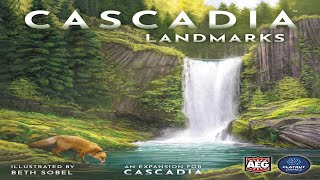






Cascadia: Landmarks Deep Dive
What the Community Thinks About Cascadia: Landmarks
Cascadia: Landmarks arrives as the first expansion to a game that reviewers describe as elegant and runaway-successful. The community consensus is enthusiastically cautious: reviewers universally praise the expansion's core additions (new animal scoring cards and support for five to six players) while remaining divided on its signature feature, the landmark module. For players who return to Cascadia frequently, the expansion delivers fresh strategic paths and meaningful replayability. For casual players who treat Cascadia as an elegant filler, the expansion risks overcomplicating what made the base game special. Most reviewers recommend separating the landmark module from the base-game content, using each according to preference. No reviewer dismisses the expansion outright; instead, they acknowledge it serves different players differently.
Core Mechanics That Define Cascadia: Landmarks
Tile Placement with Expanded Habitat Variety
At its heart, Cascadia: Landmarks retains the tile placement foundation of the base game while multiplying the content that makes each session feel distinct. The expansion adds 45 new habitat tiles and five starter habitat tiles, including Keystone tiles that feature multiple habitat types on a single piece. Reviewers note that these new tiles can be mixed seamlessly into the base deck, increasing habitat variety without requiring players to commit to the expansion's other modules. Designer Randy Flynn's expansion respects the existing elegance; players draft habitat tiles and place them to form connected corridors, competing for the largest contiguous regions of each habitat type. The new tiles expand the spatial puzzle without changing its fundamental appeal, allowing repeated plays to feel genuinely different each time.
Compound Scoring Through New Animal Objectives
The expansion's most universally praised addition is three new wildlife scoring card variants for each of the five animals. The base game offers five ways to score each animal (bears, elk, salmon, hawks, foxes); Cascadia: Landmarks adds three more per animal, bringing the total to eight. These new cards introduce more specific tactical challenges. Bears, for instance, can now score through pairs occupying forest habitat tiles, or through groups touching all four other wildlife types. Elk cards challenge players to form precise geometric formations, with bonuses or penalties based on adjacent animals. Salmon runs now zip-zag across the landscape in new patterns. These mechanical variations compound the game's scoring complexity without adding rules overhead; players still execute the same placement actions, but the winning paths multiply. Each game's random draw of animal scoring cards becomes more consequential, encouraging players to pursue diverse strategies rather than repeating the same proven approach.
The Cascadia: Landmarks Experience
Elegant Puzzle-Solving Elevated
Reviewers describe Cascadia as occupying a rare middle ground: simple enough for non-gamers to grasp in seconds, yet deep enough to engage serious players. Cascadia: Landmarks preserves this spirit through the new animal cards. The habitat and wildlife placement puzzle becomes more nuanced without feeling burdensome. Players report that mixing only the new animal scoring cards into the base game extends their engagement without overwhelming them. The experience remains one of quietly satisfying spatial reasoning, where each turn offers multiple viable paths and players craft ecosystems rather than execute rigid strategies. For players who reach for Cascadia at family gatherings or casual game nights, the base game remains the comfortable heart of the experience.
Strategic Depth for Invested Players
For groups that have played Cascadia repeatedly, the expansion offers a second layer of discovery. With eight animal scoring options per species now in rotation, veteran players recognize that memorizing all cards becomes impractical; instead, each session presents a truly novel set of objectives. Reviewers who favor depth find this aspect compelling. The asymmetry created by the five-to-six player variant also shifts the experience; while the base game plays up to four with equal board space constraints, the faster-play variant for five and six players uses a personal supply system, allowing experienced players to explore a mechanically distinct mode. This creates a sense of ongoing mastery rather than exhaustion.
What Makes Cascadia: Landmarks Stand Out
Unprecedented Variability Through Modular Card Pools
No two plays of Cascadia: Landmarks feel identical, even when using only the new animal cards. With three additional scoring options for each of five animals, the possible combinations of public objectives dwarf those of the base game. Reviewers emphasize that this variability keeps the game fresh across dozens of plays, transforming Cascadia from a game you enjoy into one you return to. The design respects player choice; you can use all the cards, or cherry-pick from the base and expansion decks, tuning the complexity to your table's preference. This modularity is rarely found in expansions, which often impose all new content at once. The result is a game that rewards both casual play (using just the base) and intensive engagement (exploring every animal scoring variant).
Five-to-Six Player Support Without Cramping
The base Cascadia accommodates four players comfortably. Cascadia: Landmarks brings five and six-player support through two pathways: a standard 20-turn game with more tiles and tokens, or a faster variant (15 turns plus a personal supply system) designed for larger tables. Reviewers who longed to share Cascadia at crowded tables see this as a major win. One reviewer noted that Cascadia is the kind of wonderful party game that reaches even non-gamers, so larger player counts unlock the expansion's social potential. The inclusion of personal tile and animal token supplies (for the faster variant) prevents the table from feeling crowded or turns from feeling slow. Players can join Cascadia nights without worrying that the base game's intimate four-player design will exclude them.
Potential Drawbacks
Landmarks Module Risks Over-Complicating an Elegant Design
Cascadia's base elegance is its defining virtue: simple rules, clear feedback, high replayability. Reviewers express measured concern about the expansion's landmark feature, which introduces habitat-type-specific scoring cards that activate when a player places their fifth tile of a given habitat type. While the mechanic itself is straightforward (place a landmark token, claim a habitat card for unique bonuses), casual players find it adds cognitive friction to a game prized for its lightness. One reviewer described the experience as sitting across ten simultaneous public objectives (even in two-player games) and feeling obligated to track them all, turning what was a flow-state game into one demanding continuous calculation. The landmark cards themselves offer minimal point values (typically 1-3 points per card), making them feel like side quests rather than meaningful strategic choices. For players who love Cascadia as a filler or family staple, the landmarks module feels like scope creep.
Landmark Scoring Feels Inconsequential
Reviewers who embraced the new animal cards found the landmarks less satisfying. Because habitat tiles and animal tokens are drafted randomly, claiming a landmark is often a consolation prize: you're at your fifth river tile but have no salmon cards in hand, so you glance at the river habitat cards available and pick whichever seems least bad. The small point swings (adding two to a corridor score, or granting one point per wildlife type on a habitat) don't significantly alter game-end standings in the way animal scoring cards do. One reviewer noted that you can completely ignore landmarks and still compete for victory by focusing entirely on animal objectives; the expansion's namesake feature thus feels optional rather than core. This creates a design tension: if landmarks were made more impactful, they would complicate the game further; if left modest, they risk feeling like busy-work for players who already have enough to consider.
If You Enjoy Cascadia: Landmarks
If you appreciate the elegant tile-placement core of Cascadia: Landmarks, start with the base Cascadia game. That foundation remains the most elegant route into the system. From there, players who replay Cascadia regularly should integrate the three new animal scoring cards per species; they refresh the puzzle without changing it structurally. If you play Cascadia frequently at larger tables, the five and six-player variants unlock social accessibility that the base game doesn't provide. Reviewers suggest treating the landmark module as an optional module for groups that have memorized the base game and want an additional layer to track. Other games reviewers mention alongside Cascadia include Race to the Raft, another cooperative polyomino puzzle with a similar meditative quality, and Canvas, which shares Cascadia's elegant approach to modular scoring within a tighter footprint.
What Reviewers Are Saying
"Cascadia has been one of my favorite games lately. It's so easy to put on the table and having more to play with is just great. It sounds like it's gonna add more ways of scoring points and more tiles, more cards, yeah, more end game bonuses. And the great thing that you can add a fifth and a sixth player to your table, that's just amazing because it's such one of those wonderful party games that even people that never play a board game will pick it up in seconds."
— Board Stupid
"So Cascadia landmarks, one of the things that it does is it adds more of those wildlife scoring cards and habitat tiles. It also has enough components to play Cascadia with five and six people, the base game only plays four, now you can play with five or six. But the main thing that Cascadia landmarks does is it adds these landmark cards and landmark tokens that you can add to your player area."
— Grant Lyon
"I don't think these are bad, I just think that they complicated a game that was already really clean to begin with. If you have played Cascadia a ton, this is the only game you play every day with your family five times a night for family game nights, then I'd say you're probably perfectly fine with regular Cascadia. But if you're playing it a lot and you're kind of tired of it, and they get this expansion, you're like oh thank God, a breath of fresh air, then yeah that's exactly kind of what I feel like this expansion is."
— Board Games UnLocked