





Crown of Critters Deep Dive
What the Community Thinks About Crown of Critters
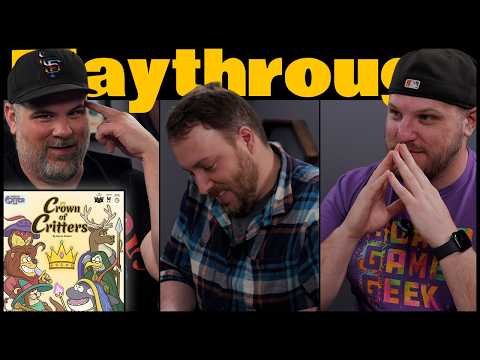
Crown of Critters has generated genuine enthusiasm from multiple reviewers who appreciate its accessible gameplay, abundant player interaction, and charming presentation. The Brothers Murph, who played a full three-player game, found themselves engaged throughout and clearly enjoyed the chaos and decision-making. Good Time Society praised the game's focus on fun and highlighted its adorable visual presentation. A reviewer identified it as a strong choice for players who enjoy games with take-that mechanics and interactive play. The consensus across channels points to Crown of Critters as a game that balances accessibility with meaningful interaction, wrapped in charming, humorous presentation that makes every card reveal feel rewarding.
Core Mechanics That Define Crown of Critters
Critter Assembly and Quest Matching
The heart of Crown of Critters, published by Curious Otter Games, revolves around building a team of five critters to match the requirements of active quests. On each turn, a player adds a critter card to their team and then checks if that critter's class aligns with what the current quest demands. Critters carry class symbols (support, attack, stealth, magic, defense, or mystery), and if a critter does not match any of the quest's required classes, it gains a penalty, losing points at the end of the quest. The challenge intensifies because quests can change mid-round through action cards, forcing players to reassess their entire lineup. Each critter also carries an ability that triggers immediately upon play, potentially shielding teammates from penalties, generating bonus points, or manipulating scoring in unexpected ways. This mechanic creates genuine decisions: chase the current quest's requirements, or build a team with critters simply loved regardless of their effectiveness.
Action Cards and Player Interaction
Crown of Critters features a robust action card system that gives players the power to disrupt opponents' strategies. These cards let a player steal critters from another player's team, swap a teammate with an opponent's critter, change the active quest card entirely, or even force a player to discard their hand and draw fresh cards. Some action cards protect against other action cards, adding a layer of tactical play. The effect is that turns are never predictable; an opponent can restructure a carefully assembled team in a single moment. This take-that gameplay creates moments where players react with visible surprise and strategic recalibration. The action card system keeps the game socially dynamic and ensures that games remain competitive throughout, preventing any player from running away with an insurmountable lead early on.
The Crown of Critters Experience
Chaotic and Social Interaction
Crown of Critters thrives on player interaction that generates laughter and surprise. The game's fast-paced turns and disruptive action cards mean there is always something to do, whether executing a strategy or undermining an opponent's plan. The take-that mechanics feel good-natured rather than punishing because the underlying game loop moves quickly and fortunes shift regularly. Reviewers noted that playing critters and resolving their abilities keeps the table engaged, and even when not taking a turn, players are watching for opportunities to deploy action cards. The social dynamic encourages table talk, negotiation, and celebratory moments when an action card lands exactly as intended.
Charming and Humorous Aesthetic
The presentation of Crown of Critters draws immediate affection from players. Dozens of unique critters populate the game, each with a whimsical, memorable name, not just functional game pieces but characters that players root for and get excited to draw. The hero characters, including King Shellford, carry personality and charm. Reviewers explicitly mentioned that the game invites players to build a team on vibes as much as on pure strategy, meaning that picking a critter simply because of its art or name is a valid and rewarding approach. This aesthetic generosity lowers the barrier to engagement; players can play strategically or play for style, and the game accommodates both approaches equally well.
What Makes Crown of Critters Stand Out
Accessibility Without Sacrificing Depth
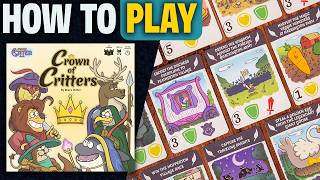
Crown of Critters is remarkably easy to teach. On each turn, a player performs straightforward phases: play one critter card, play any number of action cards, discard up to one card of each type, and draw back to the hand limit. Despite this simplicity, the game's depth emerges from the quest-matching puzzle and the tactical deployment of action cards. New players can engage meaningfully on their first turn while still discovering new strategies across multiple plays. The game respects both casual and competitive approaches, never punishing a player for prioritizing fun critter synergies over optimal play.
High Replayability Through Quest Variety and Critter Synergies
Each quest has different class requirements and point values, creating unique puzzles in each round. The large critter pool, combined with rotating hero special abilities, ensures that no two games feel identical. Critters interact with one another through bonus scoring conditions, protection effects, and specialized abilities that reward thoughtful team composition. Reviewers noted that even within the same quest, different combinations of critters and action card plays lead to wildly different outcomes, encouraging players to experiment with new team archetypes across plays.
Potential Drawbacks
Significant Luck and Randomness in Card Draw
A player's ability to execute a team-building strategy depends partly on which critters appear in hand and the recruitment pool. Reviewers noted that the draw deck heavily influences outcomes; a player who draws multiple critters aligned with the current quest has a natural advantage. Similarly, action card availability can swing games unexpectedly. For players who prefer strategy games with minimal randomness, Crown of Critters may feel slightly chaotic or frustrating when key cards do not appear when needed.
Reliance on Player Interaction Can Create Kingmaking
Because the action card system is so powerful and disruptive, late-game leader downswings can be severe. A player who is ahead in points may face coordinated action card plays from opponents seeking to redistribute wins, potentially creating scenarios where the table's focus swings toward eliminating the leader rather than pursuing optimal individual strategy. Reviewers did not frame this as a flaw but rather as a feature that keeps games competitive; however, players who dislike being heavily targeted should be aware of this dynamic.
If You Enjoy Crown of Critters
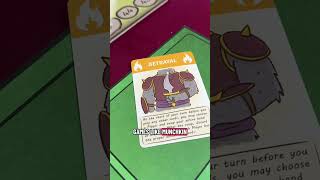
Crown of Critters shares DNA with Munchkin, another lighthearted fantasy card game centered on chaotic player interaction and comedic monster artwork. Both games celebrate absurdity and player elimination risks without taking themselves seriously. Anyone who enjoyed Munchkin's humor and take-that style will find Crown of Critters familiar but with a tighter ruleset and faster turn structure.
The game also bears comparison to King of Tokyo, a title that uses area majority, dice-driven combat, and constant player disruption to create memorable chaos at the table. Both games prioritize fun and social interaction over pure strategy, and both reward playfulness alongside tactical play. For game nights that thrive on unexpected alliances, laughter, and surprising reversals of fortune, King of Tokyo players will recognize Crown of Critters as a kindred spirit.
What Reviewers Are Saying
"I don't think there's anything wrong with building your team purely on vibes. Vibe hire all day."
— The Brothers Murph
"If you like games like Munchkin or Tokyo, then you're going to love all the special powers and action cards that will let you swipe cards, swap teammates, or even change the quest halfway through. And lastly, this game is adorable."
— Watch Review
"I love cute critters. I love when board game people are having fun with their own product because I think the prime point of playing a board game is to have fun."
— Good Time Society