





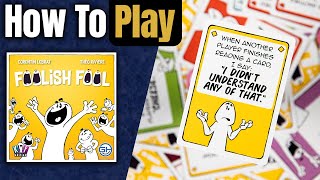
Foolish Fool Deep Dive
What the Community Thinks About Foolish Fool
Board game reviewers have embraced Foolish Fool as one of the silliest, most raucously fun party games to emerge in 2025. The game consistently draws praise for its ability to transform a casual gathering into escalating chaos. One reviewer sampling a lineup of new releases noted that while Foolish Fool may not appeal to everyone due to its inherently zany nature, those who gravitate toward table humor will find it reliably hilarious. Grant's Gamerecks ranked it among the top party games of the year, emphasizing that it rivals even the silliest party releases for sheer comedic potential. The consensus centers on one key insight: the game is not complex, but the experience is memorable because of how relentlessly it dismantles player composure as rules accumulate.
Core Mechanics That Define Foolish Fool
Rule Accumulation
The defining engine of Foolish Fool is its stacking rule system. Published by GameHead, the game asks players to draw cards each turn that introduce new rules to follow. These rules persist and layer on top of one another throughout the game. Early on, the rules are simple enough to manage, but as each new card hits the table, the cognitive load multiplies. One reviewer described this progression explicitly: the game that begins as an effortless exercise in following a single rule evolves into a chaotic tableau where every player is juggling dozens of overlapping constraints. The rules come in three flavors: horizontal cards that apply to the entire table, pink cards that target a specific opponent, and vertical personal cards that only apply to the player who drew them. When a new card of the same color is played, it covers the old card and removes that rule from play. This cover mechanic provides moments of relief, but they are fleeting as fresh cards immediately pile new demands onto the table.
Social Rule Enforcement
Beyond following rules, players must also police the table. The core tension in Foolish Fool emerges from the dual responsibility each player carries: obey all active rules and catch others when they slip up. When a player is caught breaking a rule, they lose a token. Lose all three tokens, and that player becomes the foolish fool and immediately loses the game. Reviewers highlighted how this creates a cat-and-mouse dynamic where players must maintain vigilance not only over their own behavior but also over every other player's adherence to an ever-expanding ruleset. By design, it rewards attentiveness and punishes distraction, making the game as much about table management and social observation as about rule compliance.
The Foolish Fool Experience
Escalating Chaos
What makes Foolish Fool memorable is the physical and mental escalation it inflicts on players. One reviewer captured this arc: "What starts off is a very simple game of like, oh well this is easy. I've only got one rule to follow in front of me" that becomes crazy as everybody's got all these different rules. Grant's Gamerecks expanded on the sensory experience: "It really does sort of all layer on top of themselves. And so by the end of the game, you're just doing a bunch of different ridiculous stuff before you play a card." The absurdity is intentional. Rules range from the comedic (talking like a robot on your turn, quietly petting the card you are about to play) to the genuinely constraining (playing with one hand, touching cards only with your right hand). As the game progresses, players find themselves performing increasingly convoluted rituals just to take a turn. The mounting ridiculousness is the game's selling point.
Group Hilarity and Social Pressure
The second pillar of the Foolish Fool experience is its social payoff. This is explicitly a game designed for laughter at the table. Reviewers consistently mentioned that the game succeeds because it puts players in situations where they are almost guaranteed to slip up, and those slip-ups generate mirth. The game encourages rapid play to avoid analysis paralysis, which means mistakes happen organically. Every time someone draws, reads, plays, or covers a card, players call out reactions and commentary. The resulting atmosphere is one of collaborative absurdity where the goal is entertainment rather than victory. One reviewer summed this up simply: "if you enjoy a good laugh, Foolish Fool is full of" them.
What Makes Foolish Fool Stand Out
The Trick of Targeted Rule Cards
While all three card types (personal, group, and targeted) contribute to the game's design, reviewers zeroed in on the pink targeted cards as the real trick of Foolish Fool. These cards let you hand difficult rules to other players. You can see which rules are brutal before passing them, making the choice strategic and malicious. The asymmetry this creates transforms the game beyond simple rule-following into a game about managing which rules land on which players. It adds interpersonal texture to an otherwise frantic experience.
Simple Rules, Complex Outcomes
GameHead's design succeeds because the core mechanic is instantly understandable but produces wildly complex play states. There is no hidden information, resource management phase, or long decision tree. You draw a card, read it aloud, place it, and play continues. Yet within this simplicity emerges a game that can reduce a table of eight players to helpless laughter within minutes. This economy of design is part of Foolish Fool's appeal: it requires no overhead and rewards a willingness to embrace silliness without demanding complex rules literacy.
Potential Drawbacks
Not a Game for Every Group
Reviewers acknowledged that Foolish Fool's zany party-game mentality will not resonate with every player or group. The game is built on silliness, and that silliness is non-negotiable. If a player prefers strategic depth, control over their performance, or a quieter gaming experience, Foolish Fool will feel exhausting rather than entertaining. One reviewer stated plainly that the zany, silly party-game mentality behind it means the game is not going to be for everyone. This is not a flaw in the game's design, but rather an honest limitation of its scope and target audience.
Rule Management at Higher Player Counts
While Foolish Fool plays 3-8 players, reviewers raised an implicit concern about managing the rule load at the higher end of that spectrum. With eight players and potentially dozens of active rules on the table, the game can approach a state where it becomes genuinely difficult to track what is and is not in play. At certain player counts, the chaos may tip from fun to unmanageable. The game mitigates this by encouraging rapid play and allowing groups to ignore rules that are impossible to follow, but this flexibility may not satisfy players seeking clearer game states.
If You Enjoy Foolish Fool
Foolish Fool is for players and groups who prize entertainment and social connection over competitive strategy. It works best with six or more players who are willing to embrace ridicule and laughter as core rewards. If you enjoy party games that escalate in absurdity, games with high social stakes, or any experience where the best moments are the ones you share with others rather than the points you win, Foolish Fool is a strong fit. It is ideal for gatherings where the point is to unwind, to play together, and to generate memorable table moments. It requires an appetite for controlled chaos and a willingness to prioritize collective fun over personal victory.
What Reviewers Are Saying
"What starts off is a very simple game of like, oh well this is easy. I've only got one rule to follow in front of me becomes crazy as everybody's got all these different rules."
— Watch Review
"It really does sort of all layer on top of the themselves. And so by the end of the game, you're like, Great to see you. Oo, and you're just doing a bunch of different ridiculous stuff before you play a card."
— Grant's Gamerecks
"But if you enjoy a good laugh, Foolish Fool is full of them."
— Watch Review