Let's Rank ALL 6 GameHead Gen Con Releases!
Games in This Video
6 games are featured in this video — they unlock as you watch.


Transcript
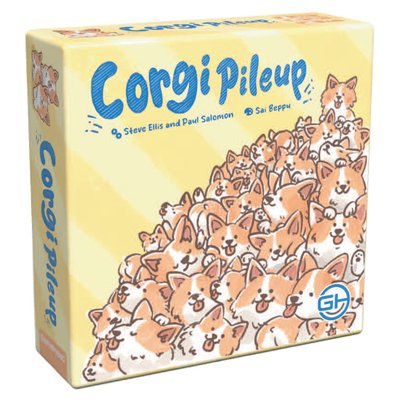
Welcome back to the table. Today I've got in front of me all six of brand new Game Head games. Gamehead is a brand new company that's going to be debuting at Gen Con with six small box releases. They sent me all six, so I'm going to rank them. Number six for me is Corgi Pileup. Now, this game features corgis and some great artwork. So, I think for a lot of people, this might be number one. But for me, it's number six because I had to start somewhere and I decided to start with corgi pileup. Now, this feels kind of like a trick- taking game, but it's really not. You're building this pile of corgis, 15 corgis, and you're kind of stacking them up. You want to be close as you can to 15 points without going over. The person that goes over is going to lose, and then you're going to look at who actually was closest to 15. But it's done in an interesting way. Like a lot of trick- taking games, when somebody plays a card, you can play a higher card and you can take that trick.
Or instead of playing the higher card, you can play the lowest possible card from your hand and slide under it, forcing someone else to take the trick. Taking tricks aren't necessarily good or bad, but what you're doing by taking the lead is choosing the card that's going to get played and potentially letting people slide under it by getting rid of some of those cards. Now, you're going to play through a certain number of hands until you have one card left. that one card everyone's going to play at the same time. That's how many points you're going to gain. So, you need to try to time it exact by leaving maybe one of the lower cards in your hand. Or if you're behind, maybe you want to leave one of the tens and you want to swing all the way to the top. A lot of the cards will also have special powers that trigger. So, there's a lot that goes into playing it. But for me, I think some of the other game head games were a little more exciting. Which brings me to number five, Foolish Fool. Now, this is a party game and it can get kind of crazy. This is a game about rules.
You're drawing cards and you're adding rules to the board. You're either adding personal rules that only affect you. You're giving tricky rules to your opponent or you're putting rules down in a global play area where all players have to follow these rules. And these rules can be silly like on your turn you have to talk like a robot or they can be really difficult like you can only play with one hand. You only can touch cards with your right hand. You've got to be thinking about these things because as this game progresses you're going to be stacking more and more rules. And these are kind of different colors. So there's can always be like three rules out in the center. You can have a pile of personal rules and then the real trick is the rules that you pass to other people because you can see rules that are very difficult that you have to pass. And what starts off is a very simple game of like, oh well this is easy. I've only got one rule to follow in front of me becomes crazy as everybody's got all these different rules. People are saying things every time somebody draws a card or reads a card or plays a card or covers a card or whatever. you've got to say thank you or can I have another or good job or just like all these random things and your job isn't just to follow your rules but to catch the other players that are maybe making mistakes with their rules.
So again, I don't think this game is going to be for everyone because of just the zany silly party game mentality that's behind it. But if you enjoy a good laugh, uh Foolish Fool is full of them. Number four is Venture Angels. This is a reprint of a game from Bruno Fidi where you're going to be investing in these different projects. a number of projects are going to come out based on the number of players playing and you're going to be bidding for control of these projects. The trick here is that all of your bids are face down at the start of the game. So, you don't know who's bidding what and there's a variety of different increments you can be bidding, including a zero. The trick here though is that each project has a funding goal. If that funding goal is not met, nobody gets the project. So you're looking around and you might see a funding project that has a lot of chips, but that doesn't necessarily mean it funds because a lot of players may have played their zeros. So there's a little bit of a guessing game here, a little bit of mind games of trying to determine if a project is going to fund or not because you want to be the one that funded the projects that get funded. You want to have contributed the most to those projects. If you do, you'll win that project. But one project every round is going to be overhyped. The project that got the most funding is taken out of the game. So, you don't want to try to win the project with the most funding, but you also don't want to win projects that aren't going to get funded. So, the balance of the game is trying to figure out where other players are placing their chips and try to sneak in there and win. At the end of the game, you're going to score points for each project of a different color that you have. So, getting a bunch of the same color is also not good. So, you want to try to spread your influence out and win these
different projects. Now, in later rounds, you do get a little bit of help because as players take projects, however many projects they have in front of them, they have to play that many of their tokens face up. So, you actually get to see their funding number. So, if somebody does take like an early lead, then you'll have the option to, you know, maybe catch up to them by making sure that they don't get projects. It feels like a Euroey game, but it's in a very small box and it literally plays in about 20 minutes. So, this scratches a lot of those like economic itches. And definitely if you like bidding games, this is one you're definitely going to want to check out. Three is first class letters. This is a roll and write game from the designer of fiction, Peter Hayward, who which I love. I love that game so much. And this game is a ton of fun. If you like word games and you like roll and write games, this one is definitely for you. It scratches a lot of itches because it's not a typical roll and write where you're rolling dice, picking them, scratching off these different boxes. Each die that you roll is a letter. You're looking at potentially three letters that you have to use or can use and one that you can't. There's a red dye that you can't use. You're trying to come up with a word that uses as many of those letters as many times as possible, but doesn't use the red letter. If you can come up with a word that uses all three letters, you get some bonus points. You get double your score for that letter. But if you can just use a couple, if you can use them multiple times, you'll score for every time that letter appears. So like if it's a P, you can say apple, get two points. But if the red dye was an e and it is often a vowel, then apple's not an option for you. So it can be
quite tricky to come up with a word that fits without actually using that red letter. But that's not the part that makes this game tricky. You're going to have a sheet of paper and on that paper, you're going to get to write your word on any of the lines. But at the end of the game, when you go down the lines, each entry on that list has to be alphabetized in alphabetical order. So at the end of the game, you have to check your sheet. If it's not fully alphabetical, you don't score the ones that are in the wrong spot. To make matters worse, at the start of the game, you're going to roll the three brown dice. You're going to alphabetize them. You're going to fill in three spots on your sheet. You're going to put the C. Those words in those spots on your sheet have to start with that letter. So, you're going to be in a situation where, you know, like the second one is C and then a little bit down is K. You've got to fill in the blanks between the C and the K. But you might later, you might fill that in with like a D or an E, which means later when you roll that F, you don't have a spot to put a word that starts with F. So, it actually becomes very tricky, especially towards the end of the game where you only have like maybe one spot left and it has to be like a very limited range. like you filled in your sheet to the point where the only letter that you could actually fit is a D and you're sitting there struggling to come up with a D word that fits with the letters that were rolled and you might end up scoring something with like one point like dig because you just couldn't think of a longer letter that started with a D. So, this is definitely a puzzly word game and it actually has a more advanced mode where you can actually set one of these three dice as priority meaning your word has to include that letter and cannot include the red letter. though you can add a little bit more of a layer of
difficulty, but I love word games. I love coming up with fun words and this game really satisfies that. Number two for me is No Loose Ends. Now, there are a few things that I like more in life than Japanese trick- taking games. I love them, which is why No Loose Ends is getting a little bit higher on my list. Uh like a lot of those games, this one does have a twist. The twist is that you're going to set aside cards from your hand as your bid. You're putting these cards down in front of you and then you're trying to cover them. These become the evidence that you're trying to hide, i.e. no loose ends. The only way to cover evidence is to take a trick with a card that matches the number that matches the suit or that happens to be the lead suit of of a particular trick. So, at the beginning of the round, when you're in the planning phase and you're looking at your hand, it's not just about how many tricks you think you can take. It's about taking very specific tricks with very specific suits or cards. So, it leads to this really interesting twist where you might overcommit yourself. You think, "Oh, it's easy." and then you realize that you put down one of the cards you needed to take a pass card as another bid thinking that you could maybe take both of them and more often than not you're probably not going to hit your bid in this game. Uh you've really got to learn how to control the bid, what a smart bid looks like and then you're playing a trick taking game on top of it. That's no loose ends at number two. And of course that brings me to my number one trinket trove. This game is a it's just a ton of fun. This is a bidding game where you're trying to collect sets, but the cards that you're collecting for your sets are also the cards that you're turning around and using to bid. Every turn, there's going to be a row of cards
that come out, and you're going to be bidding for those cards. But when you bid, you're putting one or two cards or more cards from your hand in front of you on top of your little token. And whoever bids the most cards is going to choose first. Now, when you choose, if you're the first to choose, you can choose from any of those cards that were put out originally, or you can take another player's bid. So, if you think you're going to go first and you're going to bid like four cards from your hand because you really want to go first, what you're doing is you're putting four cards in a stack out there. On another player's turn, because you can never take your bid on their turn, when it's their turn to choose, they can choose from that top row or they can take your bid. They can take those four cards into their hand. Some of those cards in the top row will actually even be more than one card, too, based on the number of players. And then, of course, everybody's bid is going to be at least one card. You can choose to bid zero, but you're going to flip a card from the top of the deck to take that spot. Now, these cards are not created equal, and it's going to tell you on the card how many there are to make a perfect set. If you can get the full amount, you can get some massive points. Some of these sets are worth over a 100 points if you have like six or seven, whereas some might only be like two, and the most you'll ever need is two. You're going to have to make decisions. What I really like about this game is, like I said at the beginning, the cards that you're collecting are also the cards that you're using to bid. So, if you're looking at your hand and you've got like six gems, you're just looking for that seventh gem, but like you really are in a situation maybe you're tempted to use one of those cards to bid to go first
because somebody might have put two cards out. You want to go first. The only way you're going first is to bid three cards or to bid two cards of a higher value. Of course, the cards that are worth more have a higher bid value. So, you're balancing these things together while you're trying to decide if you're going to take the bid or not. Now, it is 100% a bidding game, and it's just a thought-provoking game filled with decisions already, but the artwork for it is so cute. These anthropomorphic animals, all the things you're collecting are things that they might find like around the house and just it is a gorgeous looking game, but it is a fun game. Out of all the games that are coming out from Game, this is the one that I think I'll probably be playing the most, which is why this won the number one spot for me. But like I said, all of these games are going to be available at Gen Con and they're going to be having a retail release later. So if you're a completionist like me, you can get all six of them in a bundle or you can just get the ones that sound most interesting to you. So that is how I would rank all six of these game head games. Tell me in the comments below how you would rank them, which ones you're most looking forward to, and tell me why Trinket Troph is the best one. So until I see you all again, make sure everyone keeps having fun at the table.