Game Info
Year
2025
Players
2-5
Age
8+
Playtime
25 min
Complexity
1.3/5
Collection
Ratings
Creator Score
Mechanic profile
Not enough video data yet
Vibe profile
Not enough video data yet
Description
A light card game where players grow vegetables while watching out for crows. Quick filler with farming theme published by Grail Games.
Featured Videos

Playthrough

Harvest Valley 3 Player Playthrough
Ask a Rules Question
Images

GID0452794.jpg

GID0452794_thumb.jpg
All mentions
Browse transcript mentions, sentiments, pros/cons, mechanics, topics, quotes, and references.
Total mentions: 4
This page: 4
Sentiment:
pos 1 ·
mix 1 ·
neu 1 ·
neg 0
Showing 1–4 of 4
Video lsPCiHMWsLs
Crimsonboardgames Top List at 5:27 sentiment: neutral
video_pk 80988 · mention_pk 370714

Click to watch at 5:27 · YouTube ↗
Overall sentiment (raw)
neutral
Pros
none
Cons
- Two to five players (no solo mode mentioned for this specific game, only for others in the same publisher mention)
Thematic elements
- Stardew Valley inspired cutesy game
Comparison games
none
Mechanics (from transcript analysis)
- Card game — It is a small game with cards.
Video topics + discussion points
No key topics recorded for this video.
Quotes (from this video)
- Next we have Song of the Wild Kin one to four players area movement cooperative game deck bag and pool building. That all sounds perfect to me.
- So, we don't have anything to show yet really. So, we only have the box art. But look how cute that looks.
- Action-packed co-op game.
- This could again be very gimmicky. But I'm curious to see.
- I mean, it's obviously Cthulhu themed. Love that.
- I don't know. It might suck, you know.
- This is just an insta buy for me. I'm just going to get it.
- Um they just look so cute and they're both one to four or like at least this one's one to six and this one's one to four players.
- I'm very, very sad that this does not have a solo option because it looks so freaking cute...
- Look at how stunning this looks. I mean, excuse me?
- But, some for some reason this grabs me even more.
- I hope you guys enjoyed um that um I'm very excited about UK Games Expo.
References (from this video)
No references stored for this video.
Video 7_AeHXJyrGc
Unknown Channel Playthrough at 0:00 sentiment: mixed
video_pk 76018 · mention_pk 184324

Click to watch at 0:00 · YouTube ↗
Overall sentiment (raw)
mixed
Pros
- Deep, interactive scoring with adjacency and diagonal bonuses
- Variety of card effects adds strategic depth and player interaction
- Push and blocking mechanics create dynamic board state
Cons
- Rules are complex and the interactions are hard to track mid-game
- Tension around mean cards can affect enjoyment
- Tie-breaking and end-game clarity may be uncertain
Thematic elements
- Array
- Farm
- Casual explanatory
Comparison games
- Pawnscape
- 12 Rivers
Mechanics (from transcript analysis)
- Adjacency and diagonal scoring — Scoring is determined by adjacency to your house and includes diagonal bonuses via sprinklers and other effects.
- Animal and well scoring — Animals and wells create proximity-based scoring; animals near the well score points for adjacent houses.
- Blocking/negation and removal effects — Cards can destroy or block scoring elements (crow, birds) or negate scoring (weed).
- Card-driven actions / hand management — On a turn, a player selects one of three cards or their house to play, driving the action with card effects.
- Compound Scoring — Animals and wells create proximity-based scoring; animals near the well score points for adjacent houses.
- End-game and cascading scoring — Scoring is tallied at the end of the round with multiple interactions; end-game tally and tie considerations.
- Hand Management — On a turn, a player selects one of three cards or their house to play, driving the action with card effects.
- Pawn scoring — Pawns increase the value of whatever they touch, boosting near-by scoring.
- Push mechanics (tractor) — Certain cards (tractor, yellow tractor) push other cards on the grid, altering layout and scoring opportunities.
- Tile Placement — Players place houses or cards on a shared grid to maximize scoring opportunities based on what touches their house.
Video topics + discussion points
No key topics recorded for this video.
Quotes (from this video)
- Oh, this is a mean game.
- This is a lot to think about.
- Cosmic wins.
References (from this video)
No references stored for this video.
Video tMvbv3iiokc
Conre Rules Teach at 0:00
video_pk 68329 · mention_pk 164708
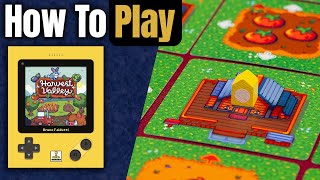
Click to watch at 0:00 · YouTube ↗
Pros
none
Cons
none
Thematic elements
none
Comparison games
none
Mechanics (from transcript analysis)
Mechanics unknown.
Video topics + discussion points
No key topics recorded for this video.
Quotes (from this video)
- Harvest Valley. Don't you just hate when the boar eats all your vegetables?
- we love talking and teaching board games to folks just like you.
- If you could harvest a vegetable or fruit, what would it be?
- And if you want to learn more about this game or the Pixel series, there's a link down there.
References (from this video)
No references stored for this video.
Video tMvbv3iiokc
Conre Rules Teach at 0:08 sentiment: positive
video_pk 68329 · mention_pk 187660
Click to watch at 0:08 · YouTube ↗
Overall sentiment (raw)
positive
Pros
- Engaging tile-placement puzzle with a clear objective
- Interaction via sabotage and cancellation effects
- Well-defined end-game scoring tied to adjacency
- Optional advanced variant adds variety
Cons
- Complex rules with many card types can be confusing
- Some components and effects can be dense on the table
Thematic elements
- Farming, harvest, and light sabotage
- A farm valley where players build a grid of land cards to score points for farmhouses and adjacent crops.
- Lightly thematic abstract with farm-related sabotage elements
Comparison games
none
Mechanics (from transcript analysis)
- end_game_scoring_by_adjacency — Scores are tallied for farmhouses based on orthogonal/diagonal adjacency to vegetables, fruit trees, ponds, and wheat fields.
- grid_size_variants — Grid size differs by player count (5x5 for 2-3 players, 5x6 for 3-5).
- Multi-Use Cards — Additional cards like sprinkler, well, locust, rabbit, boar, and variant land cards add effects.
- river_drafting_and_replacement — Three face-up land cards (the river) are drafted and replaced after selection.
- sabotage_and_card_cancelation — Crows cancel adjacent crops; weeds and other cards can cancel or alter scoring.
- special_cards_and_variants — Additional cards like sprinkler, well, locust, rabbit, boar, and variant land cards add effects.
- Tile Placement — Players place tiles on a grid to form a farm valley, following orthogonal adjacency rules.
- tile_placement — Players place tiles on a grid to form a farm valley, following orthogonal adjacency rules.
- tractor_and_plow_actions — Tractor and plow can push or move cards, rearranging the grid.
- wheat_field_scoring — Wheat fields score based on the number of adjacent wheat cards.
Video topics + discussion points
No key topics recorded for this video.
Quotes (from this video)
- Harvest Valley. Don't you just hate when the boar eats all your vegetables?
- we love talking and teaching board games to folks just like you.
- If you could harvest a vegetable or fruit, what would it be?
- And if you want to learn more about this game or the Pixel series, there's a link down there.
References (from this video)
No references stored for this video.
Transcript Navigation
Showing 1–4 of 4