








Petal Deep Dive
What the Community Thinks About Petal
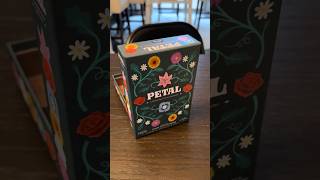
Petal has found broad appreciation among board game reviewers as a sharp, elegant two-player card game that punches above its weight in strategic depth. The consensus centers on a game that looks deceptively simple but rewards thoughtful play, wrapped in beautiful floral artwork. Alex Radcliffe from BoardGameCo frames the experience precisely: the game is "very straightforward and simple," yet it delivers "a lot of strategy in a small box." This tension between accessibility and complexity defines Petal's appeal. Reviewers at Our Family Plays Games echo this assessment, emphasizing that the colorful, pleasant presentation masks real tactical challenges. The game's companion relationship to Garden Club also generates interest, with Neon Gorilla positioning Petal as an ideal portable version when you want the same experience in a faster format, ideal for casual settings like bars or parks. Tantrum House praises its charm and cleverness as a core strength, celebrating both the theme and the mechanical puzzle it presents.
Core Mechanics That Define Petal
Tableau Building
At the heart of Petal lies a shared tableau that both players construct together. Each round, players draft cards to add to a 4x4 grid of flowers, creating a collaborative puzzle that neither player fully controls. Designers Kristen Mott and Andrew Styles structure this so that the grid emerges organically as players take turns. You cannot rotate the flower cards once placed (they must remain vertical), which adds constraint and forces adaptation. The tableau grows over exactly fourteen card placements (two starting cards plus seven from each player), creating a bounded, predictable game length. This constraint pushes players to think ahead about what patterns might emerge and how their placements influence both their own scoring and their opponent's options. The beauty of the mechanism, according to reviewers, is that the grid itself becomes the main point of contention: every placement matters because it serves the shared board and determines what players can draft for their own scoring multipliers.
Compound Scoring
Scoring in Petal splits into multiple independent tracks, each working toward the final tally. Players hold a secret objective card that grants points through four different scoring conditions (flowers of a certain color, flowers arranged in a row, clusters of matching flowers, or bonus multipliers based on rarity). Simultaneously, they collect multiplier cards face-up in front of themselves, drawn from the flower deck. At round end, multipliers multiply the completed flowers in the shared grid, then secret objectives score independently. This split attention creates the strategic core: you must commit to certain flowers while also responding to the tableau's direction and hedging against your opponent's strategies. Reviewers note that no single path dominates; you could win through color dominance, through row-building, through cluster finding, or through efficient multiplier collection. The compound approach means diverse strategies converge on similar final scores, keeping games competitive.
The Petal Experience
Strategic Depth Beneath Appealing Aesthetics
Petal delights reviewers precisely because it refuses to match its visual charm with mechanical simplicity. The artwork is gorgeous, the flowers are inviting, the pace is brisk. But once play begins, strategic layers emerge. Our Family Plays Games captured this perfectly: the game "looks simple on the outside, but once you start playing it, you start figuring out ways to strategize on how to outmaneuver and outwit your opponent." Reviewers consistently reported that early plays underestimate the game's demands, only to discover on replay that every card choice reverberates. The puzzle of the tableau, combined with the mystery of your opponent's secret objectives and multiplier strategy, creates genuine tension across a thirty-minute play session.
Quick, Punchy Satisfaction
Reviewers emphasize the speed and energy of Petal as core to its appeal. In under thirty minutes, the game delivers multiple rounds of meaningful choices and narrative arcs. When you lose a round, the apron cards (or "assistants" in tweaked versions) grant you advantages for the next one, creating a catch-up mechanism that keeps come-from-behind victories possible. This encourages rematches: players who stumble on their first play often want an immediate rematch to apply what they've learned. The compactness also makes Petal portable; Neon Gorilla took it to a bar, and friends immediately grasped and enjoyed it. That combination of brisk pacing, engaging theme, and genuine decision-making makes the game feel generous despite its brevity.
What Makes Petal Stand Out
Beautiful, Cohesive Visual and Thematic Design
Every reviewer praises Petal's presentation. The flowers are rendered in vibrant, pleasing colors. The card art is described as gorgeous, and the overall game conveys the warmth and charm of gardening. Beyond aesthetics, the theme integrates with the mechanics: you are florists building a shared shop window display and competing through your own floral objectives. This thematic alignment means the flavor serves the game rather than decorating it. Reviewers at Our Family Plays Games specifically noted that even though the components are a prototype, the potential is clear and compelling. The game manages to feel sophisticated and accessible simultaneously through this visual language.
Tight Two-Player Competition with Meaningful Information Asymmetry
Petal creates a perfect two-player dynamic through its split of public and private information. You see your opponent's multiplier cards and the growing tableau, but not their secret objectives. This means you can deduce some of their strategy (if they collect a lot of blue multipliers, they probably score on blues), but you cannot perfectly counter them. The threat of your opponent's hidden scoring condition forces you to build redundancy into your own tableau contributions. You might avoid placing certain flowers if you suspect they benefit your opponent more than you, but this is never certain. Multiple reviewers appreciated this layer of bluff and deduction, calling it a "tight" competition that rewards both board reading and adaptability.
Potential Drawbacks
Apron Card Balance and Usage Timing
Alex Radcliffe from BoardGameCo raises a key concern: the apron cards (single-use abilities granted to the loser of a round) are not balanced equally. Some cards are strictly better than others, and there is no compensating advantage for getting a weaker card. Furthermore, the optimal strategy often involves holding the apron card until late in the round to maximize its impact, particularly on the final turn. This timing dynamic, while valid, can feel inelegant. Radcliffe emphasizes that he likes the concept of catch-up cards but would house-rule their implementation to improve both balance and usage patterns. This is a structural critique, not a disqualification, but it is notable enough that reviewers have begun experimenting with house rules.
Scoring Card Pattern Repetition
The four objective scoring conditions follow a predictable pattern: single-color scoring, row bonus, cluster bonus, and multiplier bonus. While functional, reviewers note that scoring cards feel formulaic and suggest that future expansions might explore more varied or asymmetric objectives. Alex Radcliffe specifically mentions this as an area for expansion design, imagining advanced variants with more creative scoring opportunities. This is a mild critique that does not undermine the base game but hints that deeper engagement might benefit from mechanical variety over multiple plays.
If You Enjoy Petal
Players who appreciate Petal's blend of tableau-building and hidden information should explore Garden Club, the larger companion game that inspired Petal. Garden Club expands the same core design loop with more complex tile-placing, harvesting mechanics, and deeper strategic branching, offering a richer experience in a longer playtime.
For pure two-player card and tableau games, Patchwork is a classic alternative offering abstract, meditative head-to-head competition. Those seeking games with shared grid-building and simultaneous optimization should consider Paris: La Cité de la Lumière, another two-player game where building a shared landscape forces constant negotiation between shared and personal goals.
What Reviewers Are Saying
"It's very straightforward. It's very simple. It has you drafting cards trying to build towards a grid. You have these multiple things you're trying to go for."
— Alex Radcliffe, BoardGameCo
"It's a different game and I love that. And it's one of those games again, it looks simple on the outside, but once you start playing it, you start figuring out ways to strategize on how to out maneuver and outwit your opponent."
— Our Family Plays Games
"Petal is a charmingly clever card game where two florists compete for the right to open their own flower shop. Players will take turns picking two cards from any of these four piles. Each card has a flower side and a multiplier side."
— Tantrum House