











Garden Club Deep Dive
What the Community Thinks About Garden Club
Garden Club arrives at a moment when modern board game design is gravitating toward accessible mechanics paired with surprising strategic depth. Reviewers consistently praise it for achieving this balance, though opinions diverge slightly on execution. The consensus leans positive: Chris Couch Games has created a two-player tile-laying experience that looks as inviting as it feels to play. Several reviewers note that while the core rules are approachable, the strategic possibilities unfold over three seasonal rounds in ways that demand careful planning. Neon Gorilla and Good Time Society both speak to the game's elegant design philosophy, echoing designer Andrew Styles' knack for hiding complexity inside the design rather than the rules. Some reviewers, particularly those seeing Garden Club at preview events, express curiosity tempered by questions about game length, with one content creator noting it felt like it "ran too long" for their taste.
Core Mechanics That Define Garden Club
Tile Placement
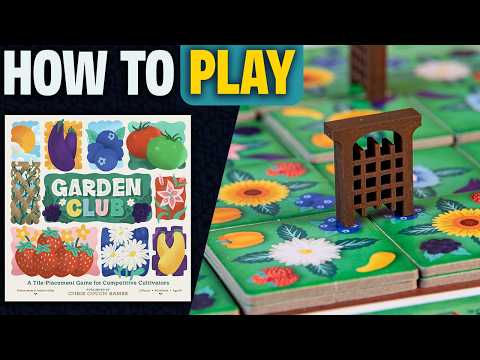
Garden Club's central mechanism invites players to plant tiles into a shared 4x4 garden grid across three seasons: spring, summer, and fall. On each turn, a player selects a tile from the display, rotates it freely, and places it anywhere within the grid. In spring, tiles fill empty spaces. Come summer and fall, players stack tiles atop one another, building layers, subject only to the restriction that trellises cannot be placed on uneven surfaces. Each placement is a decision: the tile can face either its garden or harvest side, presenting different produce types and patterns. The tiles themselves showcase beautiful dual-imagery design, where specific produce never appears on both sides of the same piece. What makes this mechanic particularly clever is how it mirrors the theme, since you are genuinely cultivating a garden, while serving the deeper puzzle of positioning tiles to generate the scoring patterns your strategy demands.
End Game Bonuses
At the conclusion of each seasonal round, players score based on majority control of produce types they've harvested. Your harvested tiles sit in personal collection crates throughout the season; whichever produce you've collected most of determines your scoring potential. Here's the compounding elegance: the more of that produce you score this round, the stronger you become next round. A successful spring gives you an extra cube in your collection basket for summer, accelerating your scoring potential as the game progresses. This system rewards forward-thinking, since you are planting today for advantages you'll cash in tomorrow. The three seasons provide natural arcs of escalating stakes, with fall's final tally deciding the winner.
The Garden Club Experience
Pattern-Building Satisfaction
What reviewers consistently emphasize is the almost tactile satisfaction of building patterns. The game isn't about racing to score fastest; it's about watching your garden take coherent shape. Good Time Society describes the game delivering "strategic pattern building" with "easy and engaging turns," letting players feel immediate progress without overwhelming decision trees. Each tile placement is meaningful, but the turn structure remains snappy. This creates a rhythm where strategy feels present without dominating playtime.
Elegant Simplicity Masking Depth
Perhaps the strongest praise comes from reviewers recognizing the design philosophy underlying Garden Club. Comparing it to Chris Couch Games' earlier title Holiday Hills, Neon Gorilla observes that the games are devilishly simple in that there isn't a ton of rules overhead, yet the complexity lives entirely within the design itself. This is the hallmark of genuinely polished game design: a player can teach Garden Club in minutes, yet tactical depth emerges through tile combinations, majority scoring, and project card timing. The advanced project cards and tomato farmer variant add layers without requiring new players to engage them.
What Makes Garden Club Stand Out
Component Quality and Visual Cohesion
The physical presentation commands attention. Ryan and Bethany Board Game Reviews note that "the components look awesome. They have like these recessed boards. It just looks really nice and it has like this 3D quality to it." The beautiful tiles and thoughtful production don't feel gratuitous; they reinforce the garden theme at every glance. When Good Time Society compares Garden Club to Azul, itself a benchmark for tile-placement aesthetics, they're making a serious claim about craftsmanship: "Azul, watch out. He's coming for your beautiful tile." The game's visual language invites players in and keeps them engaged through production value alone, before mechanisms even enter play.
Designer Pedigree and Publisher Consistency
Chris Couch Games has established a recognizable design voice. Designer Andrew Styles brings craft honed through earlier titles like Wine Seller, and the publisher's commitment to elegant, approachable games with hidden complexity creates player expectations Garden Club meets squarely. Reviewers familiar with Holiday Hills and other Chris Couch releases note the consistency: games that look inviting, teach quickly, and reward strategic play. This pedigree matters for players seeking games that balance accessibility with substance.
Potential Drawbacks
Game Length Concerns
While most reviewers praise the experience, one candid creator noted that Garden Club "ran too long" for their preference. With 40 to 60 minutes advertised and real-world plays potentially stretching longer, players who prize efficiency or play evening game sessions with limited time should be aware. The game's strategic depth means analysis-prone players can turn a shorter game into a much longer affair. This isn't a flaw in design; it's an artifact of giving players genuine strategic choices, but it's worth acknowledging for those seeking quicker two-player fare.
Limited Player Count Ceiling
Garden Club is strictly a one or two player game. This constraint means households seeking a game to scale across varying group sizes will need different titles. While the small player count allows for deep head-to-head play, it eliminates versatility for some collections.
If You Enjoy Garden Club
Reviewers suggest reaching for Azul if you prize visual elegance and tile-laying simplicity in a faster format. Holiday Hills, also from Chris Couch Games, serves up the same design philosophy applied to a different theme and mechanic set. For players seeking deeper strategic pattern-building over more time, Cascadia offers ecological competition with a similar design lineage. And if you crave tile placement with unique spatial tension, Pedal, another Chris Couch Games release, presents a fresh alternative within the same publisher's ecosystem. Finally, Layers and Key Master appeal to those drawn to elegant games where simplicity conceals strategic richness.
What Reviewers Are Saying
"You don't put a lot of boundaries or there's not a lot of overhead that a player has to understand to get into your games. But then at the same time, the complexity is within the design, not in the rules, which I thought was really really cool."
— Neon Gorilla
"The components look awesome. They have like these recessed boards. It just looks really nice and it has like this 3D quality to it."
— Ryan and Bethany Board Game Reviews
"Oh my god. Also these tiles are beautiful. They're gorgeous. Azul, watch out. He's coming for your beautiful tile."
— Good Time Society