


Inkling Deep Dive
What the Community Thinks About Inkling
Inkling stands out as a refreshingly original word game that reviewers appreciate for its creative central mechanic and accessibility. Unlike traditional word or drawing games, this party experience invites players to think visually about language in a way that feels both novel and engaging. The game earns respect for its elegant design, well-balanced difficulty curve, and surprising longevity despite its simple core premise. What reviewers consistently praise is that Inkling occupies a unique space in the party game landscape, offering something genuinely different while remaining easy to teach and quick to play.
Core Mechanics That Define Inkling
The Letter Manipulation System
At the heart of Inkling lies a deceptively simple but highly creative mechanic. Players receive letter cards drawn randomly from a deck and must arrange these letters to spell words from their personal word list. The catch is that with only eight cards in the first round, players rarely have the exact letters they need. Instead, they are encouraged to get creative. Cards can be rotated, flipped upside down, placed sideways, or overlapped. A sideways N becomes a Z. A rotated M becomes a W. Players might leave gaps or place cards face-down to indicate missing letters. This transformation of letter cards into improvised representations feels like a puzzle solved through lateral thinking rather than brute-force spelling.
The Word List and Progressive Rounds
Each player receives six words arranged by difficulty. Three words are easy and worth one point each. Two are medium difficulty and worth two points. One word is hard and worth three points. The game plays across three rounds, during which players draw progressively more cards. In round one, players work with eight letters. This increases to eleven cards in round two, then fourteen in round three. This ascending structure means players have more tools to work with as the game progresses, yet they must commit resources by discarding cards between rounds. The system creates natural tension between trying to complete difficult words early versus gambling that later rounds will bring better letters.
The Inkling Experience
Creative Satisfaction and Puzzle-Like Play
What makes Inkling memorable is how it transforms a word game into a creative problem-solving exercise. Players do not simply draw cards and make words. They actively design ambiguous letter tableaus, arranging them to be just readable enough for neighbors to decode. There is genuine satisfaction in successfully conveying a difficult word through clever rotation and spacing, and equal amusement when a neighbor interprets a letter arrangement in an entirely unexpected way. The game rewards both clarity of communication and creative thinking, making it equally appealing to literal-minded players and those who enjoy lateral creativity.
Well-Calibrated Difficulty and Accessibility
Reviewers consistently note that Inkling pitches its difficulty well. The game is not so easy that players trivially spell every word with no effort, nor is it so hard that the experience becomes frustrating. With limited letters and multiple rounds, achieving every word on a player's list represents a genuine accomplishment. This balance keeps the game engaging across multiple plays. The three-round structure also ensures the game stays brisk. At twenty minutes total, a full session never overstays its welcome, making Inkling ideal for casual gatherings or as an opener to a longer game night.
What Makes Inkling Stand Out
A True Hybrid: Word Game Meets Spatial Puzzle
Reviewers struggle to find direct comparisons because Inkling is genuinely unique. Some describe it as a hybrid of Imagine, the classic game where transparent cards are layered to build an image, combined with a traditional word game. Others liken it to Telestrations, the drawing-based party game, but note that Inkling flips the central mechanic. Instead of watching something get progressively reinterpreted through multiple iterations, players in Inkling deliberately create single ambiguous representations designed to be guessable. The result is a game that feels fresh even to players familiar with the entire party game landscape. There is nothing else quite like arranging letter cards to spell words that are only partially spelled, then hoping a neighbor can divine the intended word from the visual arrangement alone.
Potential Drawbacks
Creative Interpretation Can Be Frustrating
The game's reliance on creative interpretation means that occasionally, a letter arrangement that was crystal clear in one player's mind reads as something entirely different to a neighbor. Reviewers note that this can sometimes be frustrating, particularly when a player has put thought into an arrangement only to see it wildly misinterpreted. This is largely a feature rather than a bug, as the unexpected interpretations often generate the game's best moments. However, players who prefer games with completely objective outcomes may occasionally feel that interpretive ambiguity is working against them.
If You Enjoy Inkling
Players who love Inkling typically enjoy other creative party games like Telestrations and Codenames, which reward lateral thinking and communication outside the bounds of standard rules. Fans of word games who also appreciate spatial reasoning and visual puzzle elements will find much to engage with here. Inkling also appeals to players who enjoy Imagine and other layering-based games, but who prefer something faster and less heavy on abstract thinking. Teachers and educators have found particular value in Inkling as a classroom tool for developing both spelling skills and creative problem-solving in a playful, low-stakes environment.
What Reviewers Are Saying
"This game really encourages players to value their own space because not only are they trying to guess what other players' words are because that's how you can earn points if you're as clear as possible or creative as possible with your word selection, arranging your letters in a very clear and persuasive way, you're going to earn points for players guessing your words. And so it's just a really great system of having easier words, medium level words, and hard words."
— Tabletop Tolson
"It's fun and trying to do this, I mean it might be a bit frustrated, frustrating sometimes like when I tried the radio words or what it said, but it is a quick find, it's only played for three rounds, we do it three times and then you compare scores and the game ends."
— Meeple University
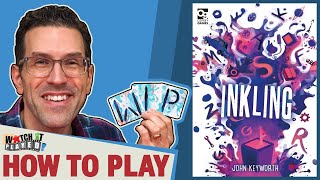
"So it seems like it's almost a combination of an image game like Imagine, where you're putting transparent cards on top of each other trying to build out a tableau so that people can figure out what you're talking about, and a word game."
— Watch It Played