



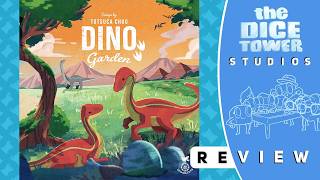




Dino Garden Deep Dive
What the Community Thinks About Dino Garden
Reviewers consistently describe Dino Garden as a satisfying step forward in the Garden trilogy, delivering meaningful complexity without overwhelming players. Where Aqua Garden laid the foundation with its simple core loop, Dino Garden layers on systems that force genuine tactical decisions at every turn. Reviewers appreciate that the game feels meaty without demanding complex individual turns, creating a puzzle-like experience that rewards forward planning while remaining responsive to what other players choose.
Core Mechanics That Define Dino Garden
The Central Rondel
Like the earlier Garden games, Dino Garden uses a circular board where players move their owner token to collect dinosaurs and resources. The rondel creates natural tension because players cannot land on occupied spaces, forcing hard choices about how far to push for premium positions. This mechanic generates much of the game's strategic depth: reaching a high-value space might mean skipping turns or sacrificing the chance to take action on specific bonus locations.
The Dual Movement System
Dino Garden's signature innovation is the introduction of a second worker moving in the opposite direction. While the owner token advances clockwise around the main board, a feeder token circulates counter-clockwise around each player's personal park, delivering meat from herbivores to hungry carnivores. This reversed directional movement creates a novel logistical puzzle, forcing players to coordinate two separate movement tracks. The feeder's position determines which pens can receive meat deliveries, adding a spatial reasoning layer to placement decisions.
The Dino Garden Experience
A Puzzle of Synergy and Restriction
The core experience centers on building a balanced ecosystem. Herbivores produce meat tokens that carnivores consume, advancing players up an asymmetric predator track unique to their player board. These tracks are randomized each game, meaning one player might score heavily for feeding pteranodons while another gains points for diversity of prey delivery. This asymmetry ensures that no two games follow identical strategies, and that players pursue meaningfully different paths to victory.
Meaningful Tradeoffs
Reviewers highlight the game's decision-making as its strongest element. Players constantly face compelling tension: place herbivores and carnivores together to move up the predator track, but doing so prevents achieving volcano or lake bonuses that reward separation. Take a distant turn in turn order to grab a key action space, but risk waiting multiple rounds before the next turn comes around. This is not a game where turns are simple and decisions are obvious. The game invites forward planning, then immediately confronts players with a randomized market board that forces adaptation.
What Makes Dino Garden Stand Out
The Meat-Handling Puzzle
The feeder system is uniquely Dino Garden, and it transforms the trilogy's core loop into a true spatial puzzle. Instead of simply placing creatures into pens, players must also orchestrate a supply chain, moving meat around the board to reach the carnivores that want it. This creates a secondary decision tree: moving a feeder token far across the park to deliver a specific meat type can be worth two to four victory points, but it consumes an action that could have been spent elsewhere. Reviewers note that this system is optional to master, allowing casual players to ignore it and still enjoy the game, while offering competitive players a rich optimization path.
Potential Drawbacks
Scoring and Component Clarity
Reviewers identify two minor but consistent friction points. First, scoring sprawls across multiple sources: predator tracks, milestone cards, dinosaur placement bonuses, and end-game event cards. Calculating final scores can feel tedious when different scoring elements sit on different boards. Second, some reviewers noted that special dinosaurs take up no space in pens despite physical dinosaurs requiring careful space accounting, creating a slight thematic inconsistency. Neither issue significantly impacts play, but both can disrupt the otherwise smooth final phase.
If You Enjoy Dino Garden
Fans of Dino Garden often gravitate toward games like Parks, Patchwork, and the other titles in the Garden trilogy itself. The combination of worker movement, spatial puzzles, and modular asymmetric powers creates appeal for players who enjoy games where theme and mechanics reinforce each other. The decision space is complex enough for dedicated hobbyists but approachable enough for players new to hobby board games, especially for those who have played Aqua Garden first. Those who love building interlocking engine combos and optimizing logistics will find Dino Garden deeply rewarding.
What Reviewers Are Saying
"This is a game that is going to evoke that sense of wonder, that desire to open a prehistoric park. This is a game where you're going to be opening your own dinosaur park in the town and trying to make it a roaring success."
— Board Game Sanctuary
"That's why Dino Garden is my favorite. I think I do like the mechanisms in Dino Garden a little bit more and I like the theme a little bit more."
— Board Of It
"Dino Garden is more about solving a more interlocked and interwoven puzzle by trying to create the recipe for feeding different species of dinosaur. And so in Dino Garden, it is quite meaty, but there's a lot more juggling and restrictions involved."
— Board Game Sanctuary