





HerStory Deep Dive
What the Community Thinks About HerStory
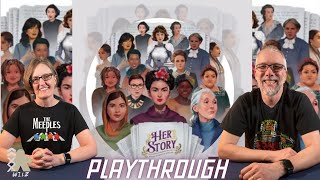
The board game community consistently praises HerStory as an underrated gem that deserves far more attention than it receives. Where There's A Wilz, There's a Play ranks it as one of their favorite games of 2022 and among their top drafting games overall. Board Game Dad describes it as the only board game regularly recommended to other parents, particularly those with daughters, emphasizing that the experience transcends typical gaming. Reviewers highlight that HerStory succeeds as both a genuinely engaging game and an educational tool, making it accessible to casual players and non-gamers alike.
Core Mechanics That Define HerStory
Card Drafting
HerStory centers on card drafting as its primary decision point. Players draft cards representing historical women from a shared pool, either reserving them for later use or playing them directly into their book. This mechanic creates meaningful moment-to-moment decisions: Do you claim the high-value card before your opponent, or collect research tokens to prepare for future chapters? The drafting system feels elegant precisely because the cards are so valuable. Underdog Games designed each card to pull double duty, making every selection carry weight.
Multi-Use Cards
Cards in HerStory function as true multi-use components. Each card can be drafted for two points, reserved on your personal board for later, or played immediately if you possess the right research tokens. Some cards provide immediate powers or end-game bonuses. This creates constant tension: the card you want offers immediate points, but holding it back might enable a more powerful play later. The system forces players to weigh opportunity costs with every selection, transforming what could be a simple collect-and-play loop into layered strategic depth.
The HerStory Experience
Educational and Inspirational
HerStory's greatest achievement is how naturally it weaves historical education into gameplay. Each card depicts a real woman from history with biographical details on the back. Reviewers consistently mention discovering women they had never heard of: pirates commanding 1,800 ships, scientists turned entertainers, inventors credited with over 100 patents. One reviewer noted that their students were amazed to discover Selena Quintanilla represented in the deck, sparking genuine interest in history. The game teaches without lectures because players are invested in their chapters; learning becomes a reward rather than an obligation.
Warmth and Accessibility
Reviewers emphasize the warmth players feel while playing HerStory. The artwork is consistently praised as fantastic. The cards are oversized and easy to read, with high production quality. The game respects players of all skill levels: it teaches quickly (setup is minimal), plays in under an hour, yet offers enough strategic texture to satisfy serious gamers. One reviewer described how their family gathered on the couch to read aloud the biographies after the game ended, turning final scoring into a shared learning moment. That's the experience HerStory delivers: a light game that feels meaningful.
What Makes HerStory Stand Out
Rigorous Historical Research
Underdog Games commissioned teachers, women professionals, and educators across multiple fields to curate the 120 women featured in HerStory. The result is a carefully considered collection spanning from historical figures to contemporary icons, from scientists to artists. Women range from ancient philosophers to modern activists. The diversity of representation is striking: you'll find Marie Curie alongside Maria Tallchief (America's first Native American prima ballerina), Hypatia of Alexandria alongside Ching Shei (a pirate commanding 880,000 followers). This wasn't a quick collection of famous names; it's a thoughtful survey of overlooked contributors across centuries and continents.
The Book as Artifact
At game's end, each player's collected cards transform into a finished book. The card backs contain biographical entries that read like a curated anthology. Players flip their card collection over, creating a physical book they can keep and revisit. This transforms HerStory from a competitive game into a collaborative act of commemoration. Reviewers describe this moment as the emotional peak: suddenly, the tokens and drafting decisions resolve into something tangible, something to read and reflect upon. It's why parents find themselves recommending this to families and why non-gamers engage with it so readily.
Potential Drawbacks
Symbol and Token Management
The game uses abstract research tokens (reading, thinking, interviewing, searching) that players must track and manage across multiple cards. One reviewer described needing to reference the rulebook to identify which token corresponds to which symbol. While the oversized components help, tracking which tokens you need, which you have, and which special powers can substitute for them creates a learning curve. The system makes sense once players internalize the four token types, but the first plays involve more table-checking than some players prefer.
Token Availability and Shuffling
As the game progresses, the research token supply in the main pool becomes depleted. Once the pool empties, used tokens return to the bag and players reshuffle. While this maintains game flow, it introduces a shuffling step that breaks momentum. Additionally, if tokens aren't distributed evenly early in the game, later players may find they're pulling suboptimal combinations from the bag. This is a minor friction point for an otherwise smooth game, but worth noting for players who dislike any element of draw-chance affecting their options.
If You Enjoy HerStory
HerStory shares DNA with several other drafting and set-collection games. Fans of Trekking Through History will appreciate Underdog Games' focus on historical education paired with solid mechanics; both teach history while remaining mechanically engaging. Draftosaurus offers similar approachable drafting and drafting-into-a-grid gameplay (you're building a museum instead of a book, but the decision space is comparable). River Valley Glassworks provides similar drafting-and-placement depth for players wanting more strategic density. For the narrative and collection aspects, Dixit offers artistic drafting with a literary bent. Timeline rewards historical knowledge in a quicker package if you want something lighter.
What Reviewers Are Saying
"I love her story. I love the history with it. I love learning about women that I honestly had no clue they existed. They did a lot of research to get this game just right and to get the cards so that it had a lot of women who one were forgotten about or two were never recognized for what they originally did because women just were not recognized in history for a lot for sciences or math or you know, um, a lot of different things. And so once they started to get credit, that's when this game should have been made. But anyway, they so, a lot of women are now finally getting the credit that they deserve."
— Where There's A Wilz, There's a Play
"Yeah, so those of you that follow our Channel and watch other stuff, you know, we like we do enjoy games where there's some learning aspects to it, um, so this is an underdog, does a good job with with those, um, I've got several of them in my board game club at school."
— Where There's A Wilz, There's a Play
"I will also say that as the father of two daughters this is the only game that I regularly tell other parents about. I tell them about this game even if they don't even like board games. I'm like, man, we have this board game it's all about women in history. When we play this with my kids we make a bigger deal out of reading the biographies than we do of playing the game. We sit on the couch, everybody takes the cards they've collected, and we all read it together, and through doing that we learn a lot."
— Board Game Dad