Game Info
Year
2025
Players
2-4
Age
12+
Playtime
60 min
Collection
Your Tier
Loading…
Mechanic profile
Not enough video data yet
Vibe profile
Not enough video data yet
Description
A puzzly island-exploration game where players move across a shared map collecting discovery tokens and recording them in journals to score against shifting secret objectives.
Featured Videos

Playthrough

Kaelora - Teach & Playthrough
Ask a Rules Question
Images

GID0452930.jpg

GID0452930_thumb.jpg
All mentions
Browse transcript mentions, sentiments, pros/cons, mechanics, topics, quotes, and references.
Total mentions: 2
This page: 2
Sentiment:
pos 1 ·
mix 1 ·
neu 0 ·
neg 0
Showing 1–2 of 2
Video pBd2X3buTkw
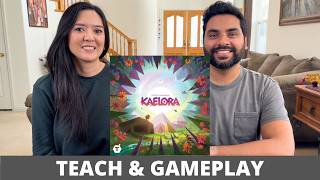
Before You Play Playthrough at 0:05 sentiment: mixed
video_pk 36296 · mention_pk 311519
Click to watch at 0:05 · YouTube ↗
Overall sentiment (raw)
mixed
Pros
- Tight two-player tension with meaningful choices on each move
- Rich, multi-faceted scoring system that combines journal lines, quadrant control, and species collection
- Interactive elements via camps, tides, and teleportation keep player agency high
- Theme and components align well with a family-weight experience
Cons
- Scoring and token interactions can be complex for new players
- Two-player pacing may feel different from 3–4 player games, reducing token variety and encounter density
- Some players may find the prototype nature of the copy a cautionary note
Thematic elements
- Exploration, wildlife documentation, area control, and puzzle-like scoring
- Explorers on a mysterious island collecting wildlife tokens and documenting them in a journal
- journal-based scoring with spatial token placement and dynamic endgame scoring
Comparison games
none
Mechanics (from transcript analysis)
- Area Control — Four camps are placed to claim geography quadrants; endgame scoring awards points based on who has the most area control in each quadrant, with some spaces counting toward multiple quadrants.
- Area control (geography) scoring — Four camps are placed to claim geography quadrants; endgame scoring awards points based on who has the most area control in each quadrant, with some spaces counting toward multiple quadrants.
- Camps and teleportation — Completing a line places a camp; camps allow teleporting between camps and contribute to quadrant scoring, with scoring implications for crossing through camps.
- End Game Bonuses — The game ends when a player fills their journal; final scoring tallies geography tiles, tokens per species, and other objective tokens.
- Endgame trigger and scoring — The game ends when a player fills their journal; final scoring tallies geography tiles, tokens per species, and other objective tokens.
- Movement — On your turn you move up to three spaces along connected pathways; you may backtrack or retrace, and you reveal tokens as you enter spaces.
- Set Collection — Tokens collected are placed in a journal; completing lines immediately scores points, with scoring determined by whether a line contains all different types or all the same type.
- Set collection / journaling — Tokens collected are placed in a journal; completing lines immediately scores points, with scoring determined by whether a line contains all different types or all the same type.
- Speed berries (movement boost) — Starting berries grant movement bonuses when discarded; leftover berries at end of game score as points.
- Tides tokens (tile swapping) — Tide tokens let players swap adjacent scoring tiles to adjust endgame values; the number of swaps scales with the number of tide tokens collected.
- Token flipping & visibility — Tokens start face-down; entering spaces flips them; adjacent tokens may flip as a consequence of ending movement.
- Weather tokens — Weather tokens (water, sun, tides) act as wilds or provide immediate scoring bonuses, affecting lines in journal scoring.
Video topics + discussion points
No key topics recorded for this video.
Quotes (from this video)
- This is a family weight set collection game that plays in about 45 to 60 minutes in which players are going to be taking turns moving around the island and collecting these tokens in order to score points for them in our journal and score the most amount of points by the end of the game.
- On your turn, you'll always start by moving up to three spaces via these connected pathways.
- The tides token allows us to swap the positions of the species tiles that we'll be scoring for at the end of the game.
- If you complete a line, you score immediately.
- In case of a tie, ties are broken in favor of the player who has the higher place token on their journal.
References (from this video)
No references stored for this video.
Video 4v0AIMk-rxU
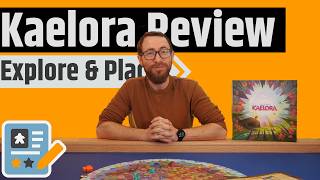
BoardGameCo Review at 0:04 sentiment: positive
video_pk 35151 · mention_pk 311518
Click to watch at 0:04 · YouTube ↗
Overall sentiment (raw)
positive
Pros
- Accessible and easy to learn
- Fast-playing with plenty of depth from multiple scoring avenues
- Engaging token interactions and card-driven objectives
- Interactive tension with opponents via tents and grid decisions
- Distinct solo mode with a different strategic flavor
Cons
- Moon tokens can feel less fun or overpowered for opponents at times
- Region scoring can feel somewhat luck-driven due to initial tent placement
- Berry scoring can feel anticlimactic or trade-off-heavy
- Solo mode can be luck-dependent due to dice/robot behavior
- Requires constant attention to opponents' boards to maximize value
Thematic elements
- Exploration and scoring through area control and token interactions.
- Map-based exploration and collection game with tokens representing elements (moon, sun, water) and animal species.
- abstract
Comparison games
- Pteranova
- Azul
- Waddle
Mechanics (from transcript analysis)
- Area Control Scoring — regional scoring across four quadrants with leading players receiving larger point totals for animal species.
- berries for movement / end-game scoring — berries allow extra moves; most berries at game end scores a point per berry.
- bonus scoring cards — bonus objective cards provide additional scoring opportunities and tailor strategies.
- deny/interactive token selection — players can influence opponents by selecting or denying tokens, impacting others' options.
- Explorer movement — move your explorer 1-3 spaces per turn across a grid-based map.
- line scoring by rows/diagonals — score points for lines that are all same or all different elements; different lengths yield varying point values.
- solo mode — a solo variant where a robot opponent follows its own rules; provides a distinct challenge from multiplayer.
- tent placement / row completion — upon completing a row, tents are placed that unlock scoring tiles and influence area scoring.
- Tile Placement — upon completing a row, tents are placed that unlock scoring tiles and influence area scoring.
- token element interaction — moon tokens modify scoring of animals; sun tokens score points for surrounding tokens; water tokens act as wild or contribute to different lines.
- token flipping / tile reveal — on your turn you may flip adjacent tokens to reveal contents and decide to take them.
Video topics + discussion points
No key topics recorded for this video.
Quotes (from this video)
- it's pretty simple. It's it's easy to learn to teach
- it's fast playing and just gives you a lot to juggle within that system
- the solo mode does play very differently than playing multiplayer
- this is a charming game
- the moon is not always the most fun
- region scoring can be a little lucky
References (from this video)
No references stored for this video.
Transcript Navigation
Showing 1–2 of 2