














Tether Deep Dive
What the Community Thinks About Tether
Tether has caught the attention of board game reviewers with its unconventional mechanics and elegant design. The consensus among players who have encountered this title leans decidedly positive, though with important caveats about player count. Reviewers consistently highlight the game's innovative approach to spatial puzzles and its surprising depth hidden beneath a deceptively simple premise. The overwhelmingly positive reception focuses on the genius of its execution rather than any spectacular production or theme, though the artwork has earned particular praise.
Core Mechanics That Define Tether
The Mirror Deck Mechanism
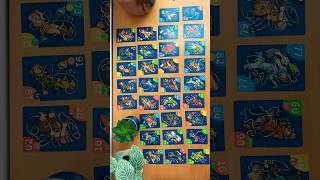
At Tether's heart lies a mirror deck, a mechanism that fundamentally reshapes how two players experience the same game. Each card in the deck carries a two-digit number. When rotated 180 degrees, the digits swap. A card showing 47 becomes 74 when flipped. This creates a genuinely asymmetric experience. One player is building vertically, placing cards downward. The other builds horizontally, placing cards across. From each player's perspective, the cards appear in completely different numerical orders. Where one player sees a sequence climbing upward, the other sees it expanding sideways. Reviewers from Board Game Sanctuary described it as "a unique mirror-deck where the numbers that you see are not the same as your opponent." This mechanism forces players to interpret the same cards from opposite orientations, creating a shared tableau that reads as two entirely different games depending on your vantage point.
Asymmetric Scoring Through Spatial Geometry
Scoring in Tether emerges from the groups of connected astronauts on the table. Players form groups by playing cards in consecutive numerical sequences, snapping them together when numbers connect. When a group reaches certain thresholds (6, 10, or 14 cards), it triggers scoring. But here lies Tether's most elegant twist. The vertical player scores based on the number of rows within each group. The horizontal player scores based on the number of columns. This creates a profound tension. Building a large group does not guarantee high scores. You might construct a massive cluster of astronauts only to discover that your opponent's perspective on its dimensions yields them far more points. Board Game Critique explained this asymmetry precisely: "they score based on width for the horizontal player and height for the vertical player." The same physical group yields completely different point totals depending on whether you're counting its width or its height. This mechanism transforms Tether from a simple sequencing game into a spatial puzzle where you must simultaneously plan for your own scoring opportunities while avoiding creating patterns that benefit your opponent.
The Tether Experience
A Brain-Bending Learning Curve
The experience of learning Tether is unique. Reviewers note that while it teaches in approximately two minutes, the mental shift required to visualize cards from both the vertical and horizontal perspectives creates an initial hurdle. Tabletop Tokki captured this experience, saying "This game was definitely a lot for me to wrap my mind around." The asymmetric number system requires active mental translation. You must remember that while you see 47, your opponent sees 79 from their rotated perspective. Over time, this mental overhead transforms from a barrier into the game's core fascination. Players describe a moment when the inversion clicks, and suddenly they can visualize the board from both angles simultaneously.
A Tactical Puzzle of Positioning and Restraint
Tether plays as a spatial puzzle with significant tactical depth. Hand management emerges as critical. Unlike games where you might play cards as soon as opportunity allows, Tether punishes careless card spending. If you exhaust your hand early, you are drawing and passing while your opponent methodically builds control of the board. Reviewers noted this dynamic, describing moments when overcommitting cards early gave opponents time to establish unbeatable scoring patterns. The game creates tension around every placement decision. You are not simply trying to build groups. You are sculpting the board to score well from your perspective while denying your opponent scoring opportunities from theirs. Each card played is a commitment with spatial consequences that extend several turns forward.
What Makes Tether Stand Out
A Deceptively Elegant Mirror Mechanic
The mirror deck mechanism is genuinely novel. Board Game Critique described Tether as "deceptively elegant," and that elegance springs from how the inversion mechanic enables asymmetry without requiring separate decks or house rules. A single deck of 53 cards becomes two incompatible perspectives without any component multiplication. Players do not need special rules or alternative card sets. The same physical deck creates fundamentally different games for each player simply by rotating cards 180 degrees. This efficiency of design speaks to careful development. The mechanism solves the problem of creating genuine asymmetry while maintaining elegant simplicity.
Unique Spatial-Asymmetric Scoring
Few games combine spatial tile placement with genuinely asymmetric scoring in the way Tether achieves. Most games that employ asymmetry do so through different player abilities or separate scoring tracks. Tether's asymmetry emerges directly from spatial orientation. The same group on the table is measured differently by each player. This creates a phenomenon where both players can be building toward the same group while valuing it completely differently. One player sees it as a potentially massive scoring opportunity. The other sees it as a threat. This tension has no parallel in most board games.
Potential Drawbacks
Optimal Play Demands Significant Player Count
While Tether plays with two to four players, reviewers who have experienced it at higher counts consistently report that it shines primarily at two players. kovray, a couple who played the game at a convention, stated clearly: "I definitely know that I enjoy it more at two and it felt a little clunky at four." At two players, you control the board's entire spatial development and can track every card played. At three or four players, the board becomes chaotic. With multiple horizontal or vertical perspectives, the shared tableau becomes harder to read, and the spatial reasoning that makes Tether special breaks down. The game includes team play rules for two versus two, which may address this, but reviewers recommend treating Tether primarily as a two-player experience.
Initial Mental Load Can Create Friction
Learning to mentally rotate card numbers and visualize both players' perspectives simultaneously is not trivial. While the game teaches quickly in terms of rules explanation, the conceptual leap requires active practice. Players expect to play their first game somewhat slowly as they build their mental model of how the inversion works. This is not a drawback for experienced gamers, but it does mean that Tether is less accessible to players who struggle with spatial reasoning or who find mental arithmetic fatiguing.
If You Enjoy Tether
Players who engage with Tether typically gravitate toward other abstract strategy games that emphasize spatial reasoning over luck. The comparison naturally extends to games like Patchwork, which involves two-player tile placement and tight decision-making, though Patchwork lacks Tether's asymmetric foundation. Those who appreciate Tether's spatial puzzle nature might explore Nova Luna, an abstract tile placement game from renowned designer Uve Rosenberg that similarly demands planning ahead and reading opponent intentions. The logic and deduction required in Tether also appeals to players of The Search for Planet X, which channels spatial reasoning into pure deduction. For those who want asymmetric competition specifically, Ironwood, a card-driven tactical game with completely different factions, delivers a similar sense that each player is solving a puzzle from an entirely different angle. Finally, players who appreciate Tether's ability to teach quickly while revealing depth over time will find Radlands, a dueling card game with simple rules and profound strategic options, a natural companion piece.
What Reviewers Are Saying
"This game was definitely a lot for me to wrap my mind around, but I think it was a genius concept and implementation that was really fun to see pieced together."
— Tabletop Tokki
"I definitely know that I enjoy it more at two and it felt a little clunky at four."
— kovray
"Tether is deceptively elegant. One player plays horizontally trying to build wide groups. The other plays vertically, trying to build tall groups. Each card has a two-digit number, and when you rotate it 180 degrees, the digits swap."
— Board Game Critique