
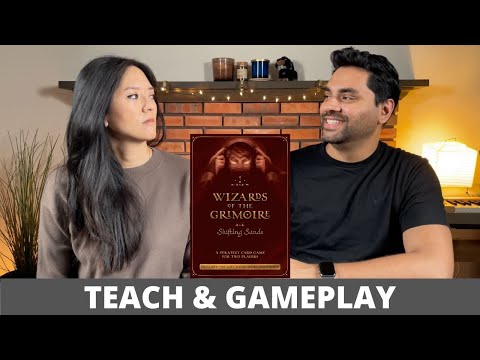




Wizards of the Grimoire: Shifting Sands Deep Dive
What the Community Thinks About Wizards of the Grimoire: Shifting Sands
Wizards of the Grimoire: Shifting Sands is a standalone expansion to the two-player wizard duel published by Grimoire Games, and reviewers treat it as a faithful extension of the base game rather than a reinvention. The Chairman of the Board calls it one of their favorite two-player games of the previous year, and in a dedicated look at the expansion stresses that the rules are a carbon copy of the original with no extra steps added. Its new cards slot into the same routine of drafting spells, cooling them down, stacking mana cards, and casting what you can afford. The Chairman's prototype copy also used placeholder artwork, so the visuals shown are not the final presentation.
Before You Play takes a different approach, teaching the game and then running a full two-player playthrough that puts the new cards on the table. It reaches a similar picture: the core loop carries over intact, and the new interactions reward careful sequencing. Taken together, the commentary positions Shifting Sands as an easy recommendation for fans of the base game, with the real question being how much those fans want more of the same system.
Core Mechanics That Define Wizards of the Grimoire: Shifting Sands
Casting by Stacking Mana and Managing Cooldowns
The expansion keeps the base game's core rhythm. Each turn a player takes a spell from the display, gains mana cards, casts spells, and optionally makes a basic attack. A spell's cost is the number of mana cards placed on top of it, and the face value of those cards does not matter for casting. Mana values only come into play when a card refers to them or when a basic attack discards a mana card and deals damage equal to its power. Spells then cool down: at the start of a turn, one mana card is removed from each spell, so a spell with mana on it cannot be recast until it is clear. Players therefore decide whether to keep a spell loaded for an ongoing effect or drain it quickly to bring it back. The Chairman of the Board highlights Multiply as a clear example, since it doubles basic attack damage only while it holds exactly three mana cards, which forces players to time their stacking carefully.
Synergy Through Moving Mana Between Spells
The most celebrated part of the design is how the new cards let players move and reshape mana across their own spells and into their opponent's. The Chairman of the Board walks through a long list of examples: Spirit Dance, which moves mana between two of the opponent's spells, Breathe Fire, which deals damage for each of your spells with exactly two mana on it, Blemish, which deals two damage for each unique mana power in the opponent's hand, and Invisible Shard, which doubles basic attacks while its spell holds exactly three mana cards. Before You Play shows the same logic in play with Cyclone, which can move mana between two of your other spells, and Eclipse, which places mana cards on any combination of your spells or your opponent's. The payoff is planning: a Death Spiral stockpiled with mana can be followed by a Premonition that deals damage equal to the mana on another spell, turning a slow setup into a big turn.
The Wizards of the Grimoire: Shifting Sands Experience
A Clever, Euro-Style Optimization Puzzle
The Chairman of the Board says they are not generally a fan of jeweling games where players chip away at each other's health, yet the base game was almost tailor made for them because it is clever and has more of a Euro feel, where the best player is going to win. The expansion carries that feel forward. Players are trying to min-max every spell, combine them, cast them in the right order, and counteract what the opponent is doing while looking for a gap in their defenses. Before You Play makes a related point, arguing that taking every attack card is tempting but that players need creative combinations to generate mana and use their cards more often.
A Tense, Swingy Race to Zero
Before You Play's playthrough shows a duel that swings sharply. A well-timed basic attack or a stacked spell can reverse the race, and the hosts repeatedly comment on how quickly the position changes once the mana runs out or a delayed effect finally fires. Turns can feel empty when a hand is depleted, and the hosts describe moments where a lot of manipulation did not deliver the result they wanted. The closing reality is that the game is one of opportunity, and players who find the right mana at the right time can finish a close game.
What Makes Wizards of the Grimoire: Shifting Sands Stand Out
Relics: One-Time Spells With Table-Turning Effects
The new spell type reviewers highlight is the Relic, marked with a broken-card symbol. Relics are gained like normal spells, but when cast the mana is discarded instead of placed on the card, and the spell is then removed from play, which makes it a one-time, high-impact play. Before You Play cites Mask of the Beast, which forces an opponent to discard their entire hand, and Silencing Amulet, which destroys a spell so its owner must replace it. The Chairman of the Board points to Crystal Shard, which can be added to your hand and treated as a five-power mana card, as an example of how Relics can break the normal boundaries of the game. These cards work as sharp, timed answers to whatever the opponent has built up.
Built to Mix With the Base Game, Same Design Quality
Reviewers praise the expansion's continuity. The Chairman of the Board says the design group has kept the level of quality they have come to expect, and Before You Play notes that the expansion is standalone yet shares the same gameplay, so its cards can be mixed with the original into one larger deck. The Chairman says they intend to shuffle the two together and look for new combinations. The box also includes a small micro-expansion deck of stronger cards that players are advised to introduce only after a few games. Before You Play describes these as more complicated, with examples such as Time Walk, which lets you choose to gain less mana in exchange for cheaper follow-up spells, and Echo, which copies the effect of a cheap instant cast immediately before it.
Potential Drawbacks
A Heavy Tracking and Memory Load
Before You Play frequently needed to keep track of which mana sat on which spell and what that spell would do once it cooled down. During the playthrough one host joked that checking your own revealed mana every time Revelation is cast needs a rule limiting how often it can happen, and the reviewers noted that players can privately review the mana placed on their spells but cannot change its order. Delayed effects, instant spells, and cooldown timing all need to be held in mind at once. This is a fair caution for groups who prefer lighter bookkeeping, although the reviewers present the memory work as part of the puzzle rather than as a flaw.
Familiar Rather Than New
The Chairman of the Board's ranking video places Shifting Sands in an honorable mention spot rather than among their ten ranked games, explaining that it is so similar to the original Wizards of the Grimoire that it does not sit in the same slot. The Chairman still considers it highly revered. For players hoping for a new system, though, the expansion mostly offers new spells and relics on a familiar engine. Players who came for the design as it stands will be well served, while those looking for a different experience should set their expectations accordingly.
If You Enjoy Wizards of the Grimoire: Shifting Sands
If you enjoy Shifting Sands, the base game Wizards of the Grimoire is essential. The expansion uses the same spell-dueling system: draft spells, stack mana cards to cast them, let them cool down, and race your opponent to zero health. Reviewers describe the expansion as more of the same, so the base game is where the core rules, mana management, and spell-stacking skills are learned in the first place. The expansion is also designed to mix with it, which gives fans a way to build combinations across both sets. The Chairman of the Board's ranking video makes the broader point clearly: if you like a two-player head-to-head jeweling game that is very deterministic, the base game is the place to start.
What Reviewers Are Saying
"This expansion is a complete no-brainer if you are a fan of the original because it's just more of the same. Still that fantastic ability to synergize your spells and get this huge satisfying combos."
— Chairman of the Board
"In a dueling game, it's probably going to be very tempting to just take all the attack cards, but you need to find creative ways to combo with the rest of your cards so that you can generate more mana, utilize your cards more often, potentially activate the delayed cards more often than they allow you to initially. So, it is a game of opportunity for sure."
— Before You Play
"To start things off, I want to give an honorable mention to Wizards of the Grimoire: Shifting Sands. Now the reason I haven't put this one on the 10 ranked games is because it is so similar to the original Wizards of the Grimoire, which I like a lot. It does have a Chairman's Commendation, so it is quite highly revered by me, but if you like a little two-player head-to-head jeweling game that's very deterministic, then give this one a look."
— Chairman of the Board