








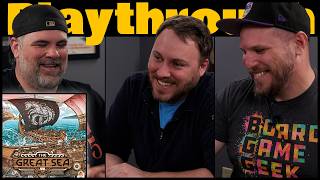



The Great Sea Deep Dive
What the Community Thinks About The Great Sea
The Great Sea is a standout that reviewers consistently praise for its depth, accessibility, and engaging gameplay. BoardGameCo and Meeple University highlight the game's complexity as a feature rather than a barrier: steep learning curve notwithstanding, players find the systems rewarding once understood. The game's theme of Mediterranean trade and naval dominance comes through authentically in how mechanics reinforce the fantasy of building an economic engine or a powerful fleet. Reviewers agree the game "can be mean," which they frame not as a flaw but as evidence that players have real agency to disrupt one another's plans. Kovray and the Brothers Murph both describe the sensation of escalating tension: the game builds toward moments where victory feels tantalizingly close for multiple players, then a well-timed action or combat can swing everything.
Core Mechanics That Define The Great Sea
Engine Building Through Dice and Pips
The heart of The Great Sea is a dice-driven action system where players spend pips (values on dice) to power their actions and unlock new capabilities. Reviewers describe this as "engine building" because early turns feel constrained (you start with low pip values on each die, limiting what you can do), but every action you take strengthens your future actions. BoardGameCo's preview walks through how the develop die acts as a ceiling: no other die can exceed its value, so players must deliberately boost develop first to unlock better actions elsewhere. As your pips climb, your individual actions become more powerful, you unlock access to restricted options, and you gain more things to do per turn. Kovray frames this progression beautifully: you "feel much more grand" by the game's end than at the start, when you were "just getting your ropes in how you're going to take on the world in this military and trade value."
Combat: Simultaneous Card Play and Tactical Bluffing
Combat in The Great Sea plays out through simultaneous card selection, creating a layer of prediction and mind games atop straightforward math. Players total their combat stats from ships, forts, and upgrades: mobility determines who attacks first, attack and shields measure offensive and defensive power, flames negate shields, and strength breaks ties. Then both players secretly choose a battle card and reveal simultaneously. The cards can modify stats or trigger special effects, but critically, the choice is made without knowing what your opponent will play. Meeple University's analysis emphasizes the depth here: you know what your opponent has already spent, so "watching what the opponent has already spent tells you what they can still throw at you," creating memory and bluffing opportunities. Kovray adds a memorable flourish: the flame/shield interaction feels intuitive, even humorous. "I want to attack you. Don't worry, I have shields. Oh no, I have flames to take down your shields." The combat system is straightforward enough to resolve quickly but rich enough that players spend meaningful mental effort predicting opponent behavior.
The Great Sea Experience
Tension That Builds Toward Multiple Possible Winners
Reviewers consistently describe The Great Sea as having a distinctive arc. The game opens with building (players place forts, upgrade dice, and plan networks), but this phase gives way to a tense middle where multiple players grow close to victory simultaneously. Kovray observed that "there's almost this arc where it's like that beginning arc of like everyone's building up. And then you reach that point where almost anybody can win at any moment." This escalating tension means the game stays dynamic: early advantages are not insurmountable, and clever play (or well-timed combat) can still swing the outcome. The temple track, which moves backward when contested and can move faster when uncontested, creates a secondary race that forces players to decide whether to race toward victory or disrupt opponents' paths. Meeple University notes that "you don't want to necessarily be timid in this game. The way that this game ends is by crossing over and intersecting, and the way you stop that from happening realistically is by taking the towers or the temple regions."
Active Player Interaction and Shared Resource Conflict
The Great Sea lives in shared space: all players maneuver ships, place forts, and claim trade posts on one map. Regions can be contested, and control can change hands through combat or careful placement. BoardGameCo describes it as "a shared environment" where "you are constantly looking at your pips and your developed eye to make yourself stronger, but all the actions that you're doing are working within this shared area." This design choice forces constant awareness of opponent positions and plans. You cannot ignore what your rivals are doing; the map is too crowded, and the stakes too high. When you consider whether to attack, place a trade post, or build a fort, you must weigh whether your opponent can counter or whether you will regret leaving them unopposed in a key region.
What Makes The Great Sea Stand Out
Multiple Paths to Victory Without Arbitrary Distinction
The Great Sea offers three victory paths: warfare (combat points), economic (fortify/trade track), and temples (control and trade posts), and reviewers note that all three feel equally viable and interconnected. You cannot simply "go military" or "go economy" and ignore the others; the three tracks support each other. Upgrading via research improves combat but also unlocks shiploads and economic bonuses. Building forts advances your trade track, and trade income funds ship construction for combat. Temples require trade posts and region control, which demand military presence. Meeple University phrases it plainly: "if either one of your left side trade or combat tracks meets your right side temple track, you win," and this structure means "it rewards long-term planning, tactical positioning, dice management, and combat timing." No single strategy dominates; instead, players commit to paths that exploit their early decisions while remaining reactive to the board state.
Thematic Resonance That Reinforces Mechanical Depth
The Mediterranean theme of trade, naval dominance, and territorial expansion is not window dressing. Reviewers highlight the thematic coherence: ships represent your presence and power projection, trade posts mark economic routes you've established, forts are strategic strongholds that multiply your income, and combat is how you dispute control. The game's flavor emerges naturally from its mechanics. Meeple University's opening narration, "From Levant to Carthage, from glorious combat to ruthless trade domination, whatever it takes, our city will prevail", captures what the game actually delivers: a narrative where players build empires through mixed strategy, not just points.
Potential Drawbacks
High Complexity and Steep Initial Learning Curve
Both Meeple University and BoardGameCo acknowledge that The Great Sea carries significant complexity. Six action types, six dice tracks, multiple scoring systems, and interconnected mechanics mean new players face a steep on-ramp. Meeple University notes "high complexity; steep learning curve" and observes that the game "requires more than one session to fully explore." BoardGameCo's playthrough includes detailed explanations of each action and how the develop die gates all others, suggesting new players need careful teaching. The branching decision space (which dice to upgrade, which actions to take, which regions to contest) creates legitimate analysis paralysis risk. That said, reviewers do not frame this as a flaw; it is the price of depth, and once players internalize the systems, the game plays more smoothly.
Downtime and Potential for "Meanness" to Feel Punishing
Meeple University flags "potential downtime during multi-player turns" as a consideration. With six actions per player and meaningful decisions at each step, turns can stretch, especially with four players. The same factor that makes the game engaging, its tactical depth, can also mean players spend minutes weighing their options. Additionally, several reviewers describe the game as "mean," a term they use to mean combat and region control can leave players in disadvantageous positions. One reviewer remarks, "this game's a little mean. I feel mean making plans against you guys." This is not a flaw in the reviewers' view; it is part of the game's appeal. However, players who prefer cooperative or low-interaction games may find the aggressive positional play uncomfortable.
If You Enjoy The Great Sea
Players who enjoy The Great Sea's engine-building and dice-management mechanics will find similar satisfaction in Paladins of the West Kingdom, which also combines worker placement with economic scaling and area control on a shared board. Raiders of the North Sea, its spiritual predecessor, offers a lighter take on dice-driven maritime conquest. Those drawn to The Great Sea's tense, territorial gameplay and the threat of combat disruption may gravitate toward Towers of Sefnos, which Garphill Games pairs with it in their crowdfunding campaign. Reviewers note that Towers of Sefnos shares similar mechanical DNA (dice tracking, shared map interaction, and multiple victory routes), making them natural companions. For players who enjoy the pure negotiation and region control of Towers of Sifos, The Great Sea deepens the economic layer while preserving the interaction and combat.
What Reviewers Are Saying
"The Great Sea is going to be a game where players feel constantly competitive because you're all working in this shared environment. You are constantly looking at your pips and your developed eye to make yourself stronger, but all the actions that you're doing are working within this shared area."
— BoardGameCo
"It rewards long-term planning, tactical positioning, dice management, and combat timing. The tension of do I mobilize now or do I wait? Do I build the economy first? That is the core decision loop."
— Meeple University
"The Great Sea is a 90-minute game that is dynamic, that's going to have you wanting to start some fights, but also wanting you to pay attention strategically to everything that's going on around you. You're going to have to decide what's more important at that exact moment so you can really stay in the game and hopefully claim yourself victory."
— Kovray