




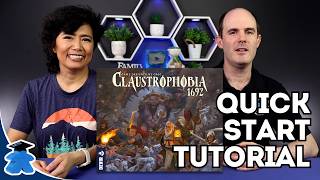


Claustrophobia 1692 Deep Dive
What the Community Thinks About Claustrophobia 1692
Claustrophobia 1692 has earned strong enthusiasm from the board game community as the third edition of a beloved series. Reviewers consistently praise the game's uncompromising asymmetrical design and tactical depth, with several calling it one of their favorite dungeon-crawling experiences. The design has been reimagined under the supervision of Croc, the game's original creator, resulting in what reviewers describe as a title that respects the DNA of the classic while delivering a darker, more brutal experience. Z Garcia from The Dice Tower calls it "one of my favorite dungeon crawling games," highlighting how the asymmetric design and bombastic moments make it stand out in the genre.
However, community members have raised legitimate concerns about pricing. With base pledges around €53 and shipping to regions outside Europe adding significant costs, the total pledge can reach €75 or more per core game, making it challenging to justify the purchase especially for players who already own previous editions. Bower's Game Corner notes that the game is already positioned competitively against retail pricing, since publisher Dveire makes these games widely available through traditional channels. Additionally, reviewers felt the campaign could have done more to clarify what players gain by upgrading from the 1643 edition to this 1692 version, beyond the visual polish and expanded component count.
Core Mechanics That Define Claustrophobia 1692
Combat: Dice
Combat in Claustrophobia 1692 is driven by custom dice, but the game deliberately avoids being a pure dice-chucker. According to the Unknown Channel reviewer, the strategy reveals itself through how players strategically position characters and manipulate the rules around character placement and movement to make combat more favorable. Combat dice show values 1 through 5 plus a skull symbol, which scores an automatic hit regardless of the defender's stats. Players roll dice equal to their combat stat plus any active buffs, and hits are scored when the die meets or exceeds the target's defense. This creates moments of cinematic tension where a crucial roll can swing the entire scenario, but victory depends far more on setup than on lucky dice. The human player deals damage by exhausting lines on the opponent's stat board, while the infernal player can exploit weaknesses as those stat lines become unavailable.
Scenario-Driven Campaign Structure with Modular Exploration
Each scenario comes with distinct win and loss conditions, creating varied play experiences across the 20 scenarios included with the expansion. Scenarios direct which warriors and demons enter play, and the map unfolds dynamically as players explore. The human player draws hellscape tiles from a stack and gives them to the infernal player, who chooses the orientation before placing them on the board. This creates uncertainty and strategic friction, because the human seeks paths to their objective while the infernal player can strategically deadend paths or create bottlenecks. Occupation limits on tiles restrict how many figures from each side can occupy a single space, forcing careful tactical positioning. Meeple University's tutorial shows how some tiles carry special effects indicated by lightning bolts or shield symbols, adding flavor and mechanical variety to each scenario. The modular nature means no two games play identically, even when running the same scenario.
The Claustrophobia 1692 Experience
Tense Asymmetric Duel
Claustrophobia 1692 creates intense back-and-forth tension between two fundamentally opposed playstyles. The human player relies on careful positioning, tactical card play with instinct cards, and methodical advancement toward their objective. The infernal player develops their strategy over time, carefully managing materia prima resources and building up forces before unleashing demonic hordes at critical moments. This mirrors the structure of many duel games, but the asymmetry runs deeper than role play; humans move through a dungeon they must explore, while demons summon from prepared positions. One reviewer notes that "when it all comes down to that final decision, that last roll, that one desperate push forward, that's where this game really lives." The back-and-forth pacing creates mounting pressure as the scenario develops, with early rounds favoring careful positioning and later rounds erupting into climactic combat.
Brutal, No-Holds-Barred Combat Atmosphere
The theme permeates every system. Humans fighting for escape must endure exhaustion as they take hits, slowly degrading their capabilities until a sixth exhaustion eliminates them permanently from the scenario. The infernal player summons endless waves of troglodytes (costing one materia prima each) or deploys a single powerful demon (costing significantly more). Reviewer Rockolid describes the experience as a "facelift that updates this emmerit while 100 percent respecting the DNA that made it a dungeon crawling classic, brutal, no holds barred game." Special abilities like the "impressive" talent, which prevents enemies from leaving a tile, or the "bodyguard" ability, which lets warriors absorb hits meant for allies, create moments of heroic sacrifice and desperate last stands. The imagery, miniatures, and card abilities all reinforce a feeling of struggling against overwhelming odds in a hostile underground world.
What Makes Claustrophobia 1692 Stand Out
Asymmetric Faction Design That Changes Everything
Unlike many asymmetric games where both sides pursue similar goals through different means, Claustrophobia 1692 gives each side incompatible victory conditions and entirely different turn structures. Humans perform preparation (rolling activation dice and gaining cards) then activation (moving and acting with each warrior). Infernal forces perform preparation (rolling special Diablo dice to gain resources and abilities), threat (spending materia prima to summon), and activation (moving and acting with creatures). This architectural separation forces each player to master a completely different game loop. The human side uses insight cards strategically, flexing their hand limit based on how many warriors remain alive, while the infernal side manages a rolling resource economy and hand of mysterious infernal will cards drawn from a deck. Reviewers consistently highlight this as the game's greatest strength, creating a matched competitive experience despite radical mechanical differences.
Miniatures and Visual Presentation
Claustrophobia 1692 ships with completely redesigned miniatures and high-production-value components. The core game includes human warrior miniatures on individual stat boards and demon/troglodyte figures. The De Profundis expansion adds new warrior and demon sculpts. Bower's Game Corner emphasizes the quality and detail of the miniatures, noting that reviewers feel confident the components justify the price for a minis game at the base pledge level. The visual presentation extends to the scenario tiles, which feature detailed art and iconography to differentiate special locations. This combination of beautiful aesthetics and mechanical clarity makes the game accessible to players unfamiliar with the series while rewarding veterans who appreciate how the visual design reinforces the asymmetric tensions.
Potential Drawbacks
Premium Pricing in a Competitive Market
The Gamefound campaign prices the core game at €53, with shipping adding €20 to €21 depending on whether the expansion is included. For North American and non-European backers, this translates to approximately $75 per core game, or $150 for the popular bundle. Bower's Game Corner notes this is already comparable to retail pricing, since Dveire publishes these games for widespread distribution. The concern is real: players may choose to wait for retail release or seek secondary-market copies of the 1643 edition at potentially lower prices. The campaign could have positioned upgrades from previous editions more persuasively or offered regional pricing adjustments to ease the burden on international backers.
Unclear Upgrade Path for Previous Edition Owners
The campaign does not clearly articulate what mechanically or strategically changes between the 1643 and 1692 editions. Bower's Game Corner's review surfaces this tension: existing owners of the beloved 1643 edition have limited incentive to back a new version when the appeal seems primarily visual (new minis, new boards) rather than mechanical. The stretch goal of including the "Lost Demons" PDF from the 1643 expansion as a PDF download helps 1643 owners slightly, but the value proposition for franchise veterans remains unclear. New players entering the series lack a clear sense of whether this iteration represents the definitive experience or if they should wait to see retail options from previous editions.
If You Enjoy Claustrophobia 1692
If Claustrophobia 1692 resonates with you, consider exploring other asymmetric dungeon crawlers like Blood Rage (asymmetric factions competing over territory), Hate (one-versus-many tactical combat), or Mars Attacks (competitive scenario play with themed factions). Players seeking more one-versus-many experiences may enjoy the original Claustrophobia editions (1636, 1643, 1962), which follow similar design philosophies but arrive at different tactical conclusions. For fans of scenario-driven games, look toward modular dungeon crawlers that emphasize exploration and table-building as core mechanics. The key shared element is the emphasis on asymmetric systems where victory paths diverge radically based on which side of the conflict you command.
What Reviewers Are Saying
"It's an asymmetrical two player back and forth game in which one person is playing a bunch of fugitives who are forced underground to fight the other player who is running a pile of different demons. It's kind of a dungeon crawl back and forth two player tactical game with some interesting dice combat."
— The Dice Tower
"It only took one scenario to earn my full attention. A 1v one asymmetric game where every dime matters and every decision carries weight."
— Bower's Game Corner
"This isn't what I would call a dice chucker. You are going to roll dice to resolve some of the combat, but a lot of the strategy in this game really kind of reveals itself as you play because you're going to want to utilize the rules that are in place for character placement and movement and whatnot in order to try to strategically position yourself so that it's harder for the other player to do what they want to do."
— Watch Review