/pic8637862.jpg)
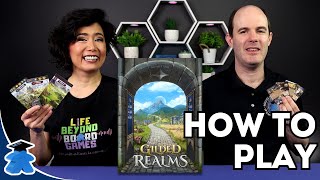
The Gilded Realms is a euro-style kingdom builder board game set in a medieval fantasy world, where players will be tasked with ruling over their young but ambitious kingdoms.
In this hybrid simultaneous turn-based game of economic management and risk assessment, you and up to three other players will command a unique Faction and compete for the title of ultimate regent.
Through careful planning of two builds a turn and management of your resources you must develop your five provinces and construct a thriving income, all the while, fending off competing kingdoms and the invading Sarrukar forces with your armies and fortifications.
Players can also earn Gold and Gems from successful caravan trading and management of their kingdom’s stance during economic events. Or they can send armies into other player’s Hinterlands to raid their Caravans and take Endeavour cards for themselves!
At the end of the 12th round of play, players earn prestigious titles based on their Victory Points, the highest earning the Serpens Champion and declared winner of The Gilded Realms!
—description from the publisher

Images


- High production quality and artwork
- Clear and easy-to-follow process
- Visually evolving cards as they upgrade
- Engaging simultaneous play
- Asymmetric factions add replayability
- Thematic integration
- Felt solitary
- Attacking other players felt less appealing due to the threat of invasions
- Caravan mechanic was difficult to resource effectively
- Kingdom building
- A realm
Mechanics (from transcript analysis)
- asymmetric factions — Each player controls a faction with unique abilities and starting quests.
- Combat — Players can attack each other or defend against invasions.
- Kingdom Building — Players build and upgrade their own kingdoms.
- Resource Management — Players manage various resources like food, bricks, gold, and gems.
- Simultaneous action selection — Many actions are performed at the same time by all players.
- Tech Tree — Players advance through a tech tree to unlock abilities and bonuses.
- Worker Placement — Workers are placed on province cards to generate income or provide bonuses.
Video topics + discussion points
Quotes (from this video)
- Yesterday, when I was young, my name is Marty.
- High school was harder.
- Well, at least they're not rutdding and all that other fun stuff and trying to hit your car cuz they do that.
- You bow before no one, you have no heart.
- So, that is a lot of different resources to track and build a deck a deck around for this game to where it feels like most of your cards are doing nothing but generating resources to take actions, which is fine, but it's just so different than so many deck building games.
- If I cannot control what cards are in my deck through purchasing or culling, I'm not as big a fan of it.
- This is basically a set collection game, you're trying to collect certain types of campers and icons together to generate victory points.
- The production in this game is absolutely amazing.
- I love games that give me a process to follow. I love my flowcharts.
- The afterlife does add a whole new twist to this game.
- The decisions you have to make of which seven cards you're going to keep for the best score.
- For a game I waited eight years on, the weight and the hype I had for it did not match the level of excitement I got out of it.
- My only hope is they have a chance to do Metroid Prime 5 because Retro Studios came out and said, 'By the way, uh, we picked up this game from another company that started Metroid Prime 4.'
References (from this video)
Mechanics (from transcript analysis)
Video topics + discussion points
Quotes (from this video)
References (from this video)
- upgrading provinces, resource management, defending lands against invasions
- medieval kingdom building
- instructional
Mechanics (from transcript analysis)
- Action Queue — cards are placed into a build queue and can be upgraded or moved into slots
- actions phase with four main actions — Expedite, Knowledge, Feed population, and Fortify; actions can be repeated as resources allow
- build queue management — cards are placed into a build queue and can be upgraded or moved into slots
- Campaigns and Invasions — attacks and defenses resolved with dice and true marks; campaigns require moving units; invasions use defense shields
- Caravan action — Caravan action allows transporting goods and advancing to the next round; vulnerable to campaigns
- combat resolution — Campaigns resolved in rank order with dice; defenders may use units to improve dice; outcomes can steal from Hinterland
- draw and build Endeavor cards — draw three Endeavor cards per round and may build up to two cards into the build queue
- end-of-round scoring — points earned from armies, gems, population, and resources; final scores determine the winner
- Expedite — spend resources to progress cards more quickly across buildings or units
- Harvest phase — end-of-round harvest provides resources based on provinces
- Hinterland management — leftover hand cards go to Hinterland; can be discarded or traded; hidden from others during event phase
- knowledge tiles — purchase knowledge tiles to upgrade provinces; there are 25 tiles across provinces with costs
- progress through queue — cards in the build queue move one step toward your territory each round
- upgrade provinces — primary mechanism for scoring; requires paying costs from cards in your territory
Video topics + discussion points
Quotes (from this video)
References (from this video)
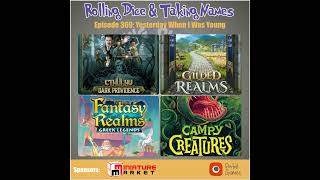
- gorgeous production and clear, thematic visuals
- strong flow of a multi-stage engine with multiple upgrade paths
- engaging tech-tree and hinterland dynamics
- rules-to-execution gap can be high for new players
- some players noted complexity in tracking all resources and phases
- medieval realm development, guilds, and technology progression
- fantasy kingdom-building with guilds and provinces
- engine-building through a tech-tree-driven realm advancement
- A Study in Emerald
- Cthulhu Dark Providence
Mechanics (from transcript analysis)
- Area Control — military provinces and fortifications involve defense mechanics and potential invasions.
- area control and combat — military provinces and fortifications involve defense mechanics and potential invasions.
- deck-building / queue management — endeavor cards move down a queue; you draft and upgrade realms via a queue-driven process.
- hinterlands and caravan economy — cards populate city spaces; caravans provide long-term income and risk from external attacks.
- Simultaneous Actions — all players act in parallel through nine 'years' with cooldowns and end-of-year events.
- simultaneous play and year structure — all players act in parallel through nine 'years' with cooldowns and end-of-year events.
- Tech Trees — players unlock technologies to gain advantages, higher capabilities, and new actions.
- tech-tree progression — players unlock technologies to gain advantages, higher capabilities, and new actions.
Video topics + discussion points
Quotes (from this video)
- There is no downtime. None.
- All this is part of the tech trees.
- I like the idea that you can't use everything on the card.
- The afterlife twist adds a lot of texture to the scoring.
- This is a quick 20 minute game at the most.
- It’s a good filler game that still rewards strategic thinking.