




Lords of Heaven Deep Dive
What the Community Thinks About Lords of Heaven
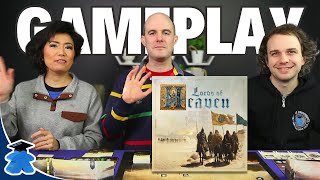
Lords of Heaven has generated consistent enthusiasm among reviewers who have experienced its prototype. The game's four-player format is universally recognized as its strongest expression. Zilla Blitz, a prominent war game reviewer, describes it as having a "shining sweet spot" in the four-player configuration, citing its ability to deliver intense diplomatic and military tension within a compact timeframe. The game successfully balances historical authenticity with engaging gameplay mechanics, drawing specific praise for how it evokes the era of the First Crusades without sacrificing accessibility. Reviewers appreciate that despite its tactical depth, Lords of Heaven moves quickly and maintains momentum throughout both crusades, making it a rare example of a war game designed for single-sitting play with a full player count.
Core Mechanics That Define Lords of Heaven
Action Drafting
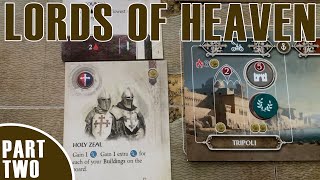
Action Drafting forms the backbone of Lords of Heaven's turn structure. Players select action cards one at a time from a shared, limited pool, with each selection typically blocking that action from other players for the round. The elegance of this system lies in its cost escalation: when a player uses a left-column action (development or presence), they must pay a cost shown at the bottom right of the card. As each successive player adds their card to the same column, costs compound, creating escalating decisions about whether to pay premium prices or pursue alternate strategies. Conversely, right-column actions (movement and income) provide rewards that increase as the round progresses, incentivizing later play. This push-and-pull creates meaningful moments on every turn where players must weigh tactical needs against resource management and predict how other factions will respond.
Influence Points
Influence Points represent a player's political control within each city on the board, distinct from military presence. Each location card contains a city track where players can place influence tokens representing their political weight. The higher a player's influence in a city, the stronger their position for control scoring. Players compete to place their influence at the highest levels within cities, and the system allows them to spend gold to increase their influence level and push opponents lower in the same column. This creates a political layer separate from military conquest: a faction can dominate militarily through battles and sieges while losing political control of territories to rivals who spend resources on influence rather than warfare. Cities are scored twice per crusade, making sustained political presence as valuable as tactical battlefield victories. The Influence Points system transforms the game from pure military conflict into a nuanced struggle for dominion across multiple dimensions of power.
The Lords of Heaven Experience
Relentless Pacing and Escalating Tension
Lords of Heaven creates an extraordinary sense of momentum. According to Zilla Blitz, the game is "literally you're like two turns into this game and it's smoldering hot." The pacing accelerates quickly, pulling players into critical decisions almost immediately. This rapid escalation occurs naturally from the game's design: as action columns fill with cards, costs rise and benefits accumulate, forcing players into increasingly difficult choices. The tension never plateaus. Reviewers repeatedly emphasize that the game maintains this accelerated pace without overstaying its welcome. A four-player game typically runs between 90 minutes and two hours once players understand the systems, despite featuring two full crusades. This represents a significant achievement in war game design, as many games with comparable strategic depth require three to four hours. The result is a game that feels tense and consequential throughout without demanding an evening-long commitment.
Historical Immersion Within Systemic Elegance
The game creates a visceral sense of historical conflict despite being a relatively streamlined design. Each of the four factions (Latin Christian Crusaders, Orthodox Christian Byzantine Empire, Shia Fatimid Caliphate, and Sunni Seljuks) begins the game with asymmetric starting positions and unit compositions, reflecting historical reality. The card artwork and thematic text reinforce the historical setting throughout play. Reviewers note that the game evokes Crusader Kings 3, the popular grand strategy computer game, but distills that experience into a playable board game format. The location cards represent real medieval cities in the Holy Land: Jerusalem, Antioch, Tripoli, Ascalon, Tyre, Edessa, and Damascus. The interplay between factions feels historically grounded without requiring players to understand medieval history deeply. The game succeeds in making players feel like they are contending for supremacy during a pivotal historical period while remaining mechanically focused on decisions rather than simulation depth.
What Makes Lords of Heaven Stand Out
Multifaceted Scoring and Strategic Flexibility
Lords of Heaven eschews the common war game trap of offering a single path to victory. Players can accumulate victory points through city control, military victories in battles and sieges, and building developments. A faction winning every battle might still lose if they neglect political influence in cities. Conversely, a player focused entirely on building and city control leaves themselves vulnerable to military rout. This multiplicity of scoring paths means that every decision carries multiple implications: spending gold on influence reduces military capacity; committing troops to battle expends resources that could upgrade fortresses or cities. Reviewers consistently praise the meaningful nature of decisions in Lords of Heaven. Every turn presents players with genuine strategic dilemmas rather than obvious optimal moves. The tightness of the design (described as possessing insufficient space to do everything players want to do, insufficient resources, and insufficient actions) ensures that compromises matter.
Diplomacy as a Core Mechanic, Not an Optional Layer
Alliances in Lords of Heaven emerge organically from the battle system rather than existing as a negotiation module bolted onto the side. When a conflict erupts, involved players can attempt to recruit nearby allies, creating moments of genuine diplomacy: "Will you join me in this battle? What do you want in return?" Reviewers highlight how this creates shifting, temporary agreements and genuine roleplay moments. Unlike games where diplomacy feels separate from mechanical victory, Lords of Heaven forces alliances to advance tactical goals. A player might ally with a religious partner (Christian or Muslim factions) or betray them for a more advantageous position. These moments create memorable stories within each game, and the frequency of conflicts means alliance opportunities arise regularly, keeping the diplomatic dimension alive throughout both crusades.
Potential Drawbacks
Two-Player Experience Requires Rebalancing
While the four-player game receives universal praise, the two-player variant presents design challenges. Zilla Blitz observes that with only two players and twenty presence markers scattered across nine locations, the board feels less constrained than in four-player games. In four-player scenarios, every space matters and scarcity creates urgency. With two players, the map opens up considerably, and the balance between military and political presence becomes less claustrophobic. Similarly, the limited citadel pool (six total) means there is always available space to build, whereas the four-player game creates genuine tension over limited building sites. Reviewers caution that while two-player play remains enjoyable, it lacks the tightness and consequentiality that define the four-player experience. This is not fatal (many games play better at certain player counts), but it means players seeking head-to-head competition should calibrate expectations accordingly.
Prototype Gaps in Rules Clarity
Multiple reviewers note that the rulebook, while generally functional, contains ambiguities and omissions. Questions arise about specific edge cases, interactions between card effects, and situational interpretations. Reviewers mention that some rules are "off in a couple places" or lack sufficient clarification for certain scenarios. However, reviewers contextualize these gaps appropriately: Lords of Heaven is currently available in prototype form through crowdfunding, and rule refinement is expected as the game moves toward final production. The core systems are clear and functional, and only specific edge cases require interpretation or house rulings. Reviewers indicate they expect the final rulebook to address these gaps, making this a concern specific to the prototype rather than a systemic design flaw.
If You Enjoy Lords of Heaven
Players who love Crusader Kings 3 and seek a board game translation of that experience should consider Lords of Heaven. The game captures similar themes of factional conflict, political intrigue, and shifting alliances across a historical map, distilled into a playable format. Those drawn to historical war games with asymmetric factions will find Lords of Heaven rewarding. The four distinct factions encourage replaying from different perspectives, much like asymmetric games such as Root. Players who appreciate the blend of area control, shifting alliances, and multiple paths to victory should also look at Kemet, whose political and military tension plays out in a similarly tight timeframe, and Inis, where temporary alliances and diplomacy are just as central to winning as any battlefield confrontation. Fans of games requiring meaningful decisions and tight resource management will appreciate Lords of Heaven's design philosophy: not enough space, resources, or actions to execute all desired strategies, forcing constant compromise. Players who value pacing and single-sitting play will find the combination of mechanical depth and playtime efficiency rare among war games. Finally, anyone seeking multiplayer negotiation and alliance-building within a system where such diplomacy directly impacts victory will discover Lords of Heaven delivers on that promise.
What Reviewers Are Saying
"Four-player Lords of Heaven this is the game's I think shining sweet spot. I absolutely love this game as four-player there are and I'll talk about some of the reasons first there's just a fantastic sense of history. I'm a big fan of Crusader Kings 3 on the PC game and this kind of brings this element of the Crusades of that part of the game to life."
— Zilla Blitz
"Sieges work pretty much the same way as battles except the area is landlocked so you can't bring in allies or your troops from adjacent areas to reinforce the battle that's going on. The Siege that's going on in the area it's just the troops that are in the area."
— Zilla Blitz
"If you perform a development or present action and the faction symbol on the played card match your faction you can also trigger the effect of that card. Some cards have split symbols of two factions which means that any of those factions can trigger the card's effect when playing it."
— ON TABLE Board Games