


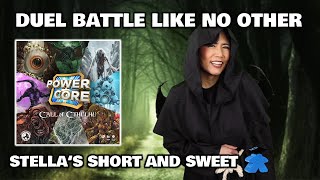

Power Core: Call of Cthulhu Deep Dive
What the Community Thinks About Power Core: Call of Cthulhu
Power Core: Call of Cthulhu is generating early enthusiasm from board game reviewers who recognize both its immediate accessibility and its deeper strategic potential. Reviewers appreciate how the game delivers Lovecraftian atmosphere paired with engaging two-player card combat that rewards both new players and those seeking tactical depth. The game's core appeal rests on a fresh take on duel systems, combining the accessibility of hand management with a novel power core mechanic that creates meaningful decision-making at every turn.
Community response emphasizes the game's elegant design philosophy: delivering simple rules that unlock complex interactions. Observers note the potential for expansion beyond its Lovecraftian origins, imagining a system robust enough to accommodate other intellectual properties and themed character pairs. The consensus suggests this is a title worth watching as it moves from prototype to retail release.
Core Mechanics That Define Power Core: Call of Cthulhu
The Power Core System
The power core system stands as the mechanical foundation that separates Power Core from traditional duel games. Players assign power cores to cards as they play them, creating combinations where the core's properties interact with the card's abilities. Each turn, power cores rotate clockwise 90 degrees, activating bonuses displayed along their edges. These bonuses range from damage and healing to shields and horror (the game's resource currency), ensuring constant engagement even during opponents' turns.
What makes this system elegant is its layered decision-making. Players must consider not only when to play a card but which of their available power cores to pair with it, knowing that rotation will eventually move the core through different benefit states. This creates a puzzle of timing and resource allocation that deepens with each round of play.
Hand Management and Resource Conversion
Power Core operates as a resource management game where horror serves as the primary currency for card play and special actions. Players balance drawing new cards against spending actions to rotate power cores for immediate benefits. The game's hand-management layer forces meaningful choices: do you draw more options, spend resources on direct damage, manipulate your power cores for future advantage, or focus on generating shields to mitigate incoming threats?
This economy creates natural tension between short-term survival and long-term positioning, preventing dominant strategies and encouraging players to adapt to the flow of each game.
The Power Core: Call of Cthulhu Experience
Fast-Paced Combat with Room for Combo Discovery
Power Core delivers games that move swiftly despite their strategic depth. The straightforward turn structure (activate start-of-turn effects, spend two actions, draw a card, resolve end-of-turn effects) keeps downtime minimal while the combo potential ensures that each hand of cards feels fresh. Players discover synergies between card abilities and power core properties, building small combo chains that create satisfying moments of engine-building within a compact game length.
Lovecraftian Atmosphere Paired with Tactile Design
The two-deity partnership structure contributes strongly to the game's flavor. Each god brings its own deck and avatar entourage, and selecting two gods creates a "deity dream team" that shapes your strategic identity in the game. The Lovecraftian theme isn't just cosmetic; it manifests in the flavor of card effects and the dark tone that permeates gameplay without requiring players to engage deeply with cosmic horror lore to enjoy themselves.
What Makes Power Core: Call of Cthulhu Stand Out
An Expandable System Built for Multiple Intellectual Properties
Reviewers and observers recognize that the power core system transcends its Lovecraftian packaging. The core mechanics are property-agnostic, capable of serving different themes and character pairs. This architectural approach allows for expansion beyond Call of Cthulhu into other licensed universes while maintaining the same strategic framework. The game essentially functions as a platform, with each new release bringing new gods, new cards, and new deck combinations without requiring rule changes.
Elegant Simplicity That Enables Depth
Power Core succeeds at a difficult design goal: creating rules simple enough for new players to grasp in a single learning game while hiding enough decision space for repeat plays to yield new discoveries. The power core rotation mechanic is straightforward to teach and understand, yet the interactions between different power core configurations and card abilities grow increasingly complex as players learn to anticipate future turns and build synergistic decks.
Potential Drawbacks
Learning Curve for Maximizing Power Core Potential
While Power Core's core loop is easy to learn, extracting maximum value from the power core system requires players to track multiple moving pieces. New players may find themselves overwhelmed by the decision space: which power core to use, whether to rotate now or save for later, how to read the trigger conditions on cards requiring specific power core symbols. Careful teaching during first play is essential for players to appreciate the strategic depth rather than merely executing turn actions.
Prototype Status and Component Considerations
Current copies exist as prototypes with components subject to change. While this reflects the game's early stage and isn't uncommon for pre-release products, it means the final retail version's visual presentation and component quality remain uncertain. Reviewers noted the deck size as modest, suggesting players who prefer larger card pools may find the initial release's scope smaller than expected.
If You Enjoy Power Core: Call of Cthulhu
Fans of Smash Up will recognize the modular character-pairing structure, though Power Core's combat is significantly more tactical. Players who appreciate Unmatched's two-player asymmetry and quick playtime will find similar appeal, particularly as future expansions introduce new god matchups. Those drawn to Lovecraftian themes will find competent flavor without requiring prior familiarity with Call of Cthulhu lore to enjoy the experience. Strategists seeking games where tight resource management and timing decisions compound across turns will appreciate the puzzle of power core rotation and horror economy.
What Reviewers Are Saying
"Power core call of cthulhu is a dual battle game where two players are battling till one player runs out of health or till one player is out of cash in their deck. The unique system is simple and straightforward but brings a new world of strategy."
— Mipple University
"Power core is a system that could easily be home for other IPs like Lord of the Rings, aliens, maybe predator or Batman. The possibilities are endless."
— Board Game Coffee
"So, power core, call it Cthulhu. Now, what I've gathered from this, I didn't get to play it yet, but I did watch some fine gentlemen play a demo of it. I watched them for about five minutes, and what I'm getting from this, especially from this logo, because this whole power core thing, this logo doesn't match anything that's happening here. My guess, this is one of those games where it's Cthulhu now, and then it might be power core Batman, power core care bears. I don't know, other than that's what I'm imagining it's going to be."
— Board Game Coffee