


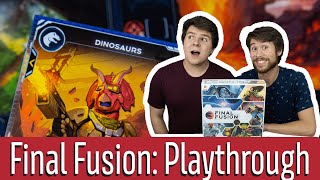

Final Fusion Deep Dive
What the Community Thinks About Final Fusion
Final Fusion is a tight, card-driven skirmish game with an engine-building core. Meeple University credits the design to Rafael Tsiviki and the publication to Gindy. Meeple University describes the game as a tactical area control game with a deck building engine, and its overview focuses on the rules structure, the combat sequence and the tracks that feed the endgame. kovray takes the opposite approach, working through a two-player playthrough and reacting to the moments that surprised them during play.
The combat sequence is central to the presentation. kovray calls the miniatures and art absolutely stunning and praises the battle reference card for laying out the battle steps and outcomes. Meeple University places the combat at the center of the game and says it should appeal to skirmish fans of all complexities. Player count changes how the board plays out: kovray's two-player game was enjoyable, but the reviewer felt the design comes alive with more people at the table, and Meeple University presents the five-player expansion as a natural extension of the base game rather than a separate experience.
Core Mechanics That Define Final Fusion
Deck Building
Each player controls two factions at once, and each faction brings its own starting cards. Those cards form a small personal deck that grows over the course of the game. Science is the currency that drives growth: Meeple University notes that players spend science to buy cards from the tech market, which is how the deck expands beyond its starting size. kovray highlights the detail that a purchased card goes directly into your hand rather than into a discard pile, so it can be played on the same turn. That change turns each purchase into an immediate tactical decision, not a long-term investment. Meeple University also ties deck building to advancement, explaining that spending science is part of how players make progress on the game's tracks.
Action Points
Each turn is structured around a fixed budget of actions. According to kovray, at the start of a turn each character receives two action points, and those points pay for abilities such as mobilizing, colonizing, initiating an extraction and space jumping. Meeple University describes the same structure from the top down, noting that a player takes two different actions with each of their two factions, for a total of four major actions per turn. Some actions have costs that matter more than others: a space jump costs two action points, so a reviewer playing kovray's game had to weigh whether moving a character across the board was worth losing the chance to take a second action. Free actions, marked with a different icon, sit alongside the budget and can be used to play cards or buy from the tech market without spending points.
The Final Fusion Experience
A Tug of War Over Void Particles
The defining feel of Final Fusion is a back-and-forth struggle over void particles. Each location begins with one, and a player can initiate an extraction to take it, but the extraction only succeeds if no opponent defeats the extracting faction in combat before the start of their next turn. kovray describes the rhythm of this clearly: a particle can be extracted, challenged, and extracted again, and the players keep trading the same objective back and forth. Meeple University frames the final fusion itself as a calculated gamble, since every void particle a player holds adds defense to the final battle, so the decision of when to attempt it is a question of how much risk to accept. The tension comes from knowing that a single successful counterattack can hand the advantage to an opponent.
Engine Momentum and Card Timing
The second feeling reviewers describe is the satisfaction of building an engine that pays off through timing. Meeple University says players advance on the colonization and domination tracks, and each step grants permanent traits and strengthens a player's chances in the endgame. kovray describes that growth in practice, drawing a trait card at a trade zone and picking a benefit such as the sedentary trait, which adds a science whenever the character performs the mobilization action. The combat itself rewards this kind of planning. Adjacent allies add military strength, black holes shift the odds of a battle, and cards played face down in a tactics phase can reverse what looked like a settled fight. Reviewers repeatedly describe moments when a single revealed card changed the outcome, which makes each turn feel like it could end differently.
What Makes Final Fusion Stand Out
Combat That Keeps Both Sides Engaged
kovray singles out the tug of war as the best part of the design. The reviewer explains that the back-and-forth battles let players keep challenging each other over the same void particle, and that the constant pressure keeps both players invested even when one of them is behind. The combat structure supports this: a battle starts automatically when a faction enters an opponent's location, the players reveal their tactics cards in sequence, and whoever has the most strength wins and forces the loser to retreat. Meeple University likewise describes the combat as a tight, tactical card-driven experience. Because combat is central, the design rewards careful reading of the battle sequence, and reviewers appear to enjoy that trade-off.
Presentation and Readable Reference Material
kovray praises two aspects of the production in particular. The first is the art and miniatures, which the reviewer calls absolutely stunning. The second is the reference card, which the reviewer describes as a clear guide that explains the player turn, the tracks, the free actions, and the battle steps on one side with the possible outcomes laid out on the other. In a game with this many interacting systems, that kind of readable layout matters because it lets players check the sequence mid-battle without stopping to hunt through the rulebook. The design is not simple, but the information is organized well enough that players can find what they need quickly.
Potential Drawbacks
Rules Friction During Combat
Combat carries a number of moving parts that trip players up early on. kovray paused the game several times to check the rulebook, including a question about whether the defending fleet receives bonuses during the final fusion. At another point, the reviewer realized that the planning cards with the brain icon should be played before the support cards with the eye icon, and had to take an action back. Those interruptions show that combat carries a learning curve that some players will feel during their first few games.
Player Count Sensitivity
The two-player game impressed kovray as fun, but the experience scales with player count: with more factions on the board, a third faction's colonies can force a choice about which side to help in a battle, pulling in interactions a two-player game never sees. Meeple University also presents the five-player expansion as the way to reach the game's full potential. Players who usually play two-player games should expect the experience to change considerably with more people at the table.
If You Enjoy Final Fusion
Players who enjoy Final Fusion's card-driven combat and deck building engine will likely enjoy skirmish games built around similar systems, where the cards in hand shape each battle and purchases pay off on the same turn. Players who like the action budget and the back-and-forth contest over a shared objective should look for area control games where each turn is a series of meaningful choices and where control of a contested location can flip more than once before the game ends. Fans of the tug of war over void particles in particular will appreciate titles where a single revealed card can reverse a settled fight.
What Reviewers Are Saying
"Combat is a significant part of Final Fusion. It is automatically initiated when you enter an opponent's location."
— Meeple University
"I feel like it would be a lot more fun with the more people and quite a lot going on not to say that I didn't enjoy this game."
— kovray
"Engine building is key to the game. In addition to building up your deck by spending science, you will make advances on two tracks: colonization every time you colonize a new location, and domination when you attack and defeat an opponent in battle."
— Meeple University