


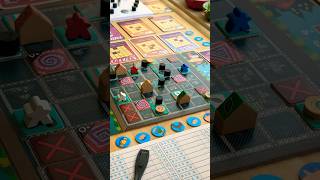

Pizza Delivery Deep Dive
What the Community Thinks About Pizza Delivery
Pizza Delivery has only two video reviews so far, and they approach the game from different angles. Meeple University, hosted by Tarek, presents it as a pick up and deliver game set in the competitive world of fast food home delivery, using a Tabletop Simulator prototype to explain the rules. Watch Review focuses on the theme instead, describing a one versus all deduction game in which one player builds a haunted town map that only they can see. Read together, the two videos describe the same game from its mechanics and its theme, and both point to the same appeal: a constant balance between efficiency and risk.
Neither reviewer delivers a verdict in the manner of a full critique. Meeple University closes by noting that the game was about to launch on Kickstarter at the time of filming, and Watch Review ends by calling the experience pretty cool after describing how the foggy town unfolds.
Core Mechanics That Define Pizza Delivery
Pick-Up and Deliver
Players are delivery staff from the best pizzeria in town, and each turn revolves around collecting pizzas from the pizzeria and carrying them to the three residential districts to fill home delivery orders. Meeple University explains that the money and tips earned from these orders decide the winner, since the player who can earn the most money in a night wins the game. Where a delivery takes place shapes its cost. City orders involve dealing with elevators and security in the skyscrapers, suburban deliveries expend more energy along long streets, and larger party orders in the park cost less time and energy but are harder to fulfill. Players can even deliver the wrong pizza to an order, which earns only half the tip, though the reviewer suggests that may be better than spending more time and energy traveling elsewhere to make the correct delivery. The game was designed by Lars Vogner Hansen and published by 2d six games, according to Meeple University.
Time Track
Turn order in Pizza Delivery is set by a time track. The player whose cube sits furthest back on the track takes the next turn, so every action advances the marker by a different amount. Meeple University points out that this creates tactical openings, because a player can take several short actions in a row to steal a pizza or an order from another player. Time cannot be recovered, and the reviewer notes that players can choose to rest during their shift, spending time to regain energy, but they can never get that time back. Time and energy are the two resources players must balance on every trip back to the pizzeria, which makes the time track more than a turn order device.
The Pizza Delivery Experience
Tense Balancing of Time and Energy
Meeple University describes the game as a running calculation. Players weigh whether to make one more trip, carry more pizzas at once, or spend time resting, and every option carries a price. The equipment purchases add another layer. Extra hot bags let a player carry more pizzas, bicycles, scooters, and mopeds each cut either time or energy costs, and all of them come with money costs. The reviewer stresses that players have to invest sensibly in equipment that pays back by enabling more deliveries. That tension between spending now and running out of time later gives the game a planning-focused feel that rewards careful accounting.
A Foggy Town of Hidden Information
Watch Review presents the game as a deduction experience that feels like exploring a foggy town. Only the game master knows the full map, while the delivery players gradually build a picture of the town on a blank canvas as they move or attack in the four cardinal directions. The reviewer describes a time limit of 20 moves in total, which keeps pressure on the delivery players to find the pizza store, pick up the pizza, deliver it to the matching customer house, and avoid the ghouls before the mayor or the game master wins. Psychic power cards add a further element of improvisation by letting players change the style of movement they make. The reviewer sums up that finding the pizza, getting it where it needs to go, and avoiding the ghouls is all part of the game's thematic allure.
What Makes Pizza Delivery Stand Out
An Asymmetric Hidden Map
Watch Review opens by calling Pizza Delivery a strange board game, and the reason is the asymmetry at its center. A single game master holds the complete map and secretly controls the ghosts, while the other players must locate the pizza store and reach the right customer using only what they have uncovered. The reviewer highlights that this structure turns every movement into a small act of discovery, since each step adds to a picture that only grows as the players explore.
Meaningful Trade-Offs in Every Route
Meeple University highlights that no single delivery plan is obviously best. A player can minimize trips by carrying more pizzas at once, reduce travel time with a bicycle, or reduce energy with a scooter or moped, but each choice has to be weighed against the money it costs. Because the player with the most money ultimately wins, the reviewer's emphasis on choosing investments that pay back gives each purchase real weight. The reviewer also notes that longer party orders are lower cost in time and energy but harder to complete, so route selection never reduces to a single correct answer.
Potential Drawbacks
Layered Bookkeeping Across Time, Energy, and Money
Meeple University describes a lot of interlocking accounting: time and energy must be balanced on every trip back to the pizzeria, equipment carries a money cost, and the player with the most money wins. The reviewer calls it a running calculation in which every option carries a price, and warns that spent time can never be recovered. For players who want a lighter touch, tracking several resources at once can feel heavy, and an early misjudgment is hard to undo.
Runtime for a Straightforward Core Concept
Meeple University calls the core concept very straightforward, with players picking up pizzas and delivering them, but notes that the gameplay is deeper than that. The overview lists a playtime of 60 to 90 minutes for two to five players. For a game whose basic loop is simple to explain, that is a substantial commitment, and groups looking for a quick night may find the length hard to justify.
If You Enjoy Pizza Delivery
Players who enjoy the hidden-map premise of Pizza Delivery, where one player secretly controls the board while the rest of the table pieces together what it looks like, will find similar satisfaction in Scotland Yard. In that classic, one player moves a fugitive on a hidden track while the detectives reconstruct the route from sparse reveals and deduce where he is heading. Fans of that kind of deduction should also try Fury of Dracula, where one player secretly moves Dracula across a map while the hunters track his trail. For the full picture, the Meeple University and Watch Review videos are the best starting points.
What Reviewers Are Saying
"The game utilizes a time track mechanism who's ever cube is furthest back on the time track takes the next turn this gives players tactical opportunities to manipulate turn order maybe taking several short actions in a row to steal a pizza or an order from another player."
— Meeple University
"The twist in this game is that only the game master knows the full map. Each player on their turn is going to either move north, south, east, or west or attack north, south, east, or west in attempt to remove ghosts from the game board."
— Watch Review
"Think of it as exploring a foggy town. There is a time limit, however, of 20 moves all together."
— Watch Review