







Catharsis Deep Dive
What the Community Thinks About Catharsis
Catharsis, the cooperative dice game from Cyber Wizard Games, has a small but devoted following among its reviewers. Quackalope is its loudest champion, calling it the best version of Dice Throne and pitching it as an excellent three, four or five player night built around a story worth talking about. That enthusiasm comes with a caveat: Quackalope has done collaborative work with Cyber Wizard Games, and some of its Catharsis gameplay videos are sponsored content. Danielle, whose unboxing copy of Divine Wrath was sent by the publisher, finds it a very neat game with a concept worth liking, while flagging readability problems. Hunger Gamers, who helped make one of the game's characters, says there is just so much to like. The shared verdict is a tense, highly variable cooperative puzzle with real accessibility rough edges.
Core Mechanics That Define Catharsis
Yahtzee-Style Dice Rolling
The engine is borrowed from Yahtzee. Quackalope describes Catharsis and Dice Throne as two games that have iterated upon the core system of Yahtzee and made it better and more gamified. As Danielle explains, players roll their dice and can reroll up to two times after the first roll, then place the results on ability cards in front of them. Each ability has a dice requirement to fulfill; Danielle's example needs two pairs and any other die. Using a power usually exhausts it, flipping it face down, and the party can spend points from a magnetic morale tracker, which starts at 21, to refresh exhausted powers.
Random Abilities That Double as Health
Every hero has a stack of ability cards, and each game the lead character draws six of them. Quackalope points out that these cards are both the actions available and the hero's health. As the party takes hits, cards are lost, so heroes grow weaker exactly when the pressure rises, which Quackalope calls one of the brilliant things in the design. Because the six cards change from game to game, the same character presents a new puzzle each time, and in cooperative play the heroes' powers combine. One of Quackalope's pairings gave a player the ability to create magic arrows that a partner could then fire, a system it describes as a giant jigsaw puzzle sorting itself out.
The Catharsis Experience
A Hard Fight Against the Boss Deck
Catharsis is difficult. Quackalope says the odds of reaching the end and winning are few and far between unless the players heavily interact and coordinate. Each boss deck card brings its own twist: in Quackalope's playthrough, a die roll decided whether a card was met at night or during the day, and at night the boss attacked first. Danielle's first solo game ended less than halfway through the boss deck, and Hunger Gamers' solo run against the Forest Elemental did not work out as planned. For families, Quackalope suggests easing the difficulty of the cards slightly.
Story and Flavorful Heroes
Story sits at the center. In Quackalope's gameplay, the backstory tells of a rune broken open, releasing a power that turned dreams into nightmares and twisted the land into corruption, with the heroes as the Bastion sent to root it out. Characters carry that flavor into their mechanics. The Angelic Baker puts things in the oven and lets them bake, dealing more damage when they come out at the cost of a delay and less protection in the meantime. Quackalope describes the game as a romantic call out to the cooperative, story-driven adventure games it adores.
What Makes Catharsis Stand Out
Variety in Every Box
Replayability is the most common praise. Quackalope's first description of the game highlights an insane amount of variability in the characters, how each one functions, and how they combine or work solo, with player counts from one to five. In a separate gameplay video, Quackalope says it has not had a game yet that felt the same. Because the abilities are drawn at random, even replaying the same box with the same hero sets up a different puzzle.
Several Ways In
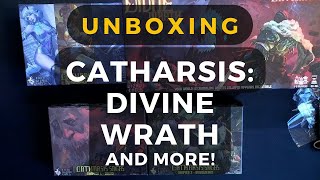
Catharsis comes in several sizes. Alongside the massive big box and a more bite-size cooperative box, Cyber Wizard Games offers the Saga boxes: standalone, single-player adventures with one hero, one boss and one story, which Quackalope notes are compatible with the big box game. Danielle's unboxing covers Divine Wrath alongside Saga chapters three and four. Danielle also appreciates how little space the game needs, suggesting the cards and tokens for a game could travel in a freezer bag.
Potential Drawbacks
Readability and Accessibility
Danielle offers the clearest criticism: some cards are hard to read, and Danielle doubts the game is fully accessible to players who have trouble seeing colors. Sleeves add glare, yet they are needed to shuffle comfortably. The unboxing video adds that the large cards have always been difficult to shuffle, while acknowledging the upside of bigger text and larger art.
Steep Odds and Sponsored Enthusiasm
The difficulty that makes wins feel earned also means frequent losses, and Quackalope is clear that success depends on close coordination around the table. Groups looking for a relaxed cooperative game may find it punishing. Buyers should also weigh that much of the most enthusiastic coverage comes from a channel with a working relationship with the publisher and a reviewer who contributed a character, so the independent evidence is thinner than the praise suggests.
If You Enjoy Catharsis
The comparison every reviewer reaches for is Dice Throne. Quackalope calls Catharsis the best version of it, and Danielle had heard the two compared before a first play. Dice Throne uses the same roll-and-assign ability system but is, in Quackalope's words, a head-to-head brutal game, so it suits players who want that engine in a competitive format. Danielle also likens the ability cards to Dione, where dice are used to pull off character abilities. And for anyone who grew up on it, Quackalope frames Catharsis as a far more gamified evolution of Yahtzee.
What Reviewers Are Saying
"This is a dice rolling kind of yatsi style game system with a insane amount of variability when it comes to the number of characters you can play the way they each function the abilities they each have the way they combine or work solo depending on how many people you're playing with scales from one to five."
— Quackalope
"Catharsis in my opinion is the best version of Dice Throne. This is a Cooperative modular game where you have various different narrative decks you're going through for a boss that you're facing off against but the most unique part is the fact that every single character has a stack of different abilities that all mix and match depending on what you've drafted out onto the table."
— Quackalope
"Very neat game I like the concept and I also like that it doesn't take up too much space so like if I wanted to try travel with this game I definitely can't bring the entire box but what I could do is take out the cards that I need to play put it in like a little folder or even a Ziploc bag and just bring this game with me with the tokens"
— Danielle, Danielle's Board Game Channel