






Subtext Deep Dive
What the Community Thinks About Subtext
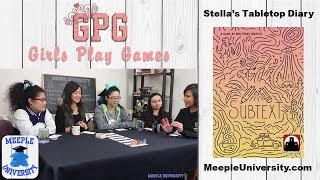
Reviewers celebrate Subtext as a standout party game that solved a problem many thought unsolvable: how to make a drawing game where artistic skill becomes irrelevant. Rather than rewarding those who can sketch, Subtext punishes clarity. The consensus across Meeple University and other board game reviewers is that this game has found something special by forcing players into an unintuitive space: the obligation to obscure, rather than illuminate. Stella from Meeple University calls it the drawing party game that had brought the most fun across an entire year of releases. For reviewers accustomed to struggling in drawing games, Subtext's inversion feels liberating.
Core Mechanics That Define Subtext
Drawing Under Obscurity
In Subtext, one player holds a leader card with a secret word. That word is shuffled into a stack of additional cards, distributed one per player. Everyone then draws their assigned word. The result is a collection of pictures representing the leader's word plus several decoys. What makes this drawing mechanic different from games like Dixit is the constraint: players must draw in such a way that their picture is obscure enough to avoid obvious interpretation, yet recognizable enough to match another player who has drawn the same thing. They do not know who that other player is, creating asymmetry in their knowledge. Reviewers note this is the mechanical heart of why Subtext works. The game does not ask for skill; it asks for the right kind of restraint.
Hidden Partnership and Word Matching
Subtext creates a hidden-partnership structure unlike traditional drawing games. Once all drawings are displayed, players attempt to match pairs. The goal for those who share a word is to find each other without being obvious. Successful pairs score if and only if no one else guesses their match. This creates a tripartite tension: players want their drawings to be recognized by their secret partner, but not by the guessers. Reviewers describe the mechanic as similar to Dixit in its reliance on lateral thinking and shared inference, but Subtext forces the obscurity intentionally through its word-matching rule, whereas Dixit merely rewards it. Players must think sideways about their assigned word, hunting for a visual angle that will trigger recognition in the mind of someone who shares that thought.
The Subtext Experience
Insight Into Other Players' Minds
Reviewers emphasize that the real pleasure of Subtext emerges not during play but in the reveal. Once matches are made and words are announced, players suddenly see how their friends think. Stella describes the joy of working out how other people's minds have gone with drawing: seeing their choices, their associations, their shortcuts. In a four or five player group especially, players get to go through everyone's words and discuss their reasoning. This creates a unique social dynamic where the game becomes a vehicle for understanding other people's approaches to lateral thinking. The game moves from competition to collective insight. One player notes that in these clue-giving and matching games, the fun is not in the guessing; it is in the understanding of where people were coming from.
Laughter and Social Bonding Through Absurdity
The forced obscurity produces moments of unintended absurdity. Because players cannot draw literally, they create shorthand, silhouettes, and metaphorical representations. These weird images generate laughter when revealed, especially when they are adjacent but not identical to another player's drawing. Reviewers note they have played Subtext three or four times with different groups, and each playthrough created its own memorable moments. The game works best when expectations are reset: the winner does not matter as much as the conversation and laughter that follows each round. Party game effectiveness here is measured not by final scores but by the shared confusion and joy when someone's obscure drawing finally connects with its intended partner, or hilariously fails to do so.
What Makes Subtext Stand Out
Forces Obscurity Rather Than Rewarding Clarity
Most drawing games reward those who can convey an idea clearly and quickly. Subtext inverts this entirely. The game explicitly demands obscurity; it punishes obviousness. Reviewers who have struggled in drawing-based games like Fake Artist Goes to New York suddenly find themselves at home, because Subtext's core rule aligns with their natural style. One reviewer notes consistently drawing obscure things and nearly being accused of being the fake artist in other games finds that Subtext says: do exactly that. Keep drawing things obliquely. Make associations, not representations. This mechanical choice fundamentally changes who can excel at the game and makes it accessible to players who might otherwise avoid drawing games.
Scalability Through Group Size and Reveals
Reviewers discover that Subtext's quality is directly tied to group composition and size. The game sprawls with large groups, but shrinks to something almost intimate with four or five players. In smaller groups, the reveal phase expands into real discussion: players defend their drawing choices, compare interpretations, and piece together how other minds approached the same word. The game becomes a conversation tool. Larger groups tend toward speed and surface-level reaction. One reviewer specifically recommends playing with four to five people and taking time to reveal and discuss everyone's words. This scalability is not a flaw but rather clarity about when the game reaches peak experience.
Potential Drawbacks
Dependent on Group Chemistry and Shared Reference Frames
Drawing games that rely on lateral thinking and association benefit from groups with overlapping knowledge and shared in-jokes. Reviewers note that Subtext works best when players know each other well. If a group's reference frames are too different, or if the lateral thinking styles diverge significantly, the game can feel flat. One reviewer plays Subtext with family members who have decades of shared TV references and inside jokes, and they play very differently than with a group of relative strangers. This is not a design flaw; it is a fact about the game's social nature. Prospective players should know that group fit matters.
Can Sprawl in Larger Groups
Reviewers acknowledge that Subtext becomes less focused when played with too many people. Large groups mean longer rounds, more drawings to parse, and less time for reveals and discussion. While the game accommodates up to eight players, reviewers suggest that the magic diminishes as the table grows. Some players may disengage during long cycles of drawing or guessing. For an ideal experience, a smaller group is better.
If You Enjoy Subtext
Reviewers who praise Subtext also recommend Dixit, noting the similar use of visual ambiguity and lateral thinking as a draw mechanic. Players who enjoy Subtext's structure of drawing obscurely will find similar satisfaction in Dixit's image-and-clue system, though Dixit works with pre-existing images rather than drawing. Fake Artist Goes to New York also appeals to Subtext fans because it forces obscure drawing and punishes clarity, though it introduces a social deduction layer that Subtext lacks. Both games reward the ability to think sideways, making them natural companions for players who discover they enjoy Subtext's inversion of drawing game expectations.
What Reviewers Are Saying
"Subtext forces you to play that way, we have a lot of fun working out how people have drawn things and where their minds have gone with drawing it."
— Meeple University
"If you get down to a group of four or five then everyone can go through what their words were as well and sort of work out how people's brains think in an obscure way, and that when it comes to a drawing game that's what's most fun for me."
— Stella, Meeple University
"The fun is not in the guessing. The fun is in the understanding where people were coming from."
— Meeple University