








Night Market Deep Dive
What the Community Thinks About Night Market
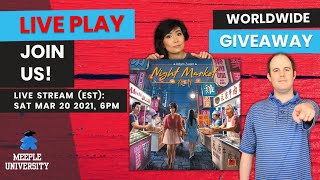
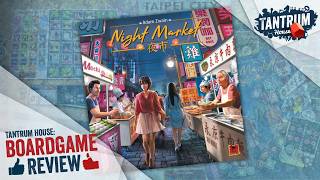
Night Market, the spatial worker placement game from Talon Strike Studios, has a small but warm following among video reviewers. The fullest evaluation comes from Jonah at Tantrum House, who calls it a midweight euro with a street food twist and recommends it as a solid game worth checking out, while warning that it takes patience to teach and a lot of table space. Meeple University played it live on stream from a Kickstarter prototype in a video sponsored by Talon Strike Studios, and in other streams the channel calls it a fun one that is quite brain burning. The New Shelves go further: Judy places Night Market at number 79 on an all-time top 100 list, a pick with sentimental weight because Judy was born and raised in Taiwan and co-host Michael lived there for 13 years. The overall picture is of a thinky, heavily themed euro that rewards careful placement, with most coverage coming from crowdfunding-era play rather than long-term retail reviews.
Core Mechanics That Define Night Market
Spatial Worker Placement
The heart of Night Market is a grid of districts where placement position matters as much as the space itself. Tantrum House explains that workers go on regular districts for free, or on lantern districts, which cost dollars once a player goes to more than one in a round. Regular districts provide the four basic foods: tofu, chicken steak, bubble tea and sausage. The twist, and the part Jonah thought really shined, is the combo system. Placing a worker one space away from another of the same player's workers, orthogonally or diagonally, earns the good on the district between them. Lining up three workers triggers a triple combo that activates every worker in the chain. Meeple University's Taran sums up the tactical upshot at the end of the playthrough: the lantern spaces are critical, and a player really has to build everything around where the lanterns are.
Permanent Chefs and Market Management
Lantern districts unlock three power actions: hiring chefs, building stalls and attracting customers. Chefs are the standout. Tantrum House describes hiring them as paying to deploy permanent workers, and Meeple University notes that chefs stay out on the board and increase the goods a player can collect there. After the day phase comes the night phase, when customers buy goods, but only from specific stall locations, so goods that are not placed where a customer shops earn nothing. Players can also prepare signature dishes, which need precise goods on color-coded stalls, and chase a sold-out bonus for emptying the market, which can upgrade stalls or advance signature tracks. Each of the four seasons brings new lantern districts and end-of-round goals, and winning those goals claims attractions such as a claw machine for stall upgrades or delivery trucks that provide free goods each season.
The Night Market Experience
A Taste of Taipei
Reviewers keep coming back to the setting. Meeple University explains that the game is set in the night market of Taipei City and that the food on the cards had the hosts hungry by the end of the stream. The New Shelves describe how the game captures the way vendors prepare ingredients, set up their stores and attract customers, and Michael says that when the pair played it, they lived it. Tantrum House finds that the art matches the theme, with cards like soup dumplings and beef noodles that simply feel right. For players with ties to Taiwan, the game carries real nostalgia; for everyone else, it offers a colorful, food-filled backdrop for a crunchy economic puzzle.
Competitive Without Being Cruel
Night Market has player interaction, but it stays friendly. Jonah says it has enough "you took my spot" going on to keep things fun without being really mean, although the last couple of rounds can get a little spicy as competition heats up. Tantrum House also notes a caveat: players who dislike any sort of take-that moment, even in small doses, may find this is not their style. Meeple University adds a thought on player count, guessing that with more people it becomes harder to get the big combos, because a larger market means more competition for space.
What Makes Night Market Stand Out
Theme Built Into the Art
Tantrum House lists the theme as the first reason to play, and the other channels echo it. The Meeple University hosts light up over stinky tofu, bubble tea and little mochi, and Tantrum House points to cards like soup dumplings and beef noodles as proof that the art and theme fit together. Even in prototype form, the Meeple University hosts found the chef pieces super cute, and Judy of The New Shelves calls the game "so fun" twice in a row. Every district, stall and customer ties back to running a food stall on a busy night.
Workers That Stay Put
The mechanic that most impressed Tantrum House is the combination of worker placement with workers who remain on the board from one round to the next. Jonah calls it "chef's kiss" and one of the coolest parts of the game. Because chefs persist across seasons, each hire changes the geometry of future combos, and early decisions keep paying off, or getting in the way, for the rest of the game. Meeple University describes the result as having everything a player wants in that sort of placement puzzle.
Potential Drawbacks
Teaching Takes Patience
Tantrum House warns that teaching Night Market takes patience and that new players might glaze over during the explanation. With combos, lantern costs, three power actions, stall placement, signature dishes, sold-out bonuses and seasonal goals, Jonah suggests this might not be the game for a first-timer. Meeple University's "brain burning" remark points the same way: this is a midweight euro that asks for real attention.
A Table Hog
Night Market also needs room. Jonah calls it a pretty good size table hog and reports needing to pull out accessories collected over the years just to hold all of the resources. Groups with a small play space should plan ahead.
If You Enjoy Night Market
Tantrum House makes the clearest recommendation: players who love Istanbul or Century: Spice Road, and that mix of efficiency and chaos, will probably dig Night Market too. Getting Games, previewing the game before release, was drawn in by its spatial worker placement and points to Little Town as the game that started that interest, while admitting no idea yet how similar the two would be.
What Reviewers Are Saying
"Second, the combination of the worker placements and the ability to have some of your workers permanently stay on the board from one round to the next. That to me is like chef's kiss. That's one of the coolest parts of the game."
— Jonah, Tantrum House
"But yeah, it has everything you want in that sort of a little placement puzzle. These lantern spaces are critical and you've got to build your lantern."
— Taran, Meeple University
"So the designer visit Taiwan many years ago and he really was very amazed by the culture, the night market culture in Taiwan, so he developed this game. Yeah, it's got the element of how the night market culture, like how they prepare their ingredients."
— Judy, The New Shelves