


Fort Sumter: The Secession Crisis 1860-61 Deep Dive
What the Community Thinks About Fort Sumter
Fort Sumter: The Secession Crisis 1860-61 comes up mainly in the Rolling Dice & Taking Names conversation about historical games for newcomers. The hosts place it among the two-player card-driven games they have been playing over the past year, and they describe it as a very simple game that both of them were drawn to because of their shared interest in the Civil War. The designer, Mark Herman, and the publisher, GMT Games, give the hosts a title that covers a moment in the American secession crisis they want to learn more about.
The hosts are candid that the game may not satisfy experienced players. They compare it directly to Twilight Struggle, describing the design as area control without battles, where players build influence in political spaces rather than fight over the map. Their view is that Fort Sumter works best as a first step, and they found the style clicked more fully only after moving on to Red Flag Over Paris, a deeper game in a similar mold.
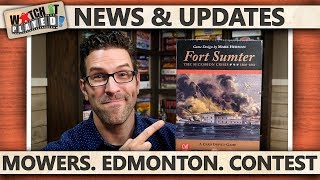
Two Watch It Played videos from Rodney Smith (one and another) take a different angle. Both are news and updates segments rather than reviews, and they mention Fort Sumter only in the context of giveaways from GMT Games. Neither video assesses how the game plays, so the impressions in this overview come almost entirely from the Rolling Dice discussion.
Core Mechanics That Define Fort Sumter
Card-Driven Play
The Rolling Dice hosts group Fort Sumter with the card-driven games that define GMT's historical catalog. Players draw from a common deck and hold a hand of cards, and those cards shape what each side can do on a given turn. The hosts treat the cards as the center of the experience, and they note that the same card play they found in Twilight Struggle and Red Flag Over Paris is what they learned to appreciate once they understood how the cards work. Because the rules are light, the hosts see the cards as the place where new players can build their understanding of a historical period without a heavy rulebook in the way.
Political Influence and Area Control
Fort Sumter does not depict battles. Instead, players compete for influence over the political and public spaces of the period, with the goal of taking control of areas and winning over public opinion. The hosts describe this as the core tension of the game, which places it closer to the influence contests of Twilight Struggle than to the troop-movement wargames that many players associate with the genre. The absence of combat is a central part of how the hosts characterize the design, and it is why they group the game with political titles rather than military ones.
The Fort Sumter Experience
A Quick Tug of War Between Two Sides
The hosts describe play as a contest in which each side pushes against the other for control of the same board. Rather than moving armies, players spend their turns trying to win the public, take hold of key areas, and eventually gain control of the government. Their description of Red Flag Over Paris, a game they consider the deeper version of this style, makes the same point: the sense of two sides competing for the same ground is what makes these short card-driven games feel charged. Fort Sumter delivers a lighter version of that pressure, and the hosts appreciate that it does so in a compact session.
Accessible Entry With Historical Hooks
The hosts treat Fort Sumter as an approachable introduction to historical gaming rather than a demanding wargame. Its light rules make it easy to teach, and its runtime is short enough to fit into an evening. At the same time, the hosts are clear that accessibility alone is not enough for a newcomer to engage with the history. They say a player needs some interest in the period to be drawn in, and the Civil War setting does that work for them. The game is easy to start, but the subject matter is what keeps the hosts coming back to it.
What Makes Fort Sumter Stand Out
A Civil War Setting That Draws Players In
The most personal praise in the Rolling Dice conversation comes from a host who is familiar with the North Carolina and South Carolina history near where they live. That familiarity is the reason they say Fort Sumter would reach the table first. The hosts suggest this kind of local connection is a powerful hook for historical games in general. Players who already care about a period are more willing to learn a new mechanic, and the theme gives them a reason to sit down with a game whose rules they might otherwise find intimidating.
A Gateway Into Card-Driven Design
The hosts see Fort Sumter as a route into a wider family of games. Their argument is that a player who enjoys a historical subject here may move on to Twilight Struggle, Watergate, and other card-driven titles, learning the card mechanic along the way. They present this as a major reason the game matters to new players. Instead of being the final destination, Fort Sumter becomes a way to discover a design style the hosts consider valuable, and they encourage newcomers to pick a period that interests them and let the game lead from there.
Potential Drawbacks
May Feel Too Simple for Experienced Gamers
The hosts acknowledge that experienced gamers may find Fort Sumter too light. They describe it as a simple design that works well as an entry point but offers less depth than the games they recommend next. Their fair assessment is that the game is good, yet Red Flag Over Paris adds new card play mechanics and more to learn, which is why that style felt complete to them there. Players who already have a lot of board game experience may want to move past Fort Sumter quickly, while newcomers may find its simplicity exactly what they need.
Theme Carries More Weight Than Design for Newcomers
The hosts suggest that a newcomer may need a reason to care about the history before picking up the game. The Rolling Dice discussion makes clear that the appeal is tied closely to the Civil War setting, and one host says they would only be drawn in because of the subject. For players who are not already interested in the period, the theme may not be enough to bring them to the table. That makes Fort Sumter a more uneven recommendation than its simple rules might suggest, since its strongest pull depends on what the player already knows and cares about.
If You Enjoy Fort Sumter
Twilight Struggle is the most natural next step. The Rolling Dice hosts compare Fort Sumter to it directly, both in card play and in influence-based area control. They say that after playing lighter games, Twilight Struggle no longer looks as intimidating, and that the card interactions and victory conditions are what make it rewarding once a player understands them.
Red Flag Over Paris, from designer Fred Serville, is the hosts' pick for a deeper version of the same style. They describe it as a similar card-driven influence game that plays in about an hour and adds new card mechanics. They also say its cards carry a lot of historical information about the Paris setting, which taught them history they did not know before.
The hosts also mention 13 Days, a trimmed version of Twilight Struggle set during the Cuban Missile Crisis, and Watergate, a two-player card game with asymmetric sides that one host taught to a non-gamer family member. Both are presented as accessible entry points that lead toward heavier historical design.
What Reviewers Are Saying
"For experienced gamers, people may feel like that's a little too simple."
— Rolling Dice & Taking Names
"Fort Sumter would hit the table only because of the Civil War and because of North Carolina, South Carolina, where we live. I'm more familiar with that history, which would drive me towards it."
— Rolling Dice & Taking Names
"These are excellent card playing games and there's a ton of them out there."
— Rolling Dice & Taking Names