





Fruit Island Deep Dive
What the Community Thinks About Fruit Island
Board game reviewers consistently describe Fruit Island as a light yet strategically engaging game that fills a unique niche in family gaming. The game comes from renowned designer Reiner Knizia, published by Analog Game Studios, and reviewers who encountered the title during its crowdfunding campaign expressed genuine enthusiasm about what Knizia achieved in this seemingly simple package. The takeaway across all channels is clear: Fruit Island is designed for families and younger players seeking their first push-your-luck experience, and it delivers that promise with surprising depth.
Dr. Brian McDonald from Brains On Games noted that the initial assumption of Fruit Island as a "kids game" proved accurate, but the game earned respect for what it does well. The Good Time Society hosts praised Knizia's signature approach: simple on the surface, elegant in execution. Meanwhile, the reviewers at Rolling Dice and Taking Names saw Fruit Island as a natural gateway into the Knizia collection for newcomers, particularly children, offering more strategic meat than traditional roll-and-move games while remaining accessible to players as young as six.
Core Mechanics That Define Fruit Island
Push Your Luck
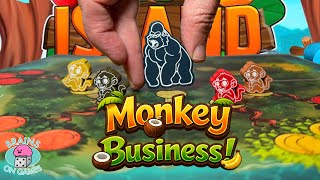
At its heart, Fruit Island is a push-your-luck game where players navigate constant tension between securing gains and risking everything. On each turn, a player draws a token from a bag. If it's a fruit token, they place it on a matching fruit tree around the island's circular board. They then move their monkey one, two, or three spaces in any direction they choose. The decision loop repeats: push forward to collect another fruit, or retreat to the trading post at the center to bank the fruit safely from the gorilla. Dr. Brian McDonald emphasized the spatial layer beneath this luck mechanic: knowing where the gorilla is positioned, how many movement tokens might remain in the bag, and whether they can afford to be caught. Each turn, the psychological weight increases as fruit piles grow in front of a player. The gorilla can be drawn at any time, forcing it to advance up to four spaces around the board and potentially landing on a monkey to steal all unbanked fruit. This is the core tension Knizia engineered: stay exposed for one more collection, or guarantee the gains already in hand?
Set Collection
The set collection layer underpins the push-your-luck experience. Trees only yield fruit when they are full, requiring players to place fruit tokens strategically on the board until a tree reaches completion. When a full tree occupies a board space where a monkey is standing, that player collects all the fruit from that tree and claims victory points. However, banked fruit is vulnerable to the gorilla. This interaction creates interesting positioning decisions: after placing fruit, should a player move toward the banana trees (which fill quickly) to grab a full tree before opponents, or race to the safety of the trading post to convert unbanked fruit into secure points? The unknown distribution of tokens in the bag adds statistical risk to every choice, which is exactly how Knizia designed it from Analog Game Studios.
The Fruit Island Experience
Family-Friendly Fun and Accessibility
Reviewers consistently highlighted Fruit Island's success in creating a welcoming entry point for young gamers. The game plays in 15 to 25 minutes and accommodates children from age six upward. The rules are straightforward enough to teach in minutes: draw, place, move, decide. The art style is approachable, featuring cute monkeys and colorful fruit, without intimidating newcomers to the hobby. The unknown channel reviewer praised the game's ability to play across all ages, hinting that the mechanics generate genuine moments of engagement whether players are six or sixty. Brains On Games noted a specific emotional regulation component: when someone's fruit gets stolen by the gorilla, the table laughs together, including the player who just lost everything. This shared humor defuses frustration and reinforces why the game works for families.
Lighthearted Tension and the Gorilla Mechanic
The gorilla disruption transforms Fruit Island from a simple collection game into something with teeth. The gorilla moves around the circular track, and its direction changes unpredictably when certain tokens are drawn. Players must constantly track its position and recalculate risk. Rolling Dice and Taking Names described this as introducing young players to probabilistic thinking: how far away is the gorilla, how many tokens remain undrawn, what is the likelihood of grabbing one more fruit before the gorilla reaches that space? The gorilla becomes a source of drama and laughter rather than frustration, making the luck element feel less like punishment and more like shared storytelling around the table.
What Makes Fruit Island Stand Out
Elegant Design from a Master
Reviewers noted that Knizia's fingerprints are visible throughout Fruit Island: mechanical simplicity that conceals strategic depth. The Good Time Society expressed what many gamers have come to expect from the designer: "whenever I see his name, I'm going to get excited about the game." The design avoids bloat. There are no special powers, no asymmetric player abilities, no exception rules. Instead, the core loop of draw-place-move-decide generates all the strategic interest the game needs. The trader-post bottleneck (only two paths lead there) creates natural tension without requiring the rulebook to spell out why positioning matters. This is hallmark Knizia.
Age-Appropriate Strategic Challenge
Unlike simple roll-and-move games such as Hi-Ho Cherry-O or Sorry, Fruit Island asks players to think ahead and manage risk. Brains On Games emphasized that while younger children might not think in terms of statistical probability, they quickly learn to recognize the pattern: more fruit in front of them equals higher danger. The game teaches that greed has consequences, that safety has value, and that timing matters. Rolling Dice and Taking Names described it as introducing complexity in a measured way, perfect for transitioning children from pure-luck games to games where decisions carry weight.
Potential Drawbacks
Limited Depth for Experienced Gamers
Multiple reviewers acknowledged that Fruit Island is not designed for hobbyists seeking mechanical innovation or puzzle-like decision complexity. Rolling Dice and Taking Names stated plainly: "For gamers, probably not so much because there's not really a lot there. It's just pulling tokens and putting them on a board." Brains On Games noted that their table of mostly adult gamers who play heavier Euro games found it fun but lightweight. The strategic space is genuinely bounded. Once players understand the pushing mechanic and the spatial positioning around the gorilla, the decisions become intuitive rather than novel.
Randomness and Swinginess
Brains On Games raised a fair concern: Fruit Island contains significant randomness. What tokens emerge from the bag is not controlled by players, and an unlucky sequence can wipe out a player's gains instantly. This swinginess can frustrate some players, particularly those who prefer games where skill determines outcome. However, the reviewers contextualized this: push-your-luck games require randomness to function, and Fruit Island includes that randomness by design. The question each player faces is whether they have accepted their current score as safe or are willing to risk it for more.
If You Enjoy Fruit Island
Fruit Island shares DNA with classics like Sorry! and Hi-Ho Cherry-O. Players who loved Hi-Ho Cherry-O as children will recognize the collecting and safe-space mechanics here, but Fruit Island adds the push-your-luck element and genuine player interaction through positioning. Those who find Sorry! too simplistic might appreciate Fruit Island's spatial layer and the choices it generates. For families looking to graduate from pure-luck games to ones where children can practice risk management and forward planning, Fruit Island serves as a natural gateway. Brains On Games suggested pairing it with games that introduce light strategy and tactical thinking, creating a collection that grows with younger players as they develop gaming skills.
What Reviewers Are Saying
"I wish I would have had a game like this when my kids were little. It's so much better than a game like Sorry, for example, because there are some limited strategic decisions. The rules are simple and the turns go quickly. There's a bit of strategy. There's some player interaction in terms of positioning your monkeys and where you're going to put that fruit."
Dr. Brian McDonald, Brains On Games
"As you start to collect more and more fruit, it becomes very risky until you get to that trading post to start turning it face down. There are only two pathways into the trading post and that does make it quite tempting to continue to push your luck to keep moving around the circle and just hoping that you're going to be able to avoid that gorilla."
Dr. Brian McDonald, Brains On Games
"It's really that simple. And I'm serious. It's like my first Canitier game. This is what this would be for your six to sevenyear-old. It is extremely straightforward that where if you have kids, the art is cute. It's really easy to understand and this is this will be a good game for them."
Marty, Rolling Dice and Taking Names