









Rattlesnake Deep Dive
What the Community Thinks About Rattlesnake
Rattlesnake occupies a unique space in the board game landscape that reviewers consistently celebrate. This is a game that succeeds by doing one thing exceptionally well, and the community recognizes that focused design. Most reviewers place it squarely in the "excellent small package" category. Dice Tower's Chris described it as "an excellent, excellent small form factor card dueling game that does not feel like anything else I've played," while also noting that despite its simplicity and quick 15-minute playtime, the game creates surprising strategic depth. The Discriminating Gamer praised it as "super simple to play, super simple to learn, super simple to teach. And it's just a lot of fun." Across reviews, there is broad agreement that Rattlesnake delivers tension and engagement that feels disproportionate to its component count and rules weight. Where opinions diverge slightly, it tends to be on whether the chaos inherent in a quick card game feels like dynamic fun or overwhelming randomness. But even reviewers who acknowledged the chaotic elements found the game's brevity made that chaos manageable and enjoyable.
Core Mechanics That Define Rattlesnake
Hand Management
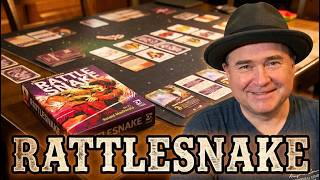
Rattlesnake presents hand management as its core tension point. Designed by Michael Hardacker and published by Osprey Games, the game gives each player an identical starting deck of 10 cards numbered one through five, and your hand size is refreshed to five cards each turn. The real pressure emerges because every card serves multiple purposes. You can play cards as part of your combo attack, you can discard cards to buy new ones from the saloon, or you can burn them to activate their special abilities. The Dice Tower review team noted that "hand management is built into the game," emphasizing how this triple-use system creates meaningful decisions. You must constantly weigh whether to spend cards now for an immediate advantage or preserve them for future turns. As you progress through a game, your hand becomes increasingly valuable precisely because cards leave the game when you use their abilities, shrinking your deck. This creates a natural rhythm where early-game flexibility gives way to late-game scarcity, forcing you to choose your moments wisely.
Deck Building
Deck building in Rattlesnake operates within strict constraints, which is exactly where its elegance shines. Rather than assembling a sprawling deck from hundreds of options, you build from a shared saloon of five available cards at any time. To buy a card, you simply discard two cards from your hand and take one from the saloon. The genius lies in event cards: when you purchase a saloon card, a new one is revealed from the deck, and if that new card is an event, it stays in play for the entire game, permanently reshaping the conditions you both play under. One event might force an extra hit on a successful attack; another might give you an extra card draw per turn. These events change the game on a dime, ensuring no two games follow the same path. Reviewers appreciated how deck building felt meaningful without requiring extensive solitaire setup time. The Discriminating Gamer specifically highlighted this: "I really like to the saloons and how those events come out that just kind of change the game on a dime." By limiting your options and layering events, Osprey Games created a deck-building experience that feels weighty in decision-making but light in overhead.
The Rattlesnake Experience
Tension Beneath the Surface
Despite its brevity and simple rules, Rattlesnake generates real tension. This tension emerges from the gap between what you can see and what you cannot. When your opponent plays cards for an attack, you see their face-down combo before revealing your own defense. You must decide whether to waste cards defending against what might be a bluff, or let an attack through and take a hit. The Discriminating Gamer captured this perfectly: "It is tense when you're trying to figure out if you got those cards and then you play for the abilities to try to enhance what you're trying to do. It really gets intense here for such a quick, simple game." Reviewers consistently noted that the tension persists despite knowing all 65 cards in the deck. The system is tight enough that every decision carries weight, and the swiftness of play means you cannot overthink. That back-and-forth, where one player commits to an attack and the other responds, creates a miniature drama repeated until someone loses all their hit cards.
The Western Duel Energy
Rattlesnake captures the spirit of a Wild West shootout through mechanics, not just theme. The revolver token passes between players each turn, indicating who is the attacker. The art by Roland McDonald reinforces this with evocative imagery. Reviewers found the thematic connection genuine and energizing. One reviewer observed that "the wildness theme does come through because of the tax on some of the cards," meaning the disruptive card effects reinforce the chaotic, unpredictable feeling of a gun duel. Another noted that you could almost "play this on a plane" due to its portability, making it perfect for unexpected moments when you and an opponent have a few spare minutes. The game's brevity serves its theme: a shootout is supposed to be fast and decisive, not a protracted standoff. Rattlesnake nails that pacing.
What Makes Rattlesnake Stand Out
Clever Card Abilities That Stay on the Table
Each card in Rattlesnake has a special ability printed on it. But here is the twist: if you want to use that ability, you burn the card out of the game permanently. You do not discard it to a pile you can reshuffle; it is gone. This creates a fascinating dynamic where you are constantly adding cards to your deck while simultaneously removing cards from it. One player explained that early in a game, you think "well, I don't want to get rid of these cuz I want to lose the cards," but after a while, you realize "I need to play as many of these as I can" to control the game state. Then eventually you circle back and think "wait, I'm playing too many, I'm losing the cards I need." The interplay between growing your deck and strategically eliminating cards becomes the emotional core of every game. Reviewers found this simple but brilliant rule created depth without complexity: you can explain it in seconds, yet it generates the tension of meaningful sacrifice.
Elegant Design That Respects Your Opponent
Rattlesnake commits to a philosophy that reviewers appreciated: never mess with your opponent's hand directly. You do not force them to discard, you do not steal cards from them, you do not manipulate their hand in hidden ways. Instead, the card abilities interact only with cards played on the table: the attack and defense stacks. Dice Tower's Chris Ye highlighted this: "You never mess with the hand of your opponent. You never take cards from them or force them to discard or anything like that. If you're discarding cards, it's because you're playing a card that says, 'I discard my hand, draw three,' hoping to get some better cards or some better special effects. So it you mess with each other, but only what's on the table." This design choice means the game creates conflict without creating the bad feelings that come from hand destruction in other games. You are always playing on the table, solving the puzzle of the current attack-and-defense exchange, never suffering surprise hand disruption that leaves you feeling robbed. It is respectful game design that still delivers cutthroat dueling.
Potential Drawbacks
Limited Depth for Strategic Architects
Rattlesnake is quick and snappy by design, but that same quality means it will not appeal to players seeking deep, multi-turn strategy. One reviewer observed that "if you're wanting deep strategy, this probably isn't for you." The 65-card deck is small enough that after a few plays, you know every card and every ability. The decisions you face are real but narrow: play this card for offense or defense, buy this card or that one from the saloon, burn this ability now or preserve cards for later. There is little room to build elaborate engines or plan five turns ahead. Players who live for optimization and analysis may find Rattlesnake too streamlined, almost like a puzzle that can be solved. For those players, the game risks feeling like a solved problem rather than an endlessly deep challenge.
Two Players Only, and Pace Depends on Draw Luck
Rattlesnake is strictly two-player, which immediately narrows its utility at larger game tables. Additionally, while reviewers praised the game's speed, the pacing can feel at the mercy of random card draws more than you might like. One reviewer noted the game can feel "too chaotic" at times, though they also noted that the 10-15 minute runtime makes that chaos manageable. Card draw determines what abilities you have access to and which events shape the game state. If luck falls one way, a game might feel lopsided. Reviewers who preferred more control over outcomes gave the game a 7/10 rather than an 8.5/10, a meaningful gap. If you play with the same opponent repeatedly, you may notice patterns emerge that make the result feel somewhat predictable once you understand the meta.
If You Enjoy Rattlesnake
Players who love Rattlesnake will find satisfaction in other focused two-player card dueling games. While reviewers did not mention specific comparable titles in the Rattlesnake discussions, the praise for its tight, elegant design suggests fans might explore other small-box card games from designers known for economy of mechanics. Look for games that prize speed and player interaction over component count. If you enjoy the specific tension of a bluffing and combo-building duel, seek out other games that respect hand management as a core decision point while avoiding direct hand destruction. You likely value portable games that deliver outsized play value relative to their footprint. Rattlesnake's western theme and duel structure may appeal to you, but the core draw is the mechanical tightness: a game that knows exactly what it is and executes that vision flawlessly.
What Reviewers Are Saying
"It is tense when you're trying to figure out if you got those cards and then you play for the abilities to try to enhance what you're trying to do. It really gets intense here for such a quick, simple game."
— The Discriminating Gamer
"This game does a lot of things absolutely right. You never mess with the hand of your opponent. You never take cards from them or force them to discard or anything like that. It does not ever lead to those like bad feeling moments where like I have the perfect hand of cards and the person goes discard your hand."
— The Dice Tower
"I think this is an excellent, excellent small form factor card dueling game that does not feel like anything else I've played. And I'm extremely pleasantly surprised with this one."
— The Dice Tower