




Junk Art Revolution Deep Dive
What the Community Thinks About Junk Art Revolution
Reviewers across multiple channels share a consensus about Junk Art Revolution: this revised edition of the classic Junk Art is a visually beautiful, accessible dexterity game that delivers genuine social fun. The Discriminating Gamer notes that despite not being a traditional dexterity fan, the component quality and artwork won them over immediately. Z Garcia from The Dice Tower gives it an 8 out of 10, calling it "a winner" and highlighting its appeal to anyone looking for a party game or family experience. Grant Lyon acknowledges the re-implementation faithfully brings back the original mechanics while refining the presentation and rules. What emerges is broad enthusiasm tempered by a clear-eyed acknowledgment that this is fundamentally a stacking game, which means you need to be comfortable with pieces tumbling and the chaos that follows.
Core Mechanics That Define Junk Art Revolution
Stacking and Balancing
At its heart, Junk Art Revolution is a dexterity game built around physically stacking wooden pieces without toppling the growing structure. Players draw cards that specify which shaped wooden piece they must place, then carefully position it on the shared tower. The game features an unusually diverse set of components, including blocks, triangles, balls, dumbbells, and other sculptural forms, all crafted from wood. The variety means each piece has different weight distribution and balance points. Grant Lyon emphasizes how this creates memorable moments: "it comes with those fun moments where the whole stack falls down and everybody's like no I was so close," and Grant Lyon notes these moments are actually what they love about dexterity games. If pieces slip or if the entire structure collapses, players face penalties or elimination, creating escalating tension as the tower grows taller and more precarious.
City-Based Round Variations
The revised edition organizes play around three different cities, each introducing distinct rule sets and scoring mechanics that dramatically shift how each round plays out. Z Garcia explains that the game feels like "three very different acts," with each city serving as an episodic round that maintains novelty and variety. In London, players use a turn-based drafting system where you pass card choices to your neighbor. Monaco shifts to timed play, where players must rapidly reveal cards from their deck and stack pieces as quickly as possible, earning points for speed. Beyond these two mechanics, scoring cards introduce mid-round objectives, such as earning points when you place a piece lower on the structure than an existing piece, or when you stack pieces of the same color together. These rotating rulesets ensure that even players familiar with the core stacking mechanic experience fresh challenges across the game's three-round arc.
The Junk Art Revolution Experience
Visual Beauty and Tactile Appeal
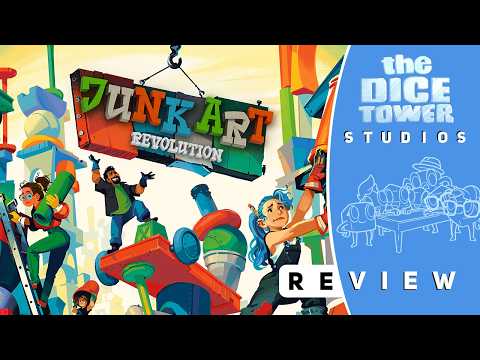
Reviewers repeatedly highlight how Junk Art Revolution looks and feels on the table. The wooden components are described as vibrant, beautifully finished, and intentionally designed so that pieces interlock and slide into each other, gradually forming sculptural artwork as the game progresses. Z Garcia notes that "many of the pieces are conceptualized so that they stack or can kind of slide into each other and start making cool looking artwork," which ties directly to the game's theme of traveling artists showcasing their creations around the world. The production quality extends to the box and rulebooks. The Discriminating Gamer praised the cover artwork as "phenomenal," and multiple reviewers note that this new edition compresses the footprint compared to the original while maintaining quality components. The cumulative effect transforms what could be a simple stacking game into something visually presentable and admirable, making the tower feel like genuine art rather than just a precarious tower of wood.
Social Fun and Shared Tension
The game creates a particular rhythm of social engagement: players take turns or race against the clock, with every other player watching intently, ready to react when pieces fall. Z Garcia describes the overall appeal as a way to "give you a lot of laughs, a lot of fun. A great way to come together with friends and family." The unpredictability of wooden pieces and the physics of stacking mean that no two towers behave identically, leading to surprising collapses that generate genuine surprise and humor. When someone's tower falls just before they would have won, the collective reaction is almost certain to be laughter rather than frustration. The episodic three-act structure, where each city plays differently, prevents any single round from wearing out its welcome and keeps players engaged in both play and observation.
What Makes Junk Art Revolution Stand Out
Component Diversity and Artistic Presentation
Unlike stacking games that rely on uniform blocks, Junk Art Revolution features a rich variety of wooden shapes: blocks, spheres, triangles, dumbbells, and stylized pieces designed to interact in interesting ways. This diversity isn't merely decorative; it meaningfully affects gameplay because different shapes have different balance points and visual footprints. The Discriminating Gamer was struck by the quality and variety: "we're just going to drop those right into there...these are all just gonna...All these components...all these big chunky wooden blocks...Really cool looking stuff in here." Z Garcia emphasizes that "the colors are vibrant and beautiful. Everything, you know, can kind of sort of work together in interesting ways." The result is a game that looks impressive from the moment you open the box and continues to look good as structures grow, creating something worthy of display and photography between rounds.
Accessible Yet Variable Gameplay
The revised edition balances simplicity with depth. The core mechanic (draw a card, place the corresponding piece) is immediately understandable, even to first-time board gamers. Z Garcia notes that "the entire thing is quite approachable. It's very family-friendly both thematically and what's going on in it, but also just the rules. There's not that many weird concepts." Yet the three-city structure and scoring card variations ensure that the game doesn't feel repetitive across a full play session. Each city introduces new rules and challenges, so players are constantly adapting rather than repeating the same action three times. The scoring system is straightforward but flexible, with cards introducing goals like placing pieces in specific color combinations or stacking order positions. This combination of accessibility and variable rules keeps both casual and experienced players engaged without bogging down the experience in complexity.
Potential Drawbacks
The Stacking Mechanic as a Barrier
Junk Art Revolution is fundamentally a dexterity game, and this isn't for everyone. Grant Lyon directly addresses this: "you got to be okay with stacking things," which means that players who dislike games of physical skill or coordination won't find this appealing. The outcome of any given turn hinges partly on luck (whether the wooden pieces cooperate with the laws of physics) and partly on individual fine-motor control, so some players may feel frustrated by factors beyond strategic decision-making. Additionally, the physical nature of the game means it's sensitive to table surface, play area vibration, and environmental factors, which can be less predictable than traditional board game mechanics.
Tower Collapses as Exclusion
While reviewers celebrate the chaos of a falling tower as part of the fun, a complete collapse can feel harsh on the player responsible. If your tower fails, you're eliminated from that round, and spectating while others complete their turns may feel less engaging than active play. The speed variant in Monaco particularly amplifies this dynamic, as faster players who make fewer mistakes gain significant scoring advantages. For some groups, this elimination mechanic (even though temporary, lasting only until the round ends) can create moments where eliminated players feel sidelined rather than entertained by the community experience.
If You Enjoy Junk Art Revolution
Junk Art Revolution occupies a unique space in the board game market. Z Garcia explicitly compares it favorably to Jenga, noting that if you enjoy Jenga and dexterity games broadly, this is an excellent choice because of its superior production, varied components, and multi-round structure. However, Junk Art Revolution iterates meaningfully on Jenga's formula. Where Jenga relies on removing blocks from a tower, Junk Art Revolution adds to the tower, creating fundamentally different spatial puzzles and gameplay rhythms. For players who own the original Junk Art, this revised edition offers updated rules and refined components, though the core experience remains recognizable. The episodic three-city structure is closer to a campaign-style game than Jenga's single-round experience, making it feel more substantial for an evening's play. If your group gravitates toward party games, games with high visual production value, or games that generate memorable shared moments, Junk Art Revolution is a strong recommendation.
What Reviewers Are Saying
"If you like the idea of dexterity games, you like Jenga, you like games of that nature, I think you're going to have a lot of fun with this one because it is visually very attractive. The collection of wooden pieces here are really neat and fun."
— Z Garcia, The Dice Tower
"So you got to be okay with stacking things, and then obviously it comes with those fun moments where the whole stack falls down and everybody's like, no, I was so close, and I love those moments about dexterity games."
— Grant Lyon
"The toy factor in this game alone is what makes it look really good to me."
— The Discriminating Gamer