



Cosmic Run: Mission One Deep Dive
What the Community Thinks About Cosmic Run: Mission One
Cosmic Run: Mission One inspires broad enthusiasm among reviewers, though their experiences diverge sharply based on dice luck. Rahdo Runs Through considers it a compelling solo experience, calling it "fun, fun, fun" and praising its design as "sharp," a descriptor returned to repeatedly across sessions. Tabletop Tokki approaches it with anticipation, noting excitement about the mechanical twist of dice-interaction systems. DaniCha appreciates both its accessibility and portability, valuing it as a travel-ready game that rewards tactical decision-making. Totally Tabled's playthrough reveals the darker side of the experience: a series of devastating rolls that highlight how vulnerability to the dice can reshape a session from enjoyable to demoralizing. The consensus among designers and mechanics-focused reviewers is strong: the game works by design. The consensus among unlucky players is more qualified.
Core Mechanics That Define Cosmic Run: Mission One
The Racing Decision Loop
At Cosmic Run: Mission One's heart lies a deceptively simple racing mechanism that generates profound tension. Each turn, the player rolls four dice and must allocate them across planets (seeking specific combinations: singles, pairs, triples, or quads) and six ally cards, each numbered 1–6. Any die not actively claimed by the player is immediately applied to the alien threat advancing toward each planet. This forced choice creates the game's central sting: sometimes you must lock in a die you don't want simply because leaving it available would hand the alien an unacceptable step forward. Rahdo describes this dynamic precisely: "You might take a die you don't want because you can't let the aliens take another step forward and leaving that die that you don't want could lead you to lose." Victory depends on reaching certain checkpoints on all four planets before the alien does. The planets operate as a ratcheting challenge: the first planet requires only singles, 1-2-3; the second demands pairs; the third, triples; the fourth, four of a kind. The alien progresses even when its die roll matches nothing, forcing the player to advance it manually. This means all four planets must receive at least one committed die before game end, or an instant loss occurs.
Dice Manipulation and Resource Management
The ally system provides the game's richest layer of agency. Six advisors (indexed 1 through 6) grant reusable special abilities, each deployable up to three times during a game. These abilities reshape dice-rolling outcomes: adjust a die by plus or minus one (with no wrap from 6 to 1), reroll one to two dice, move a previously placed die to a different location, flip a die to its opposite face, or turn any die to any desired value. DaniCha notes this is why the game resonates: "There's a bunch of dice mitigation. So, when it comes to dice games for me, um, I prefer games that can modify dice values versus just taking at face value when you roll it. And so, this game has all of that involved." These powers create moments of tactical redemption, allowing players to rescue a disastrous roll or to sacrifice an activated ability knowing its cost (an unused ability is worth bonus points at game end: six points if three remain unspent, one point per remaining charge). The decision of when to burn an ally ability versus preserving it for a more desperate moment becomes the emotional crux of longer playthroughs.
The Cosmic Run: Mission One Experience
A Perfect Travel Companion
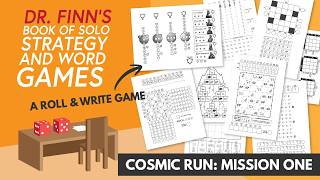
Reviewers universally praise the game's portability and low setup friction. The entire game exists on a single sheet of paper; gameplay demands only pencil and dice (or a digital dice roller via QR code). DaniCha identifies its precise use case: a game to bring "on vacations on quick work trips or even to do if I'm waiting on an appointment because you basically have a bunch of games that you can play with a minimal effort to set up because it's all in this book." The fifteen-minute playtime slots into a work break or plane-seat interlude. Totally Tabled anchors this sentiment most memorably: "This is really the perfect travel companion for, you know, a plane or a train ride, really any form of transportation. Even a zeppelin, you're ready to go." For solo gamers and puzzle enthusiasts, the low-overhead design invites frequent replays and casual engagement.
The Tense Push-Your-Luck Rhythm
The gameplay pacing creates palpable tension through forced choice. Each turn compresses decision-making into seconds: which die to claim, which to surrender, which ally to burn if any. Rahdo's framing captures why reviewers return to words like "sharp": there are no filler turns or foregone conclusions. Every single die matters because every die not claimed by the player actively helps your opponent. The racing mechanic introduces a countdown timer: the alien rolls one die per turn and progresses whether it matches a planet's requirement or not, forcing the player to occasionally advance the alien manually. This asymmetry between the player's deliberate, multi-turn advancement toward each planet and the alien's relentless forward march creates psychological pressure. A player might have just reached a checkpoint on two planets only to see the alien close dangerously near a third, forcing a pivot in strategy or a burn of scarce resources.
What Makes Cosmic Run: Mission One Stand Out
True Solo Design With Genuine Stakes
Unlike most games in the Dr. Finn collection that can be played competitively or solo (where all players access the same rolled dice and compete on score), Cosmic Run: Mission One is the only game in the book designed exclusively for solo play. Rahdo confirms this: "It's the only true solo of the bunch." The reason is mechanical: because allies allow dice manipulation, a multiplayer variant would break the fairness premise: different players would be able to alter shared dice differently. The solo-only constraint becomes a feature, not a limitation, because it creates a pure adversarial relationship between player and alien. Every decision is personal and consequential. There is no shared economy of luck; your poor roll is purely your problem to solve, and your clever mitigation is purely your victory.
Rich Dice Interaction Without Overstay
The ally abilities system delivers tactical depth while respecting the game's lightweight footprint. Rather than a complex deck-building or resource engine, the six allies are fixed and their abilities are straightforward (adjust, move, reroll, flip, transform). Yet because they recharge three times and interact with every roll outcome, the decision tree around their deployment remains engaging across multiple playthroughs. Tabletop Tokki highlights this appeal: it "uses similar elements to Cosmic Run Rapid Fire but in an all new way. And it looks like each die can help you adjust other dice as well. Very cool." This mechanical refinement, allowing dice to interact with each other rather than only being placed on fixed slots, creates emergent moments where a single reroll can cascade into a winning sequence or a cascade of failures.
Potential Drawbacks
Severe Vulnerability to Dice Luck
The game offers rich tactical knobs, but it cannot insulate players from bad variance. Totally Tabled's playthrough crystallizes this risk: a sequence of rolls so catastrophically unlucky that the reviewer explicitly names the experience "cursed." Sixes roll repeatedly when sixes would advance the alien. Needed numbers fail to appear even after ability spending. A player reaching an advanced checkpoint on three planets might roll six consecutive turns without a single die that helps the fourth planet, slowly burning through allies while the alien creeps inexorably closer. The dice mitigation systems offer agency, but they are finite (three uses each for six allies), and a sustained streak of poor rolls can exhaust those resources without generating progress. While this variance is the price of the game's elegant, pencil-and-paper design, it means that replayability depends partly on player temperament. Some will find the tension exhilarating; others will find it frustrating.
Solo-Only Play and a Tight Ruleset
The decision to lock Cosmic Run: Mission One into solo-only play restricts its table flexibility. Groups cannot easily gather around a single sheet and compete. Additionally, the rules, while clearly written, require careful reading to avoid missteps, especially around which abilities apply to which dice (only player-rolled dice can be modified; the alien's die cannot be altered), when progress advances, and when a failure cascades into an instant loss. Reviewers note the rules are comprehensive and well-organized, but they reward close attention. A misunderstanding of when a planet becomes unrecoverable (if the alien reaches it before the player reaches the first checkpoint) can pivot an entire session.
If You Enjoy Cosmic Run: Mission One
Players drawn to Cosmic Run: Mission One often gravitate toward other titles in the Cosmic Run family. Tabletop Tokki explicitly recommends Cosmic Run: Rapid Fire, calling it "excellent" and a "high recommendation" despite not having played the original Cosmic Run. Rapid Fire adds simultaneous two-player rolling and speed elements, offering a contrasting take on the same universe. Cosmic Run, the 2015 base game referenced by reviewers as the foundation for Mission One, expands the racing mechanic into a full board game with additional players and longer play sessions. Cosmic Run: Regeneration offers yet another variant approach to the racing-and-mitigation formula. For those seeking similar lightweight solo experiences with high decision density, the broader Dr. Finn collection (eight games on eight pages, all within the same book) provides a parallel entry point. All eight games in the collection share the accessibility and replayability that make Mission One appealing, though only Mission One captures the asymmetric race-against-the-alien tension.
What Reviewers Are Saying
"You might take a die you don't want because you can't let the aliens take another step forward and leaving that die that you don't want could lead you to lose. It's a sharp game."
— Rahdo Runs Through
"This is really the perfect travel companion for, you know, a plane or a train ride, really any form of transportation. Even a zeppelin, you're ready to go."
— Totally Tabled
"Something that I would bring on vacations on quick work trips or even to do if I'm waiting on an appointment because you basically have a bunch of games that you can play with a minimal effort to set up because it's all in this book."
— DaniCha