






5-Minute One Piece Deep Dive
What the Community Thinks About 5-Minute One Piece
5-Minute One Piece arrives as a reliable entry in the frenetic real-time cooperative space, drawing direct comparisons to Five Minute Dungeon while establishing itself through sharply asymmetric character design. Reviewers embrace it as an accessible gateway game that delivers genuine fun, though their enthusiasm is tempered by a clear understanding of what the game does and does not deliver. The consensus centers on two truths: it excels with three or more players in a chaotic, high-energy setting, and it struggles when played solo or with just two people.
One significant point of disagreement concerns character balance. Mike from OneStop Co-op Shop praised Zoro as a standout character whose attack card lets players turn any matched symbol into a wild, attacking without having to dig as deep into the deck. Usopp emerges as the consensus weak link, though reviewers acknowledge this may align with the character's reduced role in parts of the source material. What stands out across reviews is that no one dismisses 5-Minute One Piece outright; instead, reviewers view it as exactly what it is meant to be: a quick, thematic cooperative romp for families and casual players.
Core Mechanics That Define 5-Minute One Piece
Hand Management
Players navigate 5-Minute One Piece through careful hand management, holding cards and deciding precisely when to deploy them. Each card in a player's unique deck carries symbols that match challenges printed on cards laid out on the Going Merry, the Straw Hat crew's ship. The core loop requires matching a specific sequence of symbols across several spaces to advance. Timing and sequencing matter more than raw luck, rewarding players who think one or two turns ahead even under the pressure of a ticking timer. Mike from OneStop Co-op Shop highlighted how this mechanic allows players to avoid digging as deep into their deck, maximizing efficiency and creating moments of genuine tactical satisfaction.
Cooperative Game
5-Minute One Piece stands entirely in the cooperative moment, with no turns and no player elimination, only the collective race against the clock. As soon as the timer begins, the game becomes what one reviewer described as "a big frenzy of cards" where everyone acts simultaneously, free to play whenever they can. This absence of turn order structure means the social experience shifts dramatically based on player count. With three or more players, the chaos intensifies; each player focuses on their own character and their own hand, which paradoxically makes the experience smoother and more fun. The immediate tension comes not from outplaying opponents but from coordinating efforts, using character powers strategically, and managing collective card resources on the ship before time expires.
The 5-Minute One Piece Experience
Chaotic Team Energy
The defining feeling of 5-Minute One Piece is controlled chaos. Mike's playthrough captured the frenetic reality: players calling out card plays, forgetting to use special abilities, making split-second decisions, and occasionally acting without perfect coordination. This is not a game of elegant strategy; it is a game of communication under pressure and players calling things out to each other. That chaos strengthens the experience at the table, especially when players embrace the real-time pressure and trust the game's asymmetry to keep everyone engaged. In solo or two-player modes, however, that same frenzy becomes exhausting rather than exhilarating, as one player struggles to mentally manage multiple characters and all the moving pieces at once.
Accessible by Design
5-Minute One Piece functions as a gateway game that teaches quickly and plays cleanly. The symbol-matching core is intuitive enough that new players grasp it immediately, while character abilities introduce asymmetry without overwhelming. Players can jump in, understand the goal of defeating the boss before time runs out, and feel productive within a turn or two. This accessibility extends to teaching: experienced players can introduce the symbol-matching rules first, then layer in character powers once players feel confident. It is precisely this ease of entry that makes 5-Minute One Piece appealing to families and casual groups, even if experienced strategists find the decision space limited.
What Makes 5-Minute One Piece Stand Out
Sharply Asymmetric Character Design
Each playable character brings a fundamentally different toolkit. Luffy flips challenge cards to access different symbol requirements, Zoro can turn matched symbols into wilds, Nami manipulates the board state, and Sanji recycles piles from the ship back into players' hands. This is not flavor text bolted onto a generic character; these abilities force players to pilot each character distinctly. As Mike noted, the characters feel very different and carry special abilities that force players to use their cards differently. The asymmetry ensures that a player familiar with Zoro cannot simply swap in as Nami and play identically; the character choice reshapes how that player engages with the game's systems.
The Netflix One Piece License
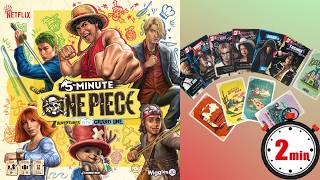
5-Minute One Piece commits fully to the Netflix adaptation aesthetic. The characters are rendered in a style based on the live-action show, and thematic encounters ground the game in the source material. Mike observed that having that kind of art style is not everyone's bag, and this directness about the art style is important: fans of the manga or anime might find the Netflix interpretation off-putting, but fans of the live-action show will find the visual identity consistent and appealing. The license also enables specific thematic touches that pure abstraction cannot deliver.
Potential Drawbacks
Solo Play Doesn't Shine
5-Minute One Piece is not designed for solo play, and the transcripts make this clear. Mike attempted a solo session managing two characters and struggled to remember character powers, manage two hands simultaneously, and keep the chaos controlled. The game's appeal derives partly from shared frenzy and collective problem-solving; remove that element, and the experience flattens. While resourceful solo players can stretch the timer or add house rules to make it workable, the core design assumes multiple players bringing energy and coordination to the table.
Character Balance
Usopp emerged as mechanically weaker than other characters in Mike's playthrough, though Mike acknowledged this might reflect Usopp's diminished role in parts of the manga and anime narrative. The imbalance means that character selection can influence outcome probability. For casual play this tightness matters little, but players seeking fairness across the full character roster may notice the gap.
If You Enjoy 5-Minute One Piece
5-Minute One Piece exists alongside Five Minute Dungeon, the original entry in this real-time symbol-matching cooperative lineage. One reviewer summed it up directly: "It's 5-Minute Dungeon, but it's 5-Minute One Piece." Fans of the dungeon-delving mechanic will recognize the bones immediately. If a player owns Five Minute Dungeon and loves the system, 5-Minute One Piece offers fresh thematic skin and new character asymmetries without reinventing the wheel. Conversely, players who enjoy quick cooperative games that reward communication and accept a degree of chaos, or who are specifically seeking family-friendly One Piece content for the table, will find 5-Minute One Piece delivers exactly that.
What Reviewers Are Saying
"My kids and I have had a blast with it. It's especially good at three plus players where the chaos is intense, but you are only paying attention to one character and one set of cards, and running out of cards is a real worry."
— Mike, OneStop Co-op Shop
"As soon as you start the timer, you can feel the immediate tension as the game becomes a big frenzy of cards. And because there's no turns, everyone's free to play whenever they can, and everyone has a chance to help the crew."
— Watch Review
"It's 5-Minute Dungeon, but it's 5-Minute One Piece. It's cute. It's fast. It's thematic. I've enjoyed this one, but this kind of real-time game is just not overall my jam."
— BoardGameCo