
Game Info
Year
2025
Players
1-4
Age
14+
Playtime
180 min
Complexity
3.8/5
Collection
Ratings
Creator Score
Mechanic profile
Not enough video data yet
Vibe profile
Not enough video data yet
Description
Tycoon: India 1981 casts players as rival industrial houses racing to dominate India's post-independence economy by securing government rights and building factories across six key sectors.
Featured Videos

Ask a Rules Question
Images
GID0453420.jpg

GID0453420_thumb.jpg
All mentions
Browse transcript mentions, sentiments, pros/cons, mechanics, topics, quotes, and references.
Total mentions: 3
This page: 3
Sentiment:
pos 3 ·
mix 0 ·
neu 0 ·
neg 0
Showing 1–3 of 3
Video oi1-Opi2PFg
Top List at 1:12 sentiment: positive
video_pk 78484 · mention_pk 191156

Click to watch at 1:12 · YouTube ↗
Overall sentiment (raw)
positive
Pros
- Great heavier economic game
- Beautiful looking game
- Interesting scoring mechanics
- Very interesting, competitive, and tight
Cons
- Too competitive for some
Thematic elements
- Business tycoons investing in India
- India during the 1980s
Comparison games
none
Mechanics (from transcript analysis)
- Area Majority — Players place buildings on a map.
- Card Drafting — Players draft political cards.
- Economic Game — Players act as business tycoons investing in different aspects of India.
- Multiple scoring tracks — Players must win two out of three scoring tracks (Influence, Assets, Favor) to win.
- Stock Holding — Players can invest in other players' stocks and receive dividends.
Video topics + discussion points
No key topics recorded for this video.
Quotes (from this video)
- Galactic Cruise continues to be a game I play it on BGA now. It's I'm almost constantly in a game or two of this game on BGA. Like I don't know that I'm going to get tired of playing it primarily because of of the interesting puzzle that it gives you every time you play.
- Shallow Sea has that really, really well because you're able to accomplish something, and by accomplishing something, it gives you this little shell resource, and you could spend that immediately to accomplish another thing, gives you another shell, and you can just have these massive turns
- The presentation is amazing. The game looks beautiful.
References (from this video)
No references stored for this video.
Video x4HuZIS4czk
The Dice Tower Top 10 List at 3:25 sentiment: positive
video_pk 39349 · mention_pk 118695

Click to watch at 3:25 · YouTube ↗
Overall sentiment (raw)
positive
Pros
- Economically tight, rewarding when you balance scoring tracks
- Deep, compelling endgame scoring with strategic depth
Cons
- Endgame scoring can be punishing and requires careful planning
- May require player patience for learning the debt mechanics
Thematic elements
- economic development, debt management, market scoring
- 1980s India; industrial and economic growth
- historical/economic simulation with tight scoring
Comparison games
none
Mechanics (from transcript analysis)
- Auction / Bidding — Auction interactions drive market mechanics and asset acquisition.
- auction-driven economy — Auction interactions drive market mechanics and asset acquisition.
- debt and risk management — Players may incur debt as part of growth and expansion, affecting strategy.
- endgame scoring tension — Two scoring tracks must be managed to avoid tiebreakers and maximize income.
- Risk Management — Players may incur debt as part of growth and expansion, affecting strategy.
Video topics + discussion points
No key topics recorded for this video.
Quotes (from this video)
- The heaviest on this list physically just massive, huge, untenable how big and heavy it is, but it's such a cool adventure game as you're going through using your dice, a very interesting, clever mitigation and dice resource management systems in order to go out and adventure and fight and go through these stories.
- I love a good track.
- Galactic Cruise. This is such a phenomenal game. It is a Vital Lacerda-esque game, but it also smoothens so much of that onboarding and learning process, but also gives you so much crunch as you're trying to build up your cruise ships.
References (from this video)
No references stored for this video.
Video Yfz4HJ2Xza0
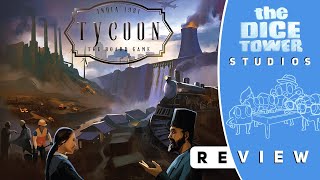
The Dice Tower Review at 0:55 sentiment: positive
video_pk 76 · mention_pk 170
Click to watch at 0:55 · YouTube ↗
Overall sentiment (raw)
positive
Pros
- Beautiful production with Brass Birmingham-inspired visuals
- Tightly interwoven economy with multiple interacting mechanics
- Satisfyingly deep strategy that rewards planning and timing
- Auction design is flavorful and keeps all players engaged
- Strong endgame drama and multiple paths to victory
Cons
- Steep learning curve and opaque scoring for first-time players
- Some fiddly components and potential component confusion
- Endgame math can be challenging and time-consuming to resolve
Thematic elements
- economic development, industrial growth, policy influence
- India during the early 1980s industrial and economic boom
- historical economic simulation
Comparison games
- Brass Birmingham
- Power Grid
- Kahora
Mechanics (from transcript analysis)
- action selection — Each round, players choose two actions from a pool, with the tycoon getting a third; must choose different actions on subsequent passes.
- Area Control — Places built industries on a map and gains bonuses on tracks and regions.
- Area control / placement — Places built industries on a map and gains bonuses on tracks and regions.
- Auction — Simultaneous bids for government policies and for industries; multiple items auctioned per round; promotes interaction.
- Auction / Bidding — Simultaneous bids for government policies and for industries; multiple items auctioned per round; promotes interaction.
- End Game Bonuses — Two main victory point types: asset value and influence; ties resolved by favors.
- Endgame scoring — Two main victory point types: asset value and influence; ties resolved by favors.
- Loans — Promissory notes grant money but must be paid back, advancing on asset-enhancing tracks.
- Policy cards / favors — Policy cards grant ongoing bonuses/favors; use promoter tokens to bid for round benefits.
- Resource Management — Ownership of tracks affects income, costs, and end-state scoring; being leader can reduce costs but increases others’ costs.
- Shares and stock — Purchase top shares of other stacks; influences asset value and track scoring.
- Stock Holding — Purchase top shares of other stacks; influences asset value and track scoring.
- Strategy pool / merit cards — Promoters and merit cards provide ongoing or endgame bonuses; used to fuel actions.
- Track-based resource management — Ownership of tracks affects income, costs, and end-state scoring; being leader can reduce costs but increases others’ costs.
Video topics + discussion points
No key topics recorded for this video.
Quotes (from this video)
- It's a beautiful looking game because I just like the look of that industrial revolution style art with gears around the outside.
- The core of this game is that cool interconnected economy.
- This is such a fun and rewarding game to play.
- The economies at play, the different aspects of it work so well together.
- The actual gameplay is fun, but it is very hard to see what you're scoring and what you're doing.
- It's mind trip.
- I think this is worth playing past the first play.
- This is an excellent game.
- The endgame is mind-tripping with lots of drama and steps.
References (from this video)
No references stored for this video.
Transcript Navigation
Showing 1–3 of 3