



Journeys Afar Deep Dive
What the Community Thinks About Journeys Afar
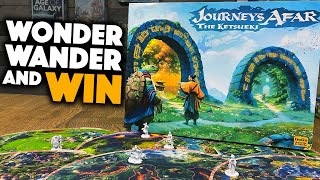
Journeys Afar: The Ketsueki arrives in reviewers' descriptions as a big, open-ended sandbox adventure for one to four players. Man vs Meeple placed it alongside Red Raven style games and the older FFG titles, describing a wildly whimsical fantasy world where every player builds a private play space that is still shared with the rest of the table. The reviewers consistently point to that tension between a personal path and a shared world as the heart of the design.
The Mill picked it as the favorite game of a Gen Con week spent around a lot of new releases. Its host Dusty had backed the game on Kickstarter the previous fall and played it early in the convention, and called the core idea of a personal world with portals into everyone else's worlds a really cool one, with small story threads tied to choices and rewards. The Game Boy Geek saw a prototype at Origins Game Fair 2025, called the production already gorgeous, and said the gameplay was a blast. That reviewer also noted the designer's personal connection to the story, which gives the game more emotional weight than a typical convention prototype.
Man vs Meeple was upfront that designer Travis Chance is a friend of the channel and asked viewers to take the praise with a grain of salt. Even so, the reviewers agree that the game is funny, varied, and rewarding for players who want to go off the map.
Core Mechanics That Define Journeys Afar
Effort as the Action Currency
Every turn in Journeys Afar runs on effort. Each player starts with six effort, and each cube spent is one action, mostly for moving around the board and interacting with the locations on it. Man vs Meeple explained that most worlds share a basic set of four locations plus one special location tied to that world, and that these locations are how you visit the market, the mine, and the other places that help build your tableau. Some costs force you to exhaust effort, which means taking fewer actions that turn, while other effects let you gain more.
The reviewers stress that effort is not limited to movement. You can repeat the same action several times, and you can spend effort to add dice to combat against the Ronin who roam the map, or to improve skill checks during encounters. Effort gives players a clear, flexible budget, which is why the same currency can drive both a quick trip across the map and a long engine-building turn.
Modular Worlds and Tableau Building
The game's signature idea is that the setup determines nearly everything. Man vs Meeple described picking three worlds for a two-player game, with each world bringing its own mechanics, locations, and characters. The decks are shuffled together, and the market, the spirits, the encounters, and even the Ronin are all drawn from the chosen worlds. Some stacks only come into play when specific worlds are selected.
That modularity drives the tableau building. Players can buy and hold as many market cards as they want, but they have to visit the right locations to get them, and cards from different worlds create specific synergies. Man vs Meeple noted that a combo that worked in one session may not even appear in the next if the worlds change. Players who chase the glass resource in one world might spend heavily on forge cards to unlock new abilities, then build a spirit engine around those abilities, which the reviewers describe as the most satisfying part of the game.
The Journeys Afar Experience
Whimsical Humor With a Dark Edge
Reviewers repeatedly return to the humor. Man vs Meeple described the game as pretty funny, and tied most of that humor to the encounter cards, which often present a choice that feels a little absurd. One example they laughed about involved an encounter that offers you many options to eat things, which turns a fantasy adventure into something both silly and slightly uncomfortable. That combination of whimsy and darkness is what the reviewers mean when they point to Adventure Time as an influence.
The art and atmosphere draw on Studio Ghibli as well. Man vs Meeple said the look of several worlds feels like it could have stepped out of one of the studio's films, and they mentioned a world with a castle that literally moves around the board. One playthrough had a character that was a porcelain doll come to life, in a world built around collecting glass, which fits the same storybook tone.
Lore Revealed Through Encounters and Choices
Narrative in Journeys Afar is mostly told through flavor rather than long scripts. Man vs Meeple pointed out that the story is revealed through worldbuilding and the encounter deck, and that the reviewers were happy with that approach because your own imagination fills in the gaps. Encounters are read to the table at the end of most turns, and they usually present a decision with consequences, which the reviewers compared to the crossroads choices in The Witcher: Old World. Because each world has its own encounter cards, playing the same faction again can reveal new background detail that you missed the first time.
What Makes Journeys Afar Stand Out
Journeys and Portals
Each character comes with a set of journeys, and each journey has chapters that serve as a guiding light for the player's goals. Man vs Meeple described a sample chapter that asks you to travel to or from a grove and a henge in a single turn, and noted that many second chapters require visiting another world. Portals, which start as gate tokens, are how you travel between worlds, so the journey system gives reasons to explore the shared map that the setup has created. The Mill's Dusty summed it up as having your own little mini missions that carry your character's story forward.
Variable Paths to Victory
The game offers two ways to end. The first is the familiar race to 15 points, which Man vs Meeple said usually goes to the player who is significantly ahead. The second is completing a journey, which grants large points for each level of the journey. That means a player who is behind on points but close to finishing a journey can still win. Man vs Meeple called both routes viable, and described the choice as deciding between an engine-building route and a focused journey, which keeps the sandbox from feeling like everyone is walking the same path.
Potential Drawbacks
A Thick Encounter Deck and Open-Ended Sprawl
The biggest practical concern the reviewers raised is volume. Man vs Meeple said the encounter deck is very thick, and that in an earlier play they got through less than half of it. That depth is a strength for replay, since new encounters and flavor appear every time a world is used, but it can also mean the game feels sprawling. Because the design is a sandbox, players can easily get sidetracked by a tempting engine or an interesting encounter, and the journeys are there partly to keep that from happening. Groups who prefer a tight, focused experience may need to commit to a journey early to stay on course.
A Swingy Ending
The second route to victory is also the main source of tension. Because completing the final steps of a journey can yield massive points, a player who was far behind can suddenly win. Man vs Meeple noted that in-game scoring is limited, so the points race is not always decisive until late in the game. Some players may enjoy that late-game comeback potential, but others may find it deflating if their engine lead disappears in a single turn.
If You Enjoy Journeys Afar
- The Witcher: Old World is the closest comparison Man vs Meeple gave for how the game balances narrative and mechanics. Its crossroads cards match the encounter-driven decisions here, and both games reward players who lean into their characters.
- Vantage came up in both Man vs Meeple and The Mill as an open-world exploration game. The Mill described its premise as a crash-landed spaceship and a co-op exploration of an unknown planet, the kind of open-ended discovery that Man vs Meeple compared to this game.
- Red Raven style games and FFG titles were the reviewers' starting point for the sandbox feel. If you enjoy big, flexible worlds where the path to victory is yours to choose, these are the designs Man vs Meeple connected to Journeys Afar.
- Studio Ghibli and Adventure Time inspired adventures are the tonal reference points for the game's look and humor. Players who enjoy whimsical worlds with a little dark humor will likely find the same charm in Journeys Afar.
What Reviewers Are Saying
"The narrative is revealed more in a lore sort of way, in a worldbuing sort of way, and less so in a storytelling. It's the flavor of this world that lets your imagine start to take over, start to fill in the blanks, which is really kind of the most efficient and best way a narrative can be presented."
— Man vs Meeple
"You each have your own world and you're kind of doing miniame goals on there, but then you can find a portal and jump to other worlds. So other people's boards where there's different kind of mini games."
— Dusty, The Mill
"Even though it's still in prototype mode, the production is already gorgeous and the gameplay was a blast. But the best part is the story behind it and how it's connected to something so personal for him."
— The Game Boy Geek