

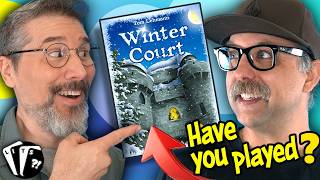


Winter Court Deep Dive
What the Community Thinks About Winter Court
Winter Court is a two-player card game from Rio Grande Games, designed by Tom Leman, and the reviews in circulation fall into two groups. Pair of Dice Paradise played the game and came away enthusiastic, calling it a great little tug-of-war game and recommending it without hesitation. Watch It Played and Getting Games previewed it from its announcement and product description, and their tone is curiosity rather than verdict.
Watch It Played found the publisher's pitch tantalizing, but its host admitted the description said little about how the game actually plays. Getting Games reached a similar position from a different angle. That reviewer noted that BoardGameGeek had little information about the game yet and that no mechanisms were listed, so the design could not be judged from the outside.
The community view, then, is a positive first impression built on a short, appealing premise and one hands-on endorsement. Reviewers agree on the basic shape of the game: a quick contest for influence over a royal court in winter. The open question is whether the depth of play matches the premise, and that is something only extended play reports can settle.
Core Mechanics That Define Winter Court
Suit-Matched Tug-of-War Over Royal Pawns
Pair of Dice Paradise explained that each member of the royal court sits on a tile with an assigned suit, and each royal starts with a pawn on that tile. On a turn, a player plays a numbered card from hand in front of a royal whose suit matches the card. If the new card's number is higher than the card on the opponent's side of that royal, the opponent discards their card and the pawn moves one space toward the player. Pawns can rest in the middle, on the player's card, or on the opponent's card, so each royal becomes a back-and-forth contest. This is the engine that Rio Grande Games built the game around, and the reviewer described it as a tug-of-war over each royal's favor.
Royal Abilities and the Cost of Sacrifice
The second mechanic is what turns the tug-of-war into a strategic decision. Pair of Dice Paradise noted that every member of the court carries a special ability. If a pawn starts its owner's turn on that owner's side, the player can move the pawn back onto its tile and use the ability, and the reviewer expected players to chain these abilities into combinations. Using an ability costs something, because the pawn leaves the favorable side of the table. The top four royals also carry purple pawns, and a player who gathers all four automatically wins. If the deck runs out first, the player with the most pawns in total takes the game.
The Winter Court Experience
A Constant Back-and-Forth Swing
Winter Court feels like a rope held taut between two players, with the advantage constantly changing hands. Pair of Dice Paradise summarized the rhythm as a tug-of-war back and forth, and the decision each turn is whether to pull ground toward yourself or to spend a pawn on an ability. Because pulling pawns is necessary to win, every turn carries a question about timing. The tension comes from the fact that a move which looks like progress can hand the opponent a useful counter.
Intrigue Inside a Winter-Bound Court
The theme sets the mood. Watch It Played described a medieval court confined by bad weather to a single castle, where two rival diplomats pursue their own agendas. Getting Games framed the experience as manipulating the people of the court, calling it a card game about influence. The result is a setting in which the numbers and suits are the surface of a political contest, which is why reviewers who had only read about it still found the premise intriguing.
What Makes Winter Court Stand Out
Combos Built From Royal Abilities
Pair of Dice Paradise responded most strongly to the way the royal abilities interact with the pawn economy. The host's reaction to the mention of combos was immediate enthusiasm, and the ability-plus-sacrifice structure gives the game a layer of planning that a light two-player card game does not always provide. Players are rewarded for setting up a royal's pawn so that its ability fires at the right moment, rather than simply playing the highest number available.
A Compact Two-Player Design
Reviewers point to the short, focused format as an advantage. Pair of Dice Paradise described the game as not asking a lot of the player, and Getting Games placed it in a 30 to 60 minute window, a length that suits a quick head-to-head session. Because the game is built only for two, it avoids the scheduling problem that larger games create, and it can be played on a short evening without a large commitment.
Potential Drawbacks
Limited Availability
Pair of Dice Paradise noted that the game sat on store shelves for about a month and a half before disappearing, and the host felt it left the market too quickly. Getting Games suggested the release was initially limited, with the game perhaps available mainly in Germany at the time of that video. For a game that reviewers want to recommend, a short retail window makes finding a copy a practical hurdle, and buyers may need to rely on secondary sources.
Limited Public Detail on How the Game Plays
Watch It Played admitted that the publisher's description "doesn't tell us too much about how to play this political card game," and Getting Games echoed that concern by pointing to sparse BoardGameGeek information. Both reviewers were working from announcements rather than play, so their hesitation is not a judgment of the game itself. It does mean that prospective players have little public detail to rely on beyond hands-on accounts, and the depth of the combo and sacrifice systems is best assessed by people who have played it.
If You Enjoy Winter Court
Watch It Played noted that Tom Leman, the designer of Winter Court, is also behind Race for the Galaxy and Roll for the Galaxy. Players drawn to Winter Court's compact card play and its focus on well-timed card decisions will likely find those designs a natural next step, because they come from the same designer and share a preference for tight, interactive card systems. The recommendations below follow that designer link.
- Race for the Galaxy: the designer's best-known card game, and a logical choice for players who want to explore more of Leman's approach to efficient card-driven play.
- Roll for the Galaxy: the dice-driven companion from the same design lineage, suited to players who enjoy the Galaxy setting and want a different way to manage their turns.
What Reviewers Are Saying
"In order to use their special ability, you got to sacrifice that pawn back to the middle. And so you lose that advantage of points on your side to win."
— Pair of Dice Paradise
"That description to me is tantalizing but also admittedly doesn't tell us too much about how to play this political card game, but there's something about this one that's really got me interested."
— Watch It Played
"Thomas Leman has designed lots of fascinating games. Two-player games in the 30 to 60 minute time frame sounds very interesting, especially when it's a card game about influence."
— Getting Games