













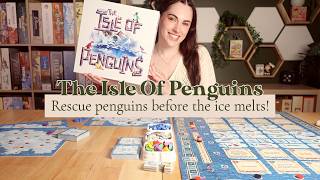


The Isle of Penguins Deep Dive
What the Community Thinks About The Isle of Penguins
The Isle of Penguins arrives as a clear successor to Frank West's acclaimed Isle of Cats, and the reviewing community embraces it wholeheartedly. Reviewers across platforms recognize the game as both mechanically refined and thematically delightful. Before You Play, Meeple University, and the Dice Tower all responded positively to the core design, praising how the game streamlines its predecessor while maintaining strategic depth. Board Game Garden and Caverna reviewers emphasize that players familiar with Isle of Cats will find The Isle of Penguins immediately accessible yet fresh. A consistent thread runs through the feedback: the game trades complexity for elegance without sacrificing the puzzle-solving satisfaction that made Isle of Cats special.
Core Mechanics That Define The Isle of Penguins
Open Drafting From Ice Flows
The heart of The Isle of Penguins centers on a streamlined drafting system. Players select penguin tiles, lesson cards, relics, and bonus items from columns on the shared board, paying fish as currency. Unlike the closed drafting of Isle of Cats, this open system means opponents can see exactly what is available and what prices players must pay. Each round, players visit columns in turn order and acquire two items per column visit, deciding whether to invest heavily in expensive Everax tiles (wild-colored penguins paired with relics) or conserve resources for future rounds. The simultaneous nature of selection, as Caverna notes, keeps all players engaged and forces constant tactical adjustment as options vanish.
Tile Placement and Family Building
The raft becomes a dynamic puzzle as players place penguin tiles on asymmetric, uniquely shaped boards. The first tile can go anywhere, but every subsequent tile must be adjacent (orthogonally, not diagonally) to existing pieces. This constraint creates genuine spatial puzzles. Players earn immediate points by forming penguin families (three or more penguins of the same color in contact), protecting eggs by surrounding them on all four orthogonal sides, and removing rocks to free up placement space. Reviewers consistently note that the simple tile shapes, mostly rectangles and L-shaped relics, make the puzzle more straightforward than Isle of Cats, yet the asymmetric boards ensure no two games unfold identically. The act of placement carries constant tension between pursuing personal objectives and adapting to what the board offers.
The The Isle of Penguins Experience
A Cozy, Engaging Puzzle
The penguin theme permeates every decision and transforms routine placement into emotional engagement. Reviewers describe the adorable art, where each penguin carries personality and players develop attachment to "rescuing" them. Board Game Garden's Jenna notes that penguins, like cats, resonate as a theme but feel fresher for many audiences. The multiple game modes (family, advanced, expert) allow tables to choose their complexity level, and even the streamlined family variant rewards thoughtful play. Meeple University captures this quality perfectly with their humorous commentary on placing penguins along the raft edges: while mechanically sound, there is something delightfully quirky about positioning penguins in precarious locations for points.
Strategic Depth Wrapped in Accessibility
Despite simpler rules than Isle of Cats, reviewers consistently mention that strategic choices matter deeply. The game incentivizes early lesson card acquisition through score track bonuses, yet players must balance this against immediate tile opportunities and the constant threat of opponents claiming pieces. The boot track determines turn order, but achieving first player status costs boots in the next round, creating a push-your-luck dynamic. Caverna emphasizes how the game's immediate scoring (points for families, eggs, and rock removal trigger score track bonuses for everyone) creates cascading decision moments. No single path leads to victory: players pursuing family-heavy strategies, lesson-focused approaches, and egg-protection schemes all compete meaningfully.
What Makes The Isle of Penguins Stand Out
Streamlined Gameplay Over Isle of Cats Foundations
Reviewers repeatedly cite how The Isle of Penguins refines its spiritual predecessor. The open drafting eliminates the tension of closed drafting while actually speeding play. Simultaneous tile placement happens in real time, and turn order resolves quickly. Most critically, the game scores immediately throughout all four rounds, creating a sense of continuous progress and allowing score track bonuses to unlock new mechanics mid-game. At 68 points, the fourth rescue round unlocks, gifting players an extra action round that shifts endgame strategies. Before You Play praises this mechanical clarity: rules are lean, player agency is constant, and downtime evaporates. The game never feels like players are waiting; there is always a decision to make.
Asymmetric Rafts Drive Replayability
Each player's board is uniquely shaped with different egg positions, rock placements, map bonuses, and tablet spaces. Call to Adventure highlights how this design transforms a common complaint about tile-laying games: your board becomes a character. One player might open up space early by clearing rocks, while another discovers a compact puzzle that rewards careful family placement. The lesson cards introduce variable objectives, with the A1/A2 and B1/B2 card decks providing four difficulty levels across game phases. Meeple University notes that lesson cards drive meaningful endgame scoring, and players cannot ignore them without consequence, yet pursuing every objective leads to scattered efforts and fewer points than focusing strategically.
Potential Drawbacks
The Everax Tile Carries High Cost
The most expensive item in the drafting pool, the Everax tile (a wild-colored penguin paired with a relic), costs five fish. Before You Play and other reviewers note this creates a decision cliff: the tile is genuinely useful for surrounding eggs and completing families, yet committing resources to it limits flexibility elsewhere. In two-player games, where fish availability tightens significantly, the Everax tile becomes something of a trap if pursued without careful accounting. Lesson cards can amplify this problem, as pursuing a five-fish tile leaves minimal resources for the remaining drafting steps in that turn.
Early Lesson Card Traps and Contingency Risk
Not all lesson cards are created equal, and some become impossible to achieve once committed to a particular board state. Before You Play mentions that certain lessons create tricky placement conditions, particularly those requiring protected eggs to touch specific penguin colors or those asking for lonely penguins (opponents specifically reward you for avoiding). Caverna observes that securing a lesson card that scores zero at game end creates emotional letdown despite the strategic failure being visible from early in the game. Players who draft objectives before fully assessing their board layout risk wasting turns chasing incompatible goals.
If You Enjoy The Isle of Penguins
Players who love The Isle of Penguins should explore Isle of Cats, the original design that established this tile-placement universe. Those attracted to the puzzle-building satisfaction might investigate Ember Reef, which shares the same score track bonus system and similar drafting tension. For open-drafting enthusiasts seeking a different theme, Pandemics</strong-adjacent games with simultaneous tile placement offer related brain-burning. Call to Adventure reviewers specifically suggest that anyone enjoying the balance of immediate and deferred scoring in The Isle of Penguins should experience other Frank West designs that similarly layer accessibility over strategic complexity.
What Reviewers Are Saying
"If you like Isle of Cats, I think you will definitely enjoy Isle of Penguins. I personally think that the Isle of Penguins is on the lighter side, but that being said, it's mostly because of the smoothness of gameplay and that there is no closed draft, instead it is more of an open draft."
— Call to Adventure
"They look freezing on the edge. Ocean views cost extra. Lesson cards are very important ways to score points, so you must not ignore them."
— Meeple University
"This is a new standalone board game set in the same world as Isle of Cats, which I love the nonsense sometimes that it's set in the same world. So apparently there's an Isle of these cats where you have to go rescue them. But there's also an Isle of Penguins, too, in the same universe."
— The Dice Tower