










Trick to the Future Deep Dive
What the Community Thinks About Trick to the Future
Trick to the Future has earned widespread acclaim from the board game community, with reviewers consistently praising its design and thematic execution. The Dice Tower's Mike Delisio called it his favorite trick-taking game of all time, while his co-host Chris Yee gave it an 8.5, noting how it has grown on him significantly. The Brothers Murph appreciated both the mechanic innovation and the thematic appeal, describing it as a strong entry in the trick-taking genre. BoardGameCo's Alex has already enjoyed it on prototype and sees it as worth reviewing, though expressed some uncertainty about how often it will make it to the table compared to other trick-taking games. Across reviewers, there is near-universal enthusiasm for the game's execution, with the only substantive criticism being that the two-player variant does not showcase the game's magic as effectively as multiplayer configurations.
Core Mechanics That Define Trick to the Future
Card Manipulation with Fuel Rods
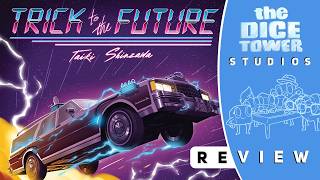
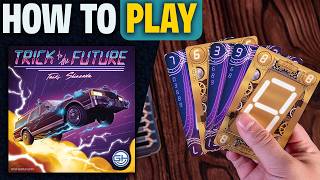
The signature mechanic of Trick to the Future is its fuel rod system, designed by Taiki Shinzawa and published by GameHead. Players receive fuel rods at the start of each round and can spend them throughout play to modify the values of cards they play. Each card displays multiple possible values around its edges in a digital clock style design; by rotating the card and spending fuel rods, players can change what number a card represents. This transforms traditional trick-taking strategy into a resource management puzzle. When a trick is won, the player collects not only the cards but also any fuel rods that were spent during that trick. This dual-purpose system makes fuel rods both a tool for winning specific tricks and a currency that directly impacts scoring.
Movable Bid Mechanic
Trick to the Future features what reviewers call a movable bid system. Unlike games where players commit to a target number of tricks at the start of a hand, here the target emerges dynamically through play. At the end of each round, players score based on how many tricks they won compared to their remaining unspent fuel rods. This creates what reviewers describe as the central tension: threading the needle to win exactly the right number of tricks. The game offers four possible outcomes: a perfect journey (tricks won equals remaining fuel, earning the best score), a safe journey (more fuel remaining than tricks won, earning moderate points), lost in time (more tricks won than fuel remaining, earning zero points), or inoperative (winning no tricks at all, earning survival points based on empty fuel spaces). This structure means players can correct course mid-round if things go poorly, giving them more agency than traditional bidding games.
The Trick to the Future Experience
Satisfying Precision Moments
Playing Trick to the Future creates moments of tangible satisfaction that reviewers consistently highlighted. The experience of threading the needle through careful card play and fuel rod management builds tension that pays off when a player successfully hits their bid in the final moments of a round. Reviewers described these victories as genuinely thrilling, not because luck was involved, but because multiple decisions stacked together to create the outcome. Chris Yee noted that players face a delightful puzzle each time: given what they know and what they suspect, what should they win, and at what cost?
Engaging Risk and Reward Tension
The game creates a compelling emotional arc through its push-your-luck-without-luck system. Players feel the weight of every decision. Spending fuel now to secure a trick may limit options later, and allowing a lower card to win can preserve resources for a more valuable round. The balancing act keeps players mentally engaged throughout, with the threat of losing everything to an overambitious round balanced against the reward of a perfectly executed bid. The Brothers Murph described this as reminiscent of Fox in the Forest, where greed can punish you, but the game's structure gives players meaningful ways to recover even from mistakes.
What Makes Trick to the Future Stand Out
Thematic Excellence Through Design
The game's Back to the Future inspired theming works not as mere window dressing but as an integral part of the design. The digital clock-style card display immediately evokes the film's aesthetic while serving a mechanical purpose; it communicates what values a card can become at a glance. The fuel rod metaphor for managing your journey through time is more than clever naming. Reviewers felt the theme helped teach and reinforce the rules, making the game more intuitive despite its nuanced scoring. Game Head's Paul Solomon and Pete Wisinger made deliberate choices to support both theme and gameplay, demonstrating what a well-integrated re-implementation can achieve.
Improved Accessibility Without Sacrificing Depth
Trick to the Future builds on earlier designs in the lineage (Segment Tricks and Twinkle Starship) by refining the scoring system. Taiki Shinzawa is celebrated as a phenomenal trick-taking designer, but reviewers often noted his scoring systems could feel punishing or off-putting. This version tweaks the formula to create more forgiving outcomes while retaining meaningful consequences. Chris Yee observed that even if a player scores zero in one round, they can still win the overall game if they execute well in the other two rounds. This change makes the game appeal to a wider audience than previous Shinzawa collaborations without feeling watered down. The design still bites when you overextend, but it feels fair and recoverable.
Potential Drawbacks
Limited Appeal in Two-Player Format
While the game works with two players, reviewers agreed that the two-player experience does not showcase what makes Trick to the Future special. The mechanics are intact and functional, but the game loses some of its tension and interactive puzzle-solving when there are only two decision-makers at the table. Chris Yee and Mike Delisio both noted they would choose almost any other two-player trick-taking game before returning to Trick to the Future at that player count. For players primarily looking for a two-player title, this is worth noting, though it does not diminish the game's excellence at three to five players.
Unintuitive Card-Face Duality
The most teachable moment reviewers flagged is that the six card also functions as a nine when rotated. This changes the effective deck composition in subtle ways and can catch new players off guard. Reviewers noted that explaining this quirk upfront is necessary, as it can sneak up on players during their first game. The two-player rules further complicate card distribution slightly. While this is not a major flaw, it adds a small bump to the learning curve that otherwise remains smooth.
If You Enjoy Trick to the Future
Players drawn to Trick to the Future should explore other precision-focused trick-taking games. Fox in the Forest shares the balance mechanic of winning the right number of tricks rather than maximizing them, though with simpler rules. Spades offers the bidding structure that Trick to the Future builds upon, providing a simpler entry point to the genre. For those wanting more thematic trick-taking, Rowdy Partners delivers strong theme integration in a wrestling-tournament package. Fans of Shinzawa's earlier designs should seek out No Loose Ends and the original Twinkle Starship if they want to explore the designer's full body of work. Vivo and Kints and Trix offer alternative takes on card value manipulation and modern trick-taking design. For purists, the classics Hearts and Spades remain unmissable foundations, though they lack the innovative mechanical hooks that make Trick to the Future feel fresh.
What Reviewers Are Saying
"Coming up next is Trick to the Future, which I gave a nine out of 10. This is my favorite trick-taking game of all time. I originally had played it as a game called Twinkle Starship. It has been re-themed into kind of a Back to the Future type of a thing, and even some little changes to the scoring, which I think are for the best, makes it a little bit more of a forgiving scoring game."
— The Dice Tower
"I'm threading the needle, and sometimes you think you've got a thread and you realize, oh no, it's come out of the needle. It could be very satisfying when you were able to like on the last play of a round do exactly what you wanted and you hit your perfect bid. It's just such a really satisfying moment and this gives that opportunity to you in spades."
— The Dice Tower
"But no, it obviously evokes Back to the Future. This is a trick-taking game that kind of falls into that category of like you want to win a lot of tricks, but you don't want to win too many."
— The Brothers Murph