




Wilderness 1864 Deep Dive
What the Community Thinks About Wilderness 1864
Wilderness 1864 has earned consistent praise from board game reviewers as a breakthrough moment in accessible American Civil War gaming. Publishers and designers have created numerous Civil War wargames over the decades, but most demand substantial complexity and time investment. What sets Wilderness 1864 apart is that it strips away the intricate subsystems common to the genre while preserving the core tactical decisions that define Civil War combat. Reviewers uniformly describe surprise and delight at discovering that a game with only an eight-page rulebook can deliver historically resonant, tension-filled gameplay. The critical consensus positions this as the entry point for players who want authentic American Civil War action without weeks of rules mastery.
Core Mechanics That Define Wilderness 1864
Leadership and Command Control
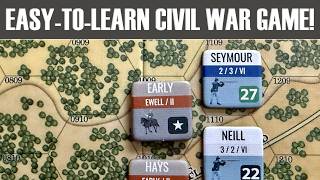
Units in Wilderness 1864 rise and fall on the quality of their commanders. Leaders stack with brigades and provide essential morale support during combat, making the placement and movement of historical commanders a critical strategic layer. The mechanic captures a fundamental truth of Civil War combat: soldiers fought harder when led by capable officers. In the Wilderness scenario specifically, this rule becomes even more pronounced, as the dense woods prevent standard line-of-sight command. Units must stay within three hexes of any friendly leader to remain effective. This creates a puzzle where players carefully position leaders not just for their morale bonuses, but to maintain control over scattered brigades in chaotic terrain. A leader lost in combat or separated from supporting units opens tactical opportunities for the opponent.
Casualties and Gradual Deterioration
Rather than the step-loss system common to wargames, where units flip to a reduced side or disappear entirely, Wilderness 1864 tracks casualties with precision markers that slide underneath unit counters. A brigade might lose one strength point, then two more over several turns of fighting. Reviewers noted that this system creates an unusually immersive experience of watching your formations gradually fray. Unlike games where units stay at full capacity until they break, players watch their left flank slowly hemorrhage strength, making visible the cumulative toll of combat. This granular tracking transforms what could be abstract number management into a visceral representation of unit deterioration, reinforcing why routing and rallying decisions matter so much as a formation weakens.
The Wilderness 1864 Experience
Dense Wooded Chaos
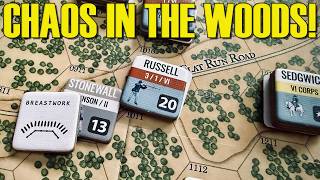
The Wilderness battle earned its place in American history partly because fighting in dense Virginia forest negated the traditional advantages of open-field tactics. Wilderness 1864 translates this into mechanics where woods block artillery line of sight, disrupt zone of control, and create pockets of intense close-quarters fighting. The map itself, with its predominance of forested hexes interrupted by rare open fields, becomes almost a character in the game. Reviewers consistently commented that simply looking at the map triggers the experience of navigating a tangled forest landscape. Visibility drops, units lose coordination, and local force concentrations matter more than army-wide positioning. The game captures not just the mechanical constraints of fighting in woods, but the claustrophobic feeling of leading soldiers into terrain where you cannot see the enemy until the moment of contact.
Accessible Depth
Wilderness 1864 delivers a second key experience: the satisfaction of learning a serious wargame in a single evening. The eight-page rulebook and straightforward combat resolution table eliminate the gatekeeping that historically excluded new players from Civil War wargaming. Players can engage with genuine tactical choices, meaningful leader placement, and historically grounded combat mechanics without memorizing subsystems. This accessibility extends to solo play, as there is no hidden information that restricts one player from controlling both sides competently. For players accustomed to games that demand either complexity or accessibility, never both, this combination proves striking. The game respects player time while delivering authentic gameplay depth.
What Makes Wilderness 1864 Stand Out
Lightweight Rules, Heavyweight Atmosphere
The core insight driving Wilderness 1864 is that Civil War combat does not require three hundred pages of rules to feel authentic. Designer decisions about what to omit are as important as what to include: cavalry, largely irrelevant in the dense Wilderness terrain, disappears from the game entirely. Artillery, historically difficult to deploy in forest fighting, becomes situational and underpowered when undeployed in woods. The game does not apologize for these simplifications, nor does it need to. By distilling combat down to infantry engagements, morale, terrain effects, and leadership, the system captures the essential feel of the Wilderness battle while inviting players to mastery in an afternoon rather than a semester.
Scenarios for Every Commitment Level
Wilderness 1864 ships with thirteen scenarios spanning two hours to fifteen hours of play. The two-map campaign game provides the complete historical experience for dedicated grognards, while smaller one-map scenarios fit into an evening's gaming. This range means a group can learn the game with a short scenario, then return for progressively longer engagements. Reviewers specifically noted the value of this scenario diversity: a player can choose their own path into the game based on available time and group size. The playbook includes design notes and historical commentary that enrich the scenarios, inviting players to research the actual battle and deepen their engagement.
Potential Drawbacks
Visual Markers Lack Polish
Wilderness 1864 features a beautiful map and clean counter design that immediately draw players into the game, yet the various condition markers scattered on the board feel less refined. Reviewers noted that simple black and white markers, despite their functional clarity, create a visual disconnect with the otherwise elegant presentation. In a game where the map dominates the table and draws constant attention, these utilitarian markers stand out as unfinished. This criticism touches aesthetics rather than functionality, but visual appeal matters in games that demand player engagement.
Counter Color Differentiation
The Union and Confederate counters use blue and gray respectively, colors that reviewers found sometimes difficult to distinguish at a glance, especially when viewing the unit marker from certain angles. Over the course of a multi-hour game, this occasional confusion slows play momentarily as players verify which side a unit belongs to. Adding visual distinction through flags, symbols, or stronger color contrast might resolve this minor friction point without fundamentally changing the design.
If You Enjoy Wilderness 1864
Players drawn to Wilderness 1864's streamlined approach to American Civil War combat should explore the wider seven-game Brigade series from Worthington Publishing, as learning one system opens access to the entire library. Reviewers also recommend A Most Fearful Sacrifice, a more detailed treatment of Gettysburg that appeals to players ready for moderate complexity increase. For those seeking a different Civil War battle at similar weight, the Blind Swords series provides tactical depth through a card-driven system. Both alternatives reward the confidence and foundational knowledge that Wilderness 1864 provides.
What Reviewers Are Saying
"I really like the smoothness and the simplicity of the rule set in this game and by extension in this series. Eight pages of rules means you are up and playing the game very fast."
— Solo Blitz
"I thought it might be too simple for my tastes, but it is not. I thought it might not be historical enough for my tastes, but it is not."
— Zilla Blitz
"This takes a little bit of a different approach, which says, let's distill it down to its essence. Let's try to make a very light rule set and have some good American Civil War game action with that."
— Zilla Blitz