


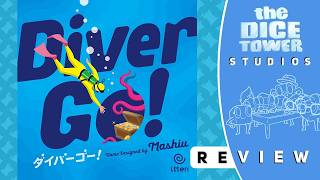

Diver Go Deep Dive
What the Community Thinks About Diver Go
Reviewers consistently describe Diver Go, the 2025 release from Itten Games, as a silly party dexterity game built around memory, touch, and nerve. The Dice Tower covered it in a full video with Mike Delisio and Joey Evans, who placed Itten among Japanese publishers known for quick, goofy dexterity titles such as Tokyo Highway and Crash Octopus. Both reviewers came away positive, with Delisio giving it an eight out of ten and Evans a 7.5. Tom Vasel's Week in Review on The Dice Tower carried the same verdict, with Delisio calling it a silly party game on the lighter end of the spectrum that is a lot of fun.
Board Gaming Ramblings approached it from a more skeptical angle in its Keep or Cull series. Sarah and Johannes enjoyed playing it, but they decided to cull it from their collection, describing it as an interesting, weird game rather than one they would return to. The overall picture is one of enthusiastic agreement that Diver Go is memorable and entertaining in the right setting, paired with a shared recognition that it is a specialized experience rather than a staple.
Core Mechanics That Define Diver Go
Two systems dominate how reviewers explain the game: the memory phase that precedes every dive, and the blind grab that follows it.
Memory-Based Coin Tracking
Each round begins with a lead diver who places the ship cover over the box and shakes the coins until they are well mixed. Everyone else crosses their arms in a diving pose, and when the lead diver shouts "Diver Go!" and lifts the cover, all players grab one of the numbered diver cards from around the outside of the box. The card values set the turn order, with the lowest number diving first, and they also set how many coins that diver will take. Before reaching into the box, the diver flips an hourglass and studies the coins in front of them, which reviewers describe as a short, timed window where touching is forbidden and only looking is allowed.
The coins come in four types in Itten's set (silver, gold, bronze, and iron), and each one is double-sided with a king face on one side and an octopus face on the other. Cursed coins carry a blue stripe on the octopus side, which reviewers noted is the detail that matters most during the study phase. Several reviewers stressed that memory is harder than it looks. Delisio observed that players tend to believe they will remember what they saw, but the moment the first coin is grabbed, the arrangement shifts and the mental picture disappears. That gap between confidence and recall is a large part of the fun.
The Blind Scuba-Mask Grab
Once the study window closes, the diver covers their eyes with the included mask and reaches in. They may touch the sides of the box for orientation, but the coins must be chosen by feel alone. After grabbing a coin, the diver pulls off the mask and checks the face to see whether it is cursed. Reviewers described the moment of the reveal as the centerpiece of the experience, with players reacting loudly to gold, silver, and king faces alike.
The curse mechanic, which ties back to the King Octo theme, gives the grab its stakes. Cursed coins are not discarded but set aside on a sunken treasure card, and the penalty accumulates at the end of the game. The Dice Tower's explanation was that three cursed coins subtract 1,000 points each, so players hold onto them until they can be spent on a reward card. Reviewers also explained that a player can use cursed coins to complete a contract, which clears them from the supply but forfeits a doubler that might otherwise make the reward worth 6,000 points rather than 3,000. Delisio called this push and pull the biggest strategic decision in the game.
The Diver Go Experience
Silly, Raucous Schadenfreude
The most consistent word reviewers use is silly. Delisio and Evans frame the game as a loud, physical party title where the audience is part of the show. Players are expected to sit in the diver pose while others are grabbing, and the reviewers described the group reaction as the main source of enjoyment. Delisio said the best part is making noises while other divers reach for their coins, and that a player who stays quiet is missing the point. They also described a kind of gleeful schadenfreude, where players delight in the failures of their opponents and enjoy their own success in return. Board Gaming Ramblings described it as a tactile, silly game that could work well with family, which aligns with The Dice Tower's view that children can grasp it quickly.
Push-Your-Luck Tension in the Grab
Beneath the comedy is a steady undercurrent of risk. Reviewers noted that players are often forced to take more coins than they want, and they may be stuck with a cursed coin at the worst possible moment. Evans described the tension of grabbing a second or third coin as something close to a crapshoot, because every additional coin changes what the player is likely to pull out. The Dice Tower reviewers felt that this combination of memory, blind selection, and grab-based turn order produces a satisfying push-your-luck feel even though the rules are simple.
What Makes Diver Go Stand Out
Components and Tactile Production
Reviewers were generally pleased with the physical product. Delisio said the coins feel like the pirate treasure found at parties, and both reviewers praised the good quality cardboard and coins. The hourglass timer received a surprising endorsement from Delisio, who typically avoids sand timers but found this one quick and effective, roughly a 20 second window. Board Gaming Ramblings described the coins as plastic that pretends to be gold and silver, which they still found enjoyable to handle. Reviewers did note that the cards will bend with repeated slapping and grabbing, a trade-off they accepted as part of the rough-and-tumble play style.
A Turn Order Built Around the Grab
The grab for diver cards is the feature reviewers most often single out as distinctive. Because the lead diver must remove the cover, the grab gives that player a chance to compete for an early position as well. Delisio said the system evens everything out, noting that the variety of turn order and risk makes the opening moments of each round feel different from the last. Delisio also argued that few other games in the quick, dexterity-driven niche do anything equivalent, saying that Diver Go has something different not seen matched elsewhere. That originality, combined with the production quality, is why reviewers consider it worth introducing to new groups.
Potential Drawbacks
Limited Replay Appeal
The most direct criticism came from Board Gaming Ramblings, which culled the game despite enjoying it. Sarah and Johannes described it as an interesting, weird experience rather than a title that earns a permanent place on the shelf. Their concern was not that the game is bad, but that its appeal is narrow and may fade after a few sessions. The Dice Tower reviewers echoed this in their own way, noting that the game is a "for everybody" kind of experience only in specific circumstances. Delisio also said the preference is for playing with four players rather than two or three, and expressed hesitation about recommending the two-player variant.
Loud, Silly, and Not for Everyone
Reviewers were clear that Diver Go will not suit every table. Delisio said it is very silly and raucous, and that it is mostly loud when players are going for the cards. Some groups may find the shouting, slapping, and arm-crossing tiresome rather than delightful, and the game depends on everyone being willing to commit to the bit. The Dice Tower reviewers also warned that the game can scratch hands and bend cards during play. Those concerns are not deal-breakers for fans of party games, but they make it a poor fit for quiet or serious game nights.
If You Enjoy Diver Go
Diver Go suits players who enjoy physical party games where the reaction of the group is part of the entertainment. The Dice Tower reviewers recommend it for a party game night or for closing out an evening when everyone is relaxed and ready for something loud. Delisio said it works best with four players who are in the mood for this kind of game, noting that it is quick enough to play twice in a row. Families looking for a silly memory challenge will also find it accessible, since reviewers said children can pick up the rules without much help. Players who want more strategy may find the decision space thin, but those who want a quick, tactile, laughter-driven experience will find it hard to beat for a single evening.
What Reviewers Are Saying
"My favorite part of this game is making noises while other divers are reaching for their coins. If you're not doing this, you're not playing this game right."
— The Dice Tower
"I can see myself playing with my family or something because it's a silly game. You are divers diving for treasure, and it's like a tactile game."
— Board Gaming Ramblings
"The idea is that you're diving under the sea for coins trying not to get corrupted coins. The really what you're doing is you're kind of blindfolding yourself after studying a group of coins in a box and trying to pick those coins out blindly to get particular ones to fulfill recipe cards essentially."
— The Dice Tower