













The Lord of the Rings: The King's Gambit Deep Dive
What the Community Thinks About The Lord of the Rings: The King's Gambit
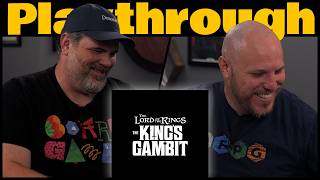
The reception for The Lord of the Rings: The King's Gambit is overwhelmingly enthusiastic. Reviewers consistently praise the game for reviving a legendary design that has long been inaccessible to most players. Rob Daviau's original Star Wars: The Queen's Gambit, released in 2001, became a white whale for collectors, commanding hundreds of dollars on the secondary market. Now, reimagined with a Lord of the Rings theme and published by Restoration Games alongside Space Cowboys, the game promises to deliver that same epic, multi-front experience at a much more attainable price point. Reviewers highlight how the game successfully captures the climactic finale from Return of the King, with accessibility that belies its strategic depth. Tim Chuon notes the tense, exciting moments that emerge naturally from play, while The Brothers Murph emphasize the thematic resonance of its actions and abilities. The consensus is clear: this is not merely a nostalgia play, but a thoughtfully updated game design that works equally well for casual players and strategic enthusiasts.
Core Mechanics That Define The Lord of the Rings: The King's Gambit
Card-Driven Action Programming
At the heart of The Lord of the Rings: The King's Gambit lies a elegant action programming system. Each round, players select four cards face-down from their display and reveal them one at a time. These cards form the backbone of decision-making, allowing players to program their units' movements and attacks while remaining responsive to opponents' plays. Each card offers two distinct action options, and players use resolve tokens to block off the action they don't wish to take. This creates a satisfying moment of tactical choice: commit to a plan without knowing exactly how your opponent will react, yet retain the flexibility to adapt when cards are revealed. The system ensures that despite the game's complexity, turns resolve at a brisk pace. Reviewers appreciate how the card system keeps everyone engaged and allows the game to accommodate four simultaneous battlefields without becoming cumbersome.
Asymmetric Factions and Multiple Victory Conditions
The game's depth emerges from its fundamentally asymmetric design. The Free Peoples and Shadow forces pursue entirely different victory conditions, creating two distinct gameplay experiences depending on which side you lead. The Free Peoples can win by destroying three encampments on Pelennor Fields or by getting Frodo and Sam to Mount Doom and destroying the Ring without their willpower reaching zero. The Shadow forces, meanwhile, can claim victory by getting units to the fourth level of Minas Tirith or by draining the Free Peoples' will to zero. This asymmetry ensures that no two games feel identical. Combined with the bag-building mechanic for the Mount Doom quest path, where players draw tokens that represent their willpower gains and losses, the game creates a tense race where both military dominance and willpower management matter equally. Rob Davio's design ensures these two pathways reach conclusion at roughly the same time, making games swing back and forth until the final rounds.
The The Lord of the Rings: The King's Gambit Experience
Tense, Back-and-Forth Tactical Drama
Reviewers consistently describe The Lord of the Rings: The King's Gambit as a game that generates genuine moments of tension and excitement. The Rolling Dice & Taking Names hosts speak to how the game captures the narrative feel of Lord of the Rings by making players feel invested in multiple outcomes at once. The Brother Murph emphasize the tense back-and-forth gameplay where control of the battlefield shifts with each card reveal. Because victories can hinge on whether a single squad gets destroyed or a unit reaches a particular level, close finishes are common. Tim Chuon notes that these nail-biting moments emerge organically from the system rather than feeling arbitrarily determined by luck. The card programming mechanic means that players are always making meaningful decisions, yet never have perfect information, creating a sweet spot where strategy and tension coexist.
Epic Spectacle and Thematic Immersion
The game's production value and thematic design work in concert to immerse players in the Return of the King climax. The high-quality miniatures, 3D set pieces representing Minas Tirith, and the visual representation of four simultaneous battlefields create a sense of grand, cinematic scale. Reviewers describe the thematic integration of mechanics, where heroes like Aragorn and Gandalf feel as powerful as they should, where the Witch King presents a genuine threat, and where the momentum system elegantly represents the shifting balance of power as Gollum's influence sways between Smeagol and the corrupting Ring. Good Time Society appreciates that the physical production supports the narrative, making every battle feel like a consequence of Middle Earth's history rather than an abstract tactical exercise. The game does not require players to spend extra money or strip away its polish to enjoy it; the deluxe Mithril edition exists for those who want maximum spectacle, while the upcoming retail edition will maintain the core experience.
What Makes The Lord of the Rings: The King's Gambit Stand Out
A Grail Game Brought Into Reach
Few games capture the imagination of board gamers quite like a legendary, out-of-print classic. Star Wars: The Queen's Gambit achieved mythical status partly due to scarcity. Finding a copy meant spending $400 to $500, if you could find one at all. Restoration Games' decision to resurrect this design with a Lord of the Rings theme removes a major barrier to access. Rolling Dice & Taking Names note that this is not a cynical cash grab but a genuine partnership where Rob Daviau, the original designer, maintains creative control. The licensing deal with Middle-earth Enterprises and Space Cowboys ensures a wide retail release, meaning players who skip the Kickstarter can purchase a standard edition later. For collectors and devoted fans, the Mithril edition offers everything one could want, but the game's core experience is not gated behind wealth or luck.
Strategic Depth Without Overwhelming Complexity
Rob Daviau and Justin Jacobson revealed in interviews with Rolling Dice & Taking Names that the design process involved radical simplification. Early prototypes featured many more rules, complex hero-led unit systems, and a seven-level Minas Tirith that led to 35-round games. By aggressively cutting mechanics and zooming in on the most narratively important conflict, the designers preserved the strategic drama while achieving a playtime target of around two hours. Reviewers universally praise the teaching experience and accessibility for new players. Tim Chuon observes that even casual game players, after two turns, realize the game is straightforward despite its apparent complexity. This is not a light game, but it is an approachable game, ensuring that the richness of tactical options and emotional investment does not come at the cost of years of play experience required to understand the rules.
Potential Drawbacks
Challenging Teaching and Rules Overhead
Despite the pruning of unnecessary mechanics, The Lord of the Rings: The King's Gambit remains a substantial game to teach. Rolling Dice & Taking Names note that teaching the final 20 percent of the rules can require 80 percent of the teaching time. Players unfamiliar with the core systems, resolve tokens, momentum mechanics, and the bag-drawing subsystem for the Mount Doom track will benefit from patient instruction. A new group playing for the first time should expect the first round or two to move slowly as players internalize their options. This is not a gateway game suitable for introducing board gaming newcomers in a single session, though Rob Daviau reports successfully teaching the game to diverse player groups after those initial questions are addressed.
Potential for Swingy Gameplay
The card and dice systems create moments where fortune can shift dramatically. Rolling Dice & Taking Names mention that games can experience big swings in momentum, depending on lucky or unlucky dice rolls, card draws, and the order in which threats appear on the battlefield. A player who falls behind militarily might find themselves mounting a rapid comeback if they draw the right cards, or conversely, a leading player's fortunes can reverse if key units are eliminated. For players who prefer tighter, more controlled strategy games where luck plays a minimal role, these swings may feel frustrating. However, reviewers frame this as a feature rather than a bug, as the unpredictability keeps every round competitive and creates the tense moments that define the experience.
If You Enjoy The Lord of the Rings: The King's Gambit
Players drawn to The Lord of the Rings: The King's Gambit tend to appreciate Star Wars: The Queen's Gambit for its multi-front battlefield design and asymmetric factions, though that original is now prohibitively expensive and rare. Those who value action programming systems where cards or tokens are played face-down to create hidden information and tactical uncertainty may enjoy games like Clash of Cultures or Twilight Struggle, which use cards as both resource and mechanism. The bag-building mechanic connecting to Frodo and Sam's quest recalls the innovative push-your-luck elements found in Quacks of Quedlinburg or Concordia. For players who want multiple victory paths and asymmetric factions, Food Chain Magnate or Spirit Island offer similarly rich, branching gameplay where different players pursue radically different strategies. Finally, those charmed by the high production value and thematic integration should consider Gloomhaven: Jaws of the Lion or Zombicide, which similarly marry great gameplay with painted miniatures and atmospheric presentation.
What Reviewers Are Saying
"I have taught this game 75 to 100 times to different people and I can see people when they sit down like I'm not going to be able to play this, right? I've gotten people who are casual game players. By the second turn of the first round they go, 'Actually, this is actually really straightforward.' And they are having a good time."
— Rolling Dice & Taking Names
"It is very very strange to be doing a restoration of a game that I did a quarter century ago. And when I did it, I was around it. Really, it was Craig Van Ness did it. I named it and did some playtesting and a little bit of development. And it's 25 years later, I'm still working on making games. That's pretty cool."
— Rob Daviau
"I think it's really cool that Rob Daviau, who originally designed this game 26 years later, gets to put his thumb print on a new version of it with a new theme. And to be honest with you, I think this theme will go over better now than what a Star Wars would."
— Rolling Dice & Taking Names