











Star Trek: Space Hunt Deep Dive
What the Community Thinks About Star Trek: Space Hunt
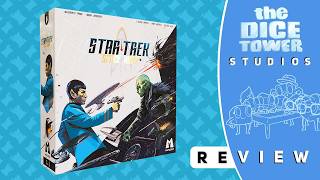
Reviewers across channels consistently praise Star Trek: Space Hunt as a breakthrough adaptation of a beloved game. The Dice Tower's Tom Vassal and Joey Evans hailed it as solving Captain Sonar's critical accessibility problem, giving it scores of 8.5 and 9 respectively. Joey Evans called it simply "fantastic," while the team at Board Stupid expressed genuine excitement about finally being able to play the hidden movement game at a reasonable player count. At Tantrum House, it earned immediate enthusiasm from Melissa and Kevin Delp, who recognized it as a genuinely fresh take on team-versus-team gameplay. BoardGameCo's Alex noted the elegant simplification during their UK Games Expo walkthrough. Across all channels, the consistent theme emerges: this is Captain Sonar for people who have groups of four, not eight.
Core Mechanics That Define Star Trek: Space Hunt
Real-Time Hidden Movement and Deduction
The game's heartbeat is simultaneous, real-time play where one team calls out movement (up, down, left, right) while the other team listens intently, drawing the opponent's likely position on their own board. As Joey Evans explained, players are constantly receiving auditory information and mentally tracking an invisible opponent. One captain announces moves while the other frantically plots potential locations. Tom Vassal captured the exhilaration perfectly: when an opponent finally fires and hits, the shock of correct positioning creates moments of tension and vindication. The mechanic is devilishly simple on the surface but layers in tremendous brain-burning difficulty, especially for the tracking player who must maintain spatial awareness of two ships simultaneously while accounting for invisibility and warping.
Asymmetric Energy Economics and Character Powers
Each captain pair brings different energy costs for the same actions, creating meaningful team composition decisions. Scanning might cost three energy for one pair but only two for another, affecting whether a team specializes in information gathering or aggressive shooting. Joey Evans emphasized how this asymmetry matters, noting some pairs can cloak more easily than others. The Federation teams (Kirk & Spock, Picard & Data, Burnham & Saru) face villainous teams built around Khan and other antagonists, each with distinct mechanical identities. This isn't mere theming; the energy system makes each pairing feel genuinely different to play and against.
The Star Trek: Space Hunt Experience
Frenetic Real-Time Tension
Multiple reviewers described the emotional arc of play. Tom Vassal called it "stressful but fun stressful," capturing how the real-time pressure creates moments of exhilaration when players successfully triangulate an opponent's position. The game requires clear, loud communication from captains who must articulate their moves crisply so tracking players hear every detail. This auditory intensity isn't a flaw; it's the game's core experience. Joey Evans described the moment-to-moment drama of a captain's pause after a guess, the relief of a near miss, and the shock when an opponent lands an impossible hit.
Demanding Dual Cognitive Loads
Reviewers recognized that both roles are exhausting in different ways. The captain pilot manages navigation, energy spending, and tactical decisions in rapid succession. The second player, the tracking officer, operates as a human computer, listening to opponent callouts and inferring position probabilities. Joey Evans described switching between the two roles as a shift in mental gears: one seat runs faster and more frazzled, the other runs slower but demands full concentration to pin down the opponent's ship. Both positions demand complete engagement.
What Makes Star Trek: Space Hunt Stand Out
Hyperspace Mechanic as Thematic Innovation
The hyperspace system wasn't in the original Captain Sonar, and reviewers singled it out as ingenious. Tom Vassal called it "really neat" and explained how it creates a mini-game of information leakage: if a ship jumps into hyperspace, opponents might know its approximate sector; if they follow, the stakes escalate dramatically. The mechanic mirrors Star Trek's theme of faster-than-light travel while introducing legitimate tactical asymmetry. Joey Evans described the emotional intensity of spending energy to leave an opponent behind, only to have that opponent jump in pursuit moments later. The mechanic simultaneously adds theme, tactical depth, and dramatic storytelling to each play.
Elegant Translation of Source Material
Tom Vassal noted this is "a really good use of Star Trek" because while ship-on-ship duels aren't the series' bread and butter, the hidden movement framework feels authentically Star Trek. Picard maneuvering, cloaking devices, and hyper-speed jumps give the game mechanical flesh that matches thematic bones. Multiple reviewers praised the character art and faction asymmetry. The game never treats the theme as window dressing; instead, hyperspace jumps and cloaking abilities emerge naturally from how the game works. This tight mechanical-thematic integration is why even non-Star Trek fans, like the Board Stupid crew, found themselves genuinely interested.
Potential Drawbacks
Noise and Table Control Requirements
Tom Vassal emphasized a critical caution: players need to be careful where they play. A loud environment makes it hard to hear callouts, and the captain cannot be mild about announcing moves; the commands need to be crisp and clear so the tracking player can plot them accurately. Restaurants, convention halls, and noisy game cafes may all pose problems. The captain must project constantly without becoming a caricature, and external noise can catastrophically derail tracking. This isn't a game to play in chaotic environments.
Real-Time Gameplay Barrier to Entry
The stressfulness that some players find exhilarating will repel others. Tom Vassal was direct about this limitation: if the premise of real-time pressure sounds stressful rather than fun, it will play that way for that person. This isn't for everybody, and Tom Vassal acknowledged carefully selecting players for the game, mentally vetting whether they'll embrace the frenetic energy. Some people prefer thoughtful, turn-based games where they can deliberate strategy. The real-time pressure, communication demands, and potential for quick elimination aren't design bugs but core features that fundamentally exclude a portion of the player base.
If You Enjoy Star Trek: Space Hunt
Reviewers consistently recommended Captain Sonar as the natural next step, though with the caveat that it requires eight players. The core hidden movement and deduction system is nearly identical, but a full team is needed to field it. Players craving more asymmetric real-time games should look toward other hidden movement titles that emphasize communication and spatial reasoning. If the Star Trek theming was the draw, the two-to-four-player accessibility means this title can actually reach the table far more often than Captain Sonar; reviewers noted this as its killer advantage.
What Reviewers Are Saying
"Captain Sonar takes eight people. This one can be played at four. And it feels really good. It's got asymmetric powers. This is fantastic. I really, really enjoyed this."
— Joey Evans, The Dice Tower
"You can jump in hyperspace. It's energy. You're like, yes, we leave everyone behind. Then the other ship jumps in hyperspace and it's like, they're on our tail. We can't shake them. And they could shoot you."
— Tom Vassal, The Dice Tower
"The whole great thing about Captain Sonar is the fact that it is a real time team versus team game. And it's basically real time battleships. You're trying to hunt the other person down. Everyone's got a different role. You're trying to listen to the other team. It's chaotic. It's hilarious fun."
— Board Stupid