







Bordeaux Deep Dive
What the Community Thinks About Bordeaux
Board game reviewers have received Bordeaux with consistent enthusiasm, appreciating it as a distilled, travel-friendly take on the worker placement mechanics that made Fromage and Fromaggio beloved strategy games. The consensus frames Bordeaux not as a radical departure but as a clever reimagining, extracting the core puzzle and repackaging it for accessibility and portability. Board Game Dad praises its "innovative simultaneous worker placement, brilliantly designed intuitive symbology, and elegant gameplay," while TheGameBoyGeek highlights the sheer ambition of 150 unique pages, each a different puzzle. (Board Game Dad and Let's Table It both say 200 pages; TheGameBoyGeek says the 150 figure was double-checked with the publisher.) Board Game Dad notes that it is a bit simpler than Fromage because it has no structures, and frames the real question as whether a player wants a more portable version of Fromage. For its specific mission, a pen-and-pencil game that can be played on a park bench, an airplane tray table or a couch, reviewers judge it a success.
Core Mechanics That Define Bordeaux
Simultaneous Worker Placement
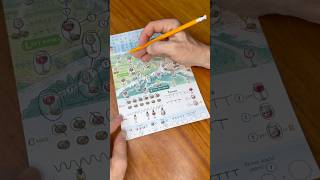
At Bordeaux's heart is simultaneous worker placement, the same system that powered Fromage and Fromaggio. Each player has three workers (represented as red, rosé, and white wine types) to deploy over 13 rounds. The critical twist: when you place a worker, you choose its duration from one to three years. A one-year placement frees that worker immediately, while a three-year commitment locks it up but provides a more powerful action. This creates the game's central tension, as Board Game Dad explains: "the core strategy is optimizing the timing of strategic worker placement so that you can make an unbroken wine tour, accomplish objectives, and ensure that your workers can complete valuable work and be available to be used again when you next need them most." Because all players act simultaneously, Bordeaux eliminates downtime entirely, keeping the table engaged from start to finish.
Paper-and-Pencil Execution
Rather than moving components around a board, players mark their personal sheet with pen or pencil. This format is deceptively elegant. Let's Table It sums it up: the game is straightforward, centered on deciding what workers will do each turn and how long they will work, while connecting wines together into a long path. The paper-based approach unlocks massive scalability: with 75 double-sided sheets in the book, TheGameBoyGeek counts 75 people playing at once, and Let's Table It cites a range of one to 100 players. The mechanic is neither roll-and-write (there are no dice) nor draft-and-write (there is no drafting). Where There's A Will calls it a choose and write: players select which workers to deploy and what to accomplish, then record their choices on their sheet.
The Bordeaux Experience
Portable Sophistication
Bordeaux was designed to travel, and reviewers consistently marvel at its success in that regard. Board Game Dad captures the appeal: "set up is immediate. You give people a paper and you're ready to go. You could easily play this on an airplane on a tray table." TheGameBoyGeek values it as a "couch game," one that doesn't require everyone seated at a table with all components in clear view. Let's Table It likes the book format, a tear-off pad with a protective sleeve, as a sensible alternative to shipping a pad in a box. This isn't a compromise on depth for the sake of convenience; reviewers see it as an elegant solution that preserves strategic play while enabling play in contexts where Fromage never could.
Endless Variation Through Unique Puzzles
What sets Bordeaux apart from most roll-and-write games is the sheer craftsmanship of its puzzle design. TheGameBoyGeek calls the 150 different puzzles just amazing, and says the book distills the Fromage puzzle into a travel-size game. The variable elements include different map layouts, different available actions, and different scoring bonuses. Board Game Dad highlights the consequence: "every game feel different from the last." Every session becomes a fresh puzzle within the same ruleset, rewarding players who master Bordeaux's core systems but ensuring novelty across dozens of plays. This design choice justifies repeated play in ways many pen-and-paper games struggle to achieve.
What Makes Bordeaux Stand Out
Beautiful Production and Attention to Detail
TheGameBoyGeek repeatedly emphasizes the quality of the book itself: thick, double-sided color pages and an excellent build. The inclusion of UV spotting on wine glasses and bottles throughout the pages shows that even in a function-first design, the publisher prioritized aesthetic care. This production quality signals respect for the game and the player's time, elevating what could have been a utilitarian pad into something worth keeping and returning to.
Seamless Scaling from Solo to 75 Players
Most games are designed for a specific player range. Bordeaux, by virtue of its simultaneous, paper-based design, is equally at home with one person and a solo ruleset as it is with 75 people in a convention hall. TheGameBoyGeek, who has run large charity game events, loves that 75 sheets means 75 people can play at once, or more with multiple copies. The solo rules, included in the back, are not an afterthought; they are cleverly designed to handle player selection for the solo player, maintaining the simultaneous decision-making that defines the game. This flexibility means a single copy serves multiple use cases: intimate solo study, family nights, or large-scale group events.
Potential Drawbacks
Worker Placement Tracking Can Confuse New Players
TheGameBoyGeek warns that the first game can be a little confusing when the same letter sits in a column from a previous worker. The mechanic itself is not complicated, but it differs enough from the physical pickup-and-place worker placement of Fromage and Fromaggio to create friction. DaniCha admits to one easy slip in solo play: reading a wine as left bank when its letters placed it on the right bank. Even attentive players need to read the sheet closely. A clear summary of the worker availability rules at the table would smooth early plays.
Three Available Workers Creates Inefficiency
Let's Table It raises a structural concern: "If you have three workers, one of them can't take an action. They will have to pass... So, plan things out to use one or two workers each turn, but three is not a good idea." This is not a flaw per se, but it means the turn structure incentivizes a particular approach and may feel wasteful if a third worker becomes available at the wrong moment. The game rewards careful planning to avoid this, but newer players unfamiliar with optimizing worker timing may find themselves frustrated by forced passes.
If You Enjoy Bordeaux
The natural companions are Fromage and Fromaggio. Where There's A Will notes that Bordeaux is by Ben Rosset, co-designer of both, and calls it basically a paper-and-pencil Fromage set in a winery, with red, rosé and white winemakers in place of the cheeses. Board Game Dad enjoys Bordeaux for many of the same reasons as Fromage and Fromaggio, while noting that it is simpler because it has no structures. TheGameBoyGeek recommends it to anyone who likes the first two games and wants something very similar that still feels different and fresh. Players who want the full tabletop experience should stay with Fromage; players who want that puzzle in a bag or on a plane should pick up Bordeaux.
What Reviewers Are Saying
"I can literally sit at the chair over there at night and just play a game of this really really quick does not take very long to play at all. I love fromage, fromage and fromaggio and this one really hit really well."
— Where There's A Will, There's a Play
"It has 200 different pages, which makes every game feel different from the last. The real question is what makes this game different from Fromage? And I would say that ultimately, this is a pen and paper version of Fromage. It is a bit simpler though, because in this game you don't have structures. The benefit of making it a pen and paper game is that it unlocks a much higher player count."
— Board Game Dad
"The fact that there's 150 different ones in here is just amazing to me. This definitely distills the Fromage puzzle to this sort of travel size game. And because of that, number one, it's great solo because you can just play it"
— TheGameBoyGeek