





Rebels Against Rebellion Deep Dive
What the Community Thinks About Rebels Against Rebellion
Rebels Against Rebellion is a card-driven, deck-building war game from Flying Pig Games, designed by David Thompson and Trevor Benjamin. It plays one or two players in about an hour and tells a very local story: Scott County, Tennessee, voted overwhelmingly against secession during the American Civil War, and one player defends its homes while the other commands Confederate forces. Early coverage is enthusiastic about the design. One Stop Co-op Shop calls it a fantastic war game and a light war game, and Zilla Blitz rates the solitaire mode a perfect 10 out of 10. The biggest reservation is that the solo bot can feel too strong.
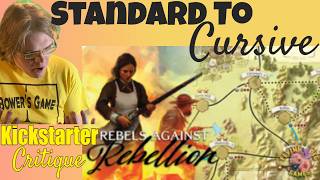
Some context on the coverage matters. Both Zilla Blitz and One Stop Co-op Shop played prototype copies ahead of the crowdfunding campaign, and One Stop Co-op Shop states that it accepts no money for coverage. Beyond Solitaire and Rolling Dice & Taking Names ran designer interviews with David Thompson, and Beyond Solitaire host Liz Davidson introduces Thompson as a recurring guest and co-designer on other projects. Bower's Game Corner reviewed the Kickstarter campaign page rather than the game itself.
Core Mechanics That Define Rebels Against Rebellion
Location-Driven Deck-Building
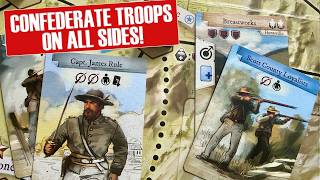
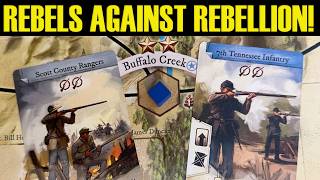
The game uses two kinds of cards. Location cards enter a player's deck when that player takes control of a place on the map, and locations can be improved: Zilla Blitz shows Huntsville upgrading to Huntsville and Breastworks, raising its defense from 1 to 3, and Buffalo turning into the Julia Markham card. Unit cards arrive when a player bolsters forces, so a humble Home Guard can grow into Captain Bill Hamby. Cubes on the map mark control rather than troops, and stars are victory points, with Huntsville worth 3.
Attacks happen along a point-to-point map. Zilla Blitz explains that roads allow up to three attack cards, creeks and rivers two, and trails one, and attackers commit cards face down. One Stop Co-op Shop highlights the tension built into this: more locations let a player project more influence, since attacking requires an adjacent location, but those location cards also clog the deck and make it harder to draw the card that is needed.
Food as Resource and Timer
Food drives both the economy and the clock. One Stop Co-op Shop describes 40 light food and 10 dark food; once the light food runs out, the game enters sudden death. Zilla Blitz puts it the same way: when the main supply is gone and only the last reserve of 10 remains, whoever starts a turn in the lead wins. The darker food near the end means the game can stop at almost any moment, so every late turn carries weight.
The Rebels Against Rebellion Experience
Holding On Against the Odds
The two sides use the same actions but play very differently. In the Beyond Solitaire research episode, David Thompson calls the game extremely asymmetric: the Scott County player is simply trying to hold on. The Confederate player has big, powerful units, but in the Rolling Dice & Taking Names interview Thompson explains that those forces have to maintain supply and cannot stay. One Stop Co-op Shop sees the consequence on the table. The Confederacy has a unit problem, because units go away as they win, so the loyalists can win a war of attrition. The loyalists start with six locations and 11 victory points, improving a location adds a point, and defeated forces are kept as points.
Fresh Games From a Fixed Map
Despite a single historical map, One Stop Co-op Shop found that games feel fresh each time and that the turn-to-turn choices are really interesting. It is also approachable. The reviewer taught it to a spouse who had never played a war game but had played deck builders, and that new player was totally getting it and put up a good fight. Zilla Blitz rates its complexity 3 out of 10 among war games, notes a 24-page rulebook, and expects players to be up and running after one quick learning game.
What Makes Rebels Against Rebellion Stand Out
Deep Local Research
The historical grounding is the headline feature. Beyond Solitaire devotes an entire episode to the research behind the board and book. Thompson describes how the War of the Rebellion atlas showed only a couple of roads through Scott County, which sent the research to the local historic society and its records. Named individuals from the county appear on cards tied to real places. The game ships with a historical companion book that Zilla Blitz counts at 38 pages, and Thompson says it will also be released as a free PDF when the game comes out. Zilla Blitz also praises the artwork, especially how the card art blends with the geography of the 22 by 34 inch mounted map.
A Solo Bot With Little Overhead
Solo play puts the human on the Scott County side against an automated Confederacy. Zilla Blitz calls the bot robust, saying it does not feel tacked on and plays like a legitimate opponent. One Stop Co-op Shop agrees it is very quick to resolve and presents a great challenge without much overhead.
Potential Drawbacks
A Relentless Bot With No Difficulty Levels
The same bot is the main concern. Zilla Blitz lost four straight solo games, including 20 to 6 and a closer 17 to 14, and concluded that the AI is indeed relentless. One Stop Co-op Shop found it a little bit too intense, winning only once in seven or eight solo games, and that win felt like a fluke. There are no difficulty levels, so the reviewer sent suggestions to the designers and planned a variant video. The competitive two-player game drew no complaints: One Stop Co-op Shop calls it 100 percent awesome.
Supply Rules and a Rough Campaign Launch
The supply rules were the one sticking point for the new player One Stop Co-op Shop taught, even though everything else made sense. The Kickstarter campaign drew harsher criticism. Bower's Game Corner called the early bird deluxe pledge, available for only 30 minutes, the worst early bird structure in more than 1,200 critiques, and objected to $20 United States shipping for a game about the American Civil War. The same channel still considered the $65 MSRP a good price and said the game looks awesome.
If You Enjoy Rebels Against Rebellion
The only direct comparison in the coverage comes from One Stop Co-op Shop, which had heard that earlier war games tied locations to cards and wondered whether Wilderness War was one of them. Players who enjoy card-driven war games built around contested locations may want to look there. Separately, One Stop Co-op Shop notes that Thompson and Benjamin also designed Undaunted and War Chest; that is designer lineage rather than a gameplay comparison, but fans of those games will recognize the pedigree.
What Reviewers Are Saying
"I think this game is great. I love love the deck building concepts here, which at least I've never seen before, although I did hear that some war games I haven't played before have done locations tied to cards before."
— One Stop Co-op Shop
"Uh for solitaire, I'll give it a 10 out of 10. The bot system seems fairly robust. It's not doesn't feel tacked on. It feels like a legitimate opponent that a lot of thought has been put into."
— Zilla Blitz
"Do I want it? Yeah, I do. I really do. I am a historically themed nerd."
— Bower's Game Corner