






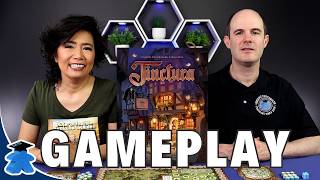
Tinctura Deep Dive
What the Community Thinks About Tinctura
Reviewers across the board recognize Tinctura as a standout euro game that successfully marries thematic depth with engaging mechanics. The game's 18th-century pharmacist setting immediately captures attention, and the execution lives up to the premise. Meeple University and BoardGameCo both highlight the vibrant, thematic experience that unfolds across five days of gameplay. The Board Game Garden mentions late backing the game on crowdfunding, reflecting genuine enthusiasm despite initial hesitation. The Dice Tower team praises the real-world foraging theme and the potions-and-foraging feel, calling out one of the best promotional videos they've seen in recent memory. There is broad agreement that Tinctura delivers on its promise of meaningful decision-making wrapped in an accessible, immersive theme.
Core Mechanics That Define Tinctura
Simultaneous Action Programming
At Tinctura's heart lies a clever system where players use privacy screens to program their actions for the day, placing tokens on a clock face to indicate the time and location they wish to visit. Once all players reveal their choices, actions resolve hour by hour. This simultaneous selection creates tension because players commit to locations without knowing what opponents will do, yet the time slot they choose affects their access to the best actions. As Meeple University explains, the game becomes one of "trying to work out what is the right time to do the right action" with "the fear of that action might be gone by the time you get to it because your opponents get to it first." The elegance of this system lies in the turn order track, which rewards players who take fewer turns early, granting them initiative if they ever compete for the same time slot and location.
Engine Building Through Permanent Upgrades
Players invest early-game actions into apprentices, skill training, and workshop furnishings that compound in power as the game progresses. BoardGameCo emphasizes the "deep engine-building through apprentices and journeymen" that creates "long-term payoff," while Meeple University highlights how players build "clear, thematic engine-building paths" with "meaningful decisions" that pay off in the endgame. Apprentices unlock special recipe bonuses tied to specific medicines. Training increases skill tracks in botany, pill pressing, mixing, and heating. Furnishings on the village merchant board advance four different tracks that unlock in-game bonuses and endgame scoring. These pieces interlock: a player who invests in pill pressing early can train an apprentice who grants bonus points every time pills are made, creating a positive feedback loop that dominates the late game.
The Tinctura Experience
Tension Through Time and Resource Scarcity
Tinctura creates constant low-level pressure by forcing players to make hard choices about where to allocate their nine hourly action tokens each day. Forest resources get picked over as the day progresses, meaning the earliest foragers get full choice but fewer items, while later foragers get more items but must accept what remains. Patient cards that appear throughout the day must be healed by the next day's matching time slot, or they disappear and cost reputation points. The market has shifting hours each day, so players must predict which time window will suit their plans. Meeple University describes the anxiety of the strategic choice: if you miss your foraging window, the specific herb you needed to cure your patient vanishes. These cascading constraints mean almost every action trade-off matters.
Satisfying Synergy and Payoff
The game rewards careful planning and the patience to invest in infrastructure early. BoardGameCo notes the "clever day-by-day timing and simultaneous reveal create tension and planning depth," and Meeple University appreciates the "solid end-game depth with multiple scoring levers." When an apprentice whom you trained last round suddenly unlocks a powerful bonus for a medicine you're about to make, or when a furnishing upgrade from the merchant lets you speed through training, players feel the architectural beauty of their decisions paying off in real time. The apprentice training sequence (where you must allocate an action token to teach a new hire before they can help you) is a small mechanical burden that feels thematic and keeps the early-game investment from becoming oppressive.
What Makes Tinctura Stand Out
Accessibility Wrapped in Euro Complexity
Tinctura manages to feel like a mid-weight euro without overwhelming new players. The five-day structure gives the game a natural rhythm, and each location (forest, village, pharmacy) has a clear purpose that players grasp quickly. Meeple University notes the "vibrant, thematic presentation with accessible humor," suggesting the game's tone keeps it light despite mechanical depth. BoardGameCo identifies "a clear path between forest gathering, village training, and pharmacy" that makes turn-by-turn decisions intuitive even as the long-term engine-building complexity unfolds underneath. The Dice Tower team specifically praised the promotional video as one that lets viewers "know how it functions" and "understand the kind of game they're making, right? And who their target audience is," without requiring deep rulebook dives.
Thematic Coherence and Memorable Details
Every mechanic reinforces the fantasy of running an 18th-century pharmacy. Botany skill grows by gathering plants in the forest and studying their properties. Pills and ointments require specific ingredients and skills, mirroring real apothecary work. Patients arrive with quirky, period-appropriate ailments like "shoulder bite," "neck cracking," and "wandering tooth," each with a humorous flavor that keeps the game light. Making tea and advancing your mortar track feels tactile and thematic. Meeple University describes the patient ailments as "very very funny," while the apprentice system (where you hire and train apprentices to eventually become journeymen helpers) grounds the engine-building in the narrative of building a reputation and staff. The merchant changes their inventory each day and has shifting hours, mimicking real-world commerce constraints.
Potential Drawbacks
Learning Curve in Rule Interactions
BoardGameCo warns that Tinctura is "a complex system with multiple tracks and interactions may require a learning period," particularly because the game layers many interconnected systems: the clock programming, foraging scarcity by time of day, apprentice management, multiple skill tracks, patient care deadlines, and market mechanics. Meeple University notes that "apprentice management can slow rounds and require careful planning," and the need to train newly hired apprentices adds another layer of scheduling constraint. Players new to euro games may struggle initially with holding all these pieces in mind simultaneously, though the five-day structure gives them a full game to ramp up understanding.
Prototype Status Creates Uncertainty
BoardGameCo explicitly reminds viewers that "this is a prototype copy in front of me so all rules, components and things like that are subject to change." While the core gameplay is clearly solid, final polish on component quality, rule clarity, or potential balance tweaks remain unknown at the point when reviewers filmed their coverage. Players considering a crowdfunding pledge should be aware that the final retail version may differ from what reviewers experienced.
If You Enjoy Tinctura
Players drawn to Tinctura's euro mechanics will find similar satisfaction in Ticket to Ride's network-building or Agricola's worker placement coupled with resource management. Those who love the thematic pharmacy setting and herbalism mechanics should explore Cascadia for nature-focused gameplay or Calico for quilting-themed puzzle satisfaction. Fans of engine-building games like Everdell or Splendor will recognize the same satisfying arc of early-game setup leading to late-game payoff. The Dice Tower team's appreciation for clear, elegant design and real-world theming suggests players who enjoyed Wingspan or Viticulture would also appreciate Tinctura's approach to grounding euro mechanics in accessible, evocative settings.
What Reviewers Are Saying
"It's a game of trying to work out what is the right time to do the right action and also with the fear of that action might be gone by the time you get to it because your opponents get to it first."
— Meeple University
"This is a game that's very clever where you're playing over the course of five different days that you'll track over here a typical work week for your pharmacist if you will. And you are working over the course of 9 hours so you have from 8:00 to 4:00 you are filling your day with your work."
— Professor Meg, BoardGameCo
"This is one of the best videos I've seen in a long time. It's not flashy. It's not expensive. Doesn't look expensive. But I watched that video and I know if I would like this game or not and I know how it functions."
— The Dice Tower