




Encyclopedia of Monsters Deep Dive
What the Community Thinks About Encyclopedia of Monsters
Encyclopedia of Monsters has struck a remarkable chord with reviewers across the community. Players repeatedly cite it as one of their favorite memory games ever released, and the enthusiasm is genuine. One enthusiast reports playing it over 20 times and wholeheartedly recommends it to any family with children between 5 and 10. The game's 30 dollar MSRP is widely celebrated as an absolute steal, with reviewers noting you will easily extract 15 to 30 distinct games from the five boxes alone, making replayability and value exceptional by comparison to most children's games on the market.
Core Mechanics That Define Encyclopedia of Monsters
Cooperative Memory Matching with Escalating Difficulty
At its heart, Encyclopedia of Monsters presents a deceptively simple system. Players hold cards in hand, each with special abilities tied to monster iconography. On your turn, you perform the action on one of your cards, which usually involves flipping a tile blindfolded or with eyes open while others observe. The core memory loop involves searching for specific creatures while teammates retain information from revealed tiles. As you progress through the five continents (Europe, Americas, Asia, Africa, and underwater in the final box), the game introduces new mechanics that layer onto this foundation. The dog card functions as a wild, offering flexibility. Later, the banshee card demands that teammates verbally navigate a blindfolded player to the correct tile in the center of the board, creating a collaborative puzzle within the cooperative structure.
Progressive Unlocking Across Five Distinct Boxes
The design brilliance lies in how Encyclopedia of Monsters reveals itself gradually. Each box contains a rulebook that teaches you how to play that specific section while introducing regional monsters and wildlife. You might encounter mummies that require dice rolls in one location, mermaids with a breathing mechanic in the underwater section, or creatures with unique card combinations. Reviewers noted that each of the 15 games feels genuinely distinct, with their own quirks and flavor. Players are not simply repeating the same puzzle 15 times but rather experiencing 15 small, self-contained memory adventures that share a common core system but feel fresh each time.
The Encyclopedia of Monsters Experience
Discovery and Thematic Learning
Beyond the mechanics, Encyclopedia of Monsters weaves education into play. The rulebook for each box teaches you about real locations: Scotland, Japan, tropical regions, and the depths of the ocean. Players encounter monsters and creatures from folklore in these real settings. One family pulled out a full atlas during play because one location had an unusually detailed description of lakes. This world-building is not preachy or detached. It arrives naturally as flavor text and artwork, inviting curiosity. For younger players especially, the game becomes a vehicle for discovery, learning geography and mythology alongside the memory challenge.
Escalation and Satisfying Challenge Progression
The five boxes create a satisfying arc of increasing complexity. The first box (Europe) teaches the basics with straightforward mechanics. By the final box, you are managing breathing meters, multiple-item searches, and advanced card combinations. Reviewers appreciated that this escalation does not overshoot younger players. The game remains accessible at age 6 and above, yet offers enough strategic depth that adults engage meaningfully. Limited communication rules (you cannot verbally share what is in your hand or what you see) add social tension and cooperative challenge that scales with player experience.
What Makes Encyclopedia of Monsters Stand Out
Exceptional Design Pedigree and Replayability Value
Encyclopedia of Monsters comes from three designers with proven track records. Antoine Bauza designed 7 Wonders and Ghost Stories, both regarded as genre-defining games. Corentin Lebrat and Théo Rivière also carry strong credentials in the hobby. This pedigree matters because the design is lean and intentional. At 30 dollars MSRP, you receive 15 minimum plays (likely 20 to 30 in practice) in a compact box. Each game takes 15 to 30 minutes, making it ideal for family sessions or casual hangouts. Reviewers consistently highlighted the bang for buck as rare in modern board game publishing, especially for cooperative titles.
Iconic Simplicity and Accessibility Across Age Ranges
The iconography is so clear that a four year old can understand and play meaningful turns with minimal coaching. Monster symbols are distinct and memorable. Card actions use simple pictorial language rather than dense text. This accessibility does not dumb down the experience. Adults find the memory challenge and cooperative timing genuine. The game respects the intelligence of younger players while demanding engagement from adults, achieving a rare balance in family design.
Potential Drawbacks
Repetitive Monster Mechanics in Later Continents
One consistent observation among reviewers is that some of the final boss monsters across continents follow a similar pattern. In Europe, the Americas, and Asia, the closing monster challenges all require finding multiple tokens in a specific sequence or combination. While each feels like its own puzzle, the underlying structure repeats. One player noted that the Banshee, which appears early, would have made an excellent finale monster due to its unique navigation mechanic. A few players wished the designers had rotated finale mechanics more to sustain novelty through the fifth box.
Component Quality Issues and Card Duplication
The skeleton cards, which appear identically in multiple boxes except for different-colored card backs, create frustration. If a card becomes damaged during play in one continent, you cannot substitute a skeleton from another box because the backs do not match, leaving a gameplay gap. Additionally, one physical component, a lamp that stands during certain sections, consistently failed to remain upright during play and required house-ruling with an external stand. These represent missed opportunities for better component design or thoughtful component reuse that does not rely on visual matching.
If You Enjoy Encyclopedia of Monsters
You might also love Ghost Stories, also from Bauza, which offers cooperative puzzle solving with escalating difficulty. Sea Salt and Paper, from one of Encyclopedia's co-designers, delivers a lighter memory and bluffing game with beautiful presentation. Werewolf attracts similar players who enjoy social deduction and limited communication mechanics. For memory specifically, 7 Wonders Duel appeals to fans of the design pedigree and multi-path decision-making. If the travel and learning elements resonated with you, games themed around geography or world discovery often pair well with Encyclopedia of Monsters in a collection.
What Reviewers Are Saying
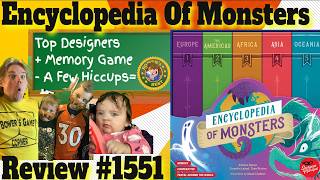
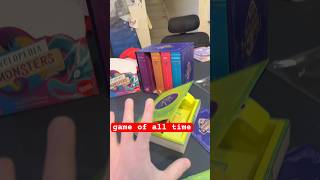
"I think this might be my favorite memory game of all time. And let me tell you, I don't use those words lightly, because I really love board games, specifically family and children's board games."
— Bower's Game Corner
"It's a cooperative game, it's a memory game, but I think you can play each of these are continents, and so there's these different monsters all over these different continents, so you're learning about real world geography while playing a cooperative memory game about monsters. And like, that shouldn't go together at all, but it does, and I can't wait to see how."
— Ryan and Bethany Board Game Reviews
"The name and just the vibes of this, it's like a little cube of a bunch of little boxes, which I think is so cool... I am super intrigued by just the look of the game and the theming of like having an encyclopedia of monsters. I think that's just so cool."
— The Board Game Garden