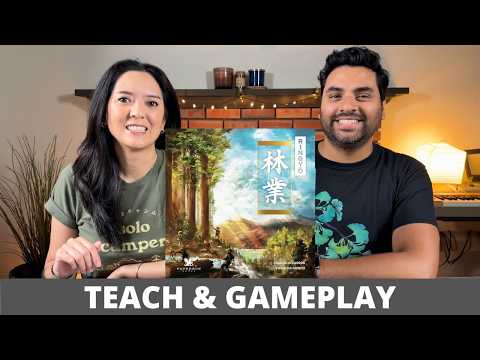



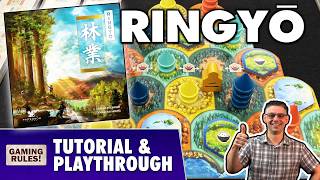



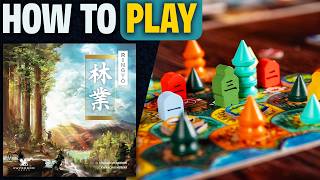

Ringyo box art

Ringyo

Game ID: GID0458076
Game Info
Year
2026
Players
1-4
Age
14+
Playtime
68 min
Collection
Your Tier
Loading…
Mechanic profile
Not enough video data yet
Vibe profile
Not enough video data yet
Description

Players are daimyo developing provinces through sustainable forestry in feudal Japan

Description

Players are daimyo developing provinces through sustainable forestry in feudal Japan

Ask a Rules Question
All mentions
Browse transcript mentions, sentiments, pros/cons, mechanics, topics, quotes, and references.
Total mentions: 9
This page: 9
Sentiment: pos 8 · mix 0 · neu 1 · neg 0
Mentions per page
Showing 1–9 of 9
Video f6utGghbaVY Before You Play Playthrough at 0:05 sentiment: positive
video_pk 95168 · mention_pk 261197
Before You Play - Ringyo video thumbnail
Click to watch at 0:05 · YouTube ↗
Overall sentiment (raw)
positive
Pros
  • Managing flood tokens and converting flooded areas to rice paddies is key.
  • Simultaneous action selection can lead to interesting plays.
  • Engine building through research tracks and structures.
  • The weather phase and flood mechanic add strategic depth.
  • Shogun's demand tiles provide clear objectives.
  • The game offers multiple paths to scoring points.
  • The final scoring incentivizes diverse strategies.
Cons
  • The game can be complex with many actions and rules.
  • Misreading arrows on the research track can have consequences.
  • Some Shogun's favor cards can be tough to fulfill.
Thematic elements
  • Managing provinces as feudal lords to satisfy the shogun and score honor points.
  • Edeto period of Japan
Comparison games
none
Mechanics (from transcript analysis)
  • Area management — Managing province board spaces, including dealing with flood tokens and expanding the province.
  • Hand Management — Managing diplomat cards, Shogun's favor cards, and forestry cards.
  • Resource Management — Managing rice, military tokens, and research tokens.
  • Set Collection — Collecting specific tree combinations to build structures.
  • Simultaneous action selection — Players choose actions at the same time. Demonstrated sequentially in the playthrough.
  • Tile Placement — Placing bonus land tiles to expand the province.
  • Worker Placement — Placing workers on action spaces on the player board.
Video topics + discussion points
No key topics recorded for this video.
Quotes (from this video)
  • The probabilities do not actually influence these cards are just shuffled and randomly randomly placed. The probability is just in the case of a tie.
  • So, this is why you really need to manage the flood tokens on your board because things can escalate quickly.
  • This building is this 11 points right here.
References (from this video)
No references stored for this video.
Video 4bZQ-boWjoc Gaming Rules! Discussion at 34:10 sentiment: neutral
video_pk 81099 · mention_pk 309567
Gaming Rules! - Ringyo video thumbnail
Click to watch at 34:10 · YouTube ↗
Overall sentiment (raw)
neutral
Pros
none
Cons
none
Thematic elements
Comparison games
none
Mechanics (from transcript analysis)
Mechanics unknown.
Video topics + discussion points
No key topics recorded for this video.
Quotes (from this video)
  • Cloudspire is one of those games that I would absolutely love to play more of and there are plans for a rematch between me and JP on my birthday week in July.
  • The Graft is one of the new factions that just came out and it doesn't have a fortress. What it does is it has one piece on the board which moves around and that is their fortress. So, it's actually a mobile piece and it's big amoeba type thing.
  • That's that's nonsense. Um where things like saving the game, the math, the upkeep is made trivial by the video.
  • I have Frostpunk the board game. I have Frostpunk the computer game. They're the same game, but they are entirely different experiences.
  • As much as I love Agemonia, it's a 30-minute setup each time we play because we're having to get all of these things out and these things and these things and these things. And that's just the nature of the game.
  • No.
  • Give me a good Uwe Rosenberg game, Feast for Odin. Feast for Odin solo, I love it. It's a beat your own score game, but I I love it.
  • The reason why it was a bad experience for me is the solo mode for Perseverance is a very good solo mode at recreating what another player would do, but it was so far beyond my comfort level I really struggled.
  • My favorite game in that category is probably either Tower Up or Ingenious. I might have to give it to Ingenious just because of my personal story with that game and the fact that I can play it with Vicky and her family and things like that.
  • My copy of Imperium Classics, Imperium Legends, and Imperium Horizons have left my collection.
  • I love Star Trek Captain's Chair, so there will never ever be a situation where I would prefer to play Imperium compared to Star Trek Captain's Chair.
  • Assyria second edition, which has only just come out, is my favorite game from Garfield Games.
  • So, if you're asking honestly for my favorite game from Garfield Games, it has to be Assyria second edition.
  • The discussion has been had a number of times.
  • It's not as easy as people think.
  • 65% of people say that polyomino games are a subset of tile laying games.
  • The secret word is scissors.
  • As of this morning, we had 1,331 patron supporters.
  • I will be back tomorrow at 4:00 with a live unboxing of the deluxe version of World Order.
  • And then on Friday is the public public release of the final video in the Star Trek Captain's Chair series, which is the Pike solo play through.
References (from this video)
No references stored for this video.
Video lsPCiHMWsLs Crimsonboardgames Top List at 14:03 sentiment: positive
video_pk 80988 · mention_pk 313720
Crimsonboardgames - Ringyo video thumbnail
Click to watch at 14:03 · YouTube ↗
Overall sentiment (raw)
positive
Pros
  • Soloable
  • Looks cool
Cons
none
Thematic elements
  • Overseeing a personal province as a daimyo or feudal lord
  • Edo period of Japan
Comparison games
none
Mechanics (from transcript analysis)
  • auction and bidding — It is an auction bidding game.
  • Worker Placement — It is a worker placement game.
Video topics + discussion points
No key topics recorded for this video.
Quotes (from this video)
  • Next we have Song of the Wild Kin one to four players area movement cooperative game deck bag and pool building. That all sounds perfect to me.
  • So, we don't have anything to show yet really. So, we only have the box art. But look how cute that looks.
  • Action-packed co-op game.
  • This could again be very gimmicky. But I'm curious to see.
  • I mean, it's obviously Cthulhu themed. Love that.
  • I don't know. It might suck, you know.
  • This is just an insta buy for me. I'm just going to get it.
  • Um they just look so cute and they're both one to four or like at least this one's one to six and this one's one to four players.
  • I'm very, very sad that this does not have a solo option because it looks so freaking cute...
  • Look at how stunning this looks. I mean, excuse me?
  • But, some for some reason this grabs me even more.
  • I hope you guys enjoyed um that um I'm very excited about UK Games Expo.
References (from this video)
No references stored for this video.
Video eeYkeExY6jU kovray Top List at 4:49 sentiment: positive
video_pk 80931 · mention_pk 309466
kovray - Ringyo video thumbnail
Click to watch at 4:49 · YouTube ↗
Overall sentiment (raw)
positive
Pros
none
Cons
none
Thematic elements
Comparison games
  • Skyrockets
  • Four Humors
Mechanics (from transcript analysis)
  • Simultaneous worker placement — This is a simultaneous worker placement game.
Video topics + discussion points
No key topics recorded for this video.
Quotes (from this video)
  • So, we have two more games to talk Oh, wait, no. I guess four more games to talk about because two to buy and two to demo. Wait, one more to demo, two buy. Oops, silly little figured.
  • You're going to play and you're going to instantly get hungry cuz all the unique illustrations and of all the little treats are just
  • This is a The Lord of the Rings. The Lord of the Rings and it is a roll and write. It is a roll and write.
  • I understand the game being like very much you're playing the person on your right and you're playing the person on your left. You're taking the role of like the good and the bad in this game to uh go on against the opposite on the right and the opposite on the left and I think there's a lot of interactions that go on, a lot of communication that will have to happen around the table to make sure that the turns are flowing.
  • I'm a huge fan of Sashi and Sashi and they will be debuting to move Railway Porters at UKGE.
  • It is by Taiki Shinzawa and it's a trick taking game where every player has a condition that they must follow in their trick taking. But every condition is different.
References (from this video)
No references stored for this video.
Video hs4qFJntJM8 Board Stupid Discussion at 11:43 sentiment: positive
video_pk 80824 · mention_pk 198155
Board Stupid - Ringyo video thumbnail
Click to watch at 11:43 · YouTube ↗
Overall sentiment (raw)
positive
Pros
  • Really enjoyed it
  • Cool mechanics
  • Weather mechanics are very cool
  • Strategic resource utilization
  • Auction system determines first player
  • Balanced bidding system
  • Made interaction in a multi-solitaire game
  • Really cool
Cons
  • Concerns about it being just multi-solitaire were unfounded
Thematic elements
  • Sustainable land management and development
  • Japan
Comparison games
none
Mechanics (from transcript analysis)
  • Auction — A core mechanic to determine player order, with bidding involving potential rewards and penalties.
  • Resource Management — Managing resources like trees and land is key.
  • Set Collection — Implied through needing to fulfill contracts and manage resources for building.
  • Tile Placement — Players grow trees on different terrain types and build structures.
  • Weather system — A mechanic where weather affects terrain and growth.
  • Worker Placement — Players place workers to perform actions.
Video topics + discussion points
No key topics recorded for this video.
Quotes (from this video)
  • There was a a new version of Mexico which is actually part of the Mask trilogy of games. And this new version looks absolutely awesome.
  • if you like old school Eurogames like I do, go check that out. It's an old school Euro area control game.
  • It's take Flip Seven, mix it with craps.
  • The really cool things that they've done, you can play without, but there is an app that actually takes away all the mean math that you normally have to do with Flip Seven, for example.
  • Ubongo is a cooperative dexterity game and it is the dumbest, most amazing thing. It's so stupid.
  • This is the perfect pub game.
  • Ridiculous fun.
  • Worth a pop for like 15 quid. Great fun. We had a blast with it. Very silly. Very, very fun.
  • I met Hugo Myatt who played the original Treguard in uh, in Nightmare and uh, my face just absolutely lit up.
  • the Eden game was can't wait and I couldn't wait can't win, sorry. I couldn't I couldn't wait to go and grab it. It's it's all gone. Sold out. It was sold out literally like 10 minutes after the the show was open.
References (from this video)
No references stored for this video.
Video MHbBlBBlkjk Gaming Rules! Rules Teach at 0:03 sentiment: positive
video_pk 80183 · mention_pk 313530
Gaming Rules! - Ringyo video thumbnail
Click to watch at 0:03 · YouTube ↗
Overall sentiment (raw)
positive
Pros
  • The game has thematic depth with the research track.
  • Simultaneous play in the province phase makes it engaging.
  • Weather mechanics add an interesting layer of consequence.
  • The diplomat selection for turn order adds interaction.
Cons
  • Building higher up on the player board costs extra rice.
  • Some actions are complex to explain, like building and studying.
  • The risk of cascading floods can be devastating.
Thematic elements
  • Sustainable forestry and rebuilding after a period of conflict.
  • feudal Japan in the 1600s
Comparison games
none
Mechanics (from transcript analysis)
  • action selection — Workers have a certain number of actions based on their level, performing actions on surrounding spaces.
  • Area Control — Players expand their provinces by adding tiles to the edges.
  • Hand Management — Forestry cards are one-use abilities that can be played or discarded for rice.
  • Resource Management — Managing wood, rice, and military tokens is crucial for building and actions.
  • Set Collection — Players collect sets of trees or fulfill Shogun's demands for points.
  • Simultaneous action selection — The province phase is played simultaneously, though explained turn-by-turn for teaching.
  • Track Advancement — Players move markers up the research track for bonuses and end-game scoring.
  • Worker Placement — Players place workers (samurai, artisans, villagers) onto intersections on their board to perform actions.
Video topics + discussion points
No key topics recorded for this video.
Quotes (from this video)
  • So, Ringyo actually translates, we were talking about this earlier on, to forestry.
  • Any game with weather gets a thumbs up in my books.
  • The diplomat that you use is gone for the game.
  • The first important rule to remember is that your samurai are yours.
  • The research track is your other track that you have, and you will have a marker that starts off on the bottom space.
  • This is the part of the game which I find thematically fascinating.
  • The more you build, the more points you're going to get at the end of the game.
  • The risk was if I left that area empty and it rained there twice, then what would have happened is the second flood tile would have been added, and then it would have gone down to either there or there, and it would have been, based on this card, it would have been the pine, but I would have lost it, so I decided not to do that.
References (from this video)
No references stored for this video.
Video 0aLdLS2xHXw BoardGameCo Preview at 0:02 sentiment: positive
video_pk 80054 · mention_pk 305903
BoardGameCo - Ringyo video thumbnail
Click to watch at 0:02 · YouTube ↗
Overall sentiment (raw)
positive
Pros
  • Multiple ways to gain victory
  • Can go for diversity in scoring or synergize cards
  • Can build structures for points and benefits
  • Can advance on forestry track for points and benefits
  • Randomized goals offer replayability
Cons
  • Floods can be detrimental and cause players to lose trees
  • Someone is always left with the least appealing option for diplomat cards
  • Losing workers (villagers/artisans) at the end of the round
Thematic elements
  • Growing and managing forests, accomplishing shogun's demands
Comparison games
none
Mechanics (from transcript analysis)
  • action programming — Secretly choosing diplomat cards each round to determine player order and gain potential benefits.
  • Area management — Managing your own province of forests, placing structures like rice paddies and fortresses.
  • Resource Management — Managing resources like rice and military tokens to build structures and perform actions.
  • Set Collection — Gathering different types of trees and potentially pairs of those trees for scoring.
  • Simultaneous action selection — Players are going to be simultaneously placing out their workers to perform actions in their own province.
  • Tableau Building — Building structures like fortresses and farms within your province.
  • Track Advancement — Advancing on your forestry track by studying trees, which provides benefits and end-game scoring.
  • Worker Placement — Players are going to be using simultaneous worker placement to grow their forests.
Video topics + discussion points
No key topics recorded for this video.
Quotes (from this video)
  • This is a sponsored preview and this is a prototype copy in front of me, so all rules, components, and things like that are subject to change.
  • So, all of these different things are going to feed into ways that you are able to get victory points for yourself because you have shogun's demands at the end of each round the players are trying to accomplish, and it's all a race for victory points where if you are the first one to do so, you get the most and everyone after that is going to get less than you.
  • So, you want to make sure that you have everything that is necessary to be able to accomplish that, including being first in priority order, which is all going to happen with the diplomat that you choose for each turn.
  • So, you're going to have a hand of six cards numbered one through six, and those are going to be your diplomats.
  • This is when players are going to be simultaneously placing out their workers to perform actions in their own province.
  • Over the course of five rounds, players are going to follow this general phasing where you're going to choose your diplomats to determine player order, as well as perhaps a benefit for yourself that you were hoping to gain.
References (from this video)
No references stored for this video.
Video fXFEqFgmcUM kovray Rules Teach at 0:05 sentiment: positive
video_pk 80096 · mention_pk 304825
kovray - Ringyo video thumbnail
Click to watch at 0:05 · YouTube ↗
Overall sentiment (raw)
positive
Pros
  • Players can achieve bonuses by building structures in rows, columns, or adjacent spaces.
  • Farms double rice production.
  • Fortresses provide military tokens.
  • Forestry track advancement is a primary way to obtain research tokens.
  • Forestry cards can be used to gain bonuses or complete actions without a worker.
  • Special actions allow for tree manipulation, hiring villagers, expanding the province, and manipulating weather cards.
  • Weather effects can be positive (tree growth, rice generation) or negative (floods).
  • Shogun's demands offer honor points.
  • End-game scoring includes structures, forestry track progress, Shogun's demands, and Shogun's favors.
Cons
  • Diplomat cards used in a round are permanently discarded.
  • Floods can destroy trees, rice paddies, and structures.
  • Building in higher spaces of the structure board requires paying food.
  • Only one worker can be placed in each intersection.
  • Workers cannot be placed on the edge intersections of the province board.
Thematic elements
  • Managing a personal province as a daimyo, impressing the shogun.
  • Feudal Japan (Edo/Tokyo)
Comparison games
none
Mechanics (from transcript analysis)
  • action selection — Players choose from a variety of basic, artisan/samurai-specific, and samurai-only actions.
  • area control/influence — Controlling spaces in the province with trees, paddies, or structures and managing floods relates to area influence.
  • Card Drafting — Players draft diplomat cards, Shogun's favor cards, and bonus land tiles.
  • Resource Management — Players collect and spend resources like rice, military tokens, and research tokens.
  • Set Collection — Fulfilling Shogun's demands and achieving Shogun's favors involves collecting sets of resources or meeting specific conditions.
  • Simultaneous action selection — The province phase involves players taking actions simultaneously.
  • Tile Placement — Players place bonus land tiles and flood tokens on their province boards.
  • Track Advancement — Players advance on the forestry track to gain bonuses.
  • Variable Player Powers/Goals — Shogun's favor cards provide personal goals.
  • Worker Placement — Players place workers (samurai, artisans, villagers) on their province board to take various actions.
Video topics + discussion points
No key topics recorded for this video.
Quotes (from this video)
  • Together we make up Calvert, a couple that loves to play board games.
  • As a note, what you see in this video is still a prototype of the game and the final game may be subject to change.
  • In Ryo, you'll play as a daimyo, a feudal lord overseeing your personal province.
  • The goal in this game is to earn the most honor points.
  • This game is played over a course of five rounds with each round containing four phases.
  • The diplomat with the number one will allow you to draw three bonus land tiles.
  • The description must cite something specific from the transcript. Generic game knowledge is not a vibe.
  • You'll take back the yellow and green samurai back to your own supply.
  • And that's Ryo. Do you have any questions?
  • Now, for our question of the day, we have explored the forestry industry. What industry would you love to see a game be depicted about?
  • But until next time, we will see you later.
References (from this video)
No references stored for this video.
Video 9FFBe7rEKjA Board Gaming Ramblings Review at 0:07 sentiment: positive
video_pk 80098 · mention_pk 305258
Board Gaming Ramblings - Ringyo video thumbnail
Click to watch at 0:07 · YouTube ↗
Overall sentiment (raw)
positive
Pros
  • Interesting balancing act between different strategies (tree cutting vs. growing, building vs. not building).
  • Simultaneous play doesn't add too much playtime.
  • Core puzzle of different workers with different actions is good.
  • The risk management aspect with the river mechanics is engaging.
  • The game is not too long.
Cons
  • Player interaction is limited due to simultaneous play.
  • The bidding/priority card system feels less impactful with two players.
  • Some scoring cards (e.g., military power, city building) might be unbalanced or not well-understood.
  • Can lead to a 'water park' scenario if mistakes are made early.
Thematic elements
  • Forestry
Comparison games
none
Mechanics (from transcript analysis)
  • Action Point Allowance — Workers have a specific number of actions (one, two, or three) they can perform per placement.
  • Area Activation — Weather events activate specific areas on the player board, potentially causing trees to grow, flood, or die, and affecting rice paddies.
  • Blind Auction — Players choose priority cards face down in a blind auction to determine player order, with bonuses or costs associated with the chosen number.
  • Resource Management — Players manage resources like wood from trees to build structures and convert land to rice paddies to gain income.
  • Set Collection — Players can build buildings (farms, fortresses) which function like a tech tree, with bonuses and points awarded for certain combinations or quantities.
  • Variable player powers — Different worker types have distinct abilities and action counts, influencing player strategy.
  • Worker Placement — Players use different types of workers (villager, artisan, samurai) to perform actions in areas adjacent to trees. Workers have different action capabilities and uses (one-time or permanent).
Video topics + discussion points
No key topics recorded for this video.
Quotes (from this video)
  • The name is forestry, not water park.
  • The core puzzles, I think, is really good because the different workers work in like different ways.
  • There is a lot of that balance here, which I really enjoy.
  • It's not a lot of interaction in this game, but it's very tense when you're choosing what card you want because that gives you like the first bid dibs for these bonuses.
References (from this video)
No references stored for this video.
Transcript Navigation
Top
Showing 1–9 of 9