






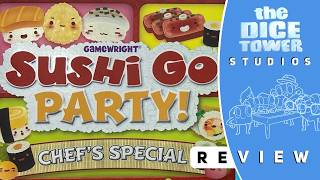
Sushi Go Party! Chef's Special Deep Dive
What the Community Thinks About Sushi Go Party! Chef's Special
Sushi Go Party! Chef's Special has earned strong praise from The Dice Tower's review team, who see it as a refined, feature-rich continuation of the beloved Sushi Go franchise. The game arrives as a complete standalone release, meaning players need no prior experience with earlier titles, though veterans will find an entirely fresh roster of cards waiting for them. Wendy Yi, who has long championed the original Sushi Go as a top-ten game of all time, gives Chef's Special a perfect 10, calling it exactly what Yi has wanted from the series for over a decade. Tom Vasel, while slightly more measured, praises it as a superbly good drafting game worthy of an 8.5. The standout compliment centers on the experience itself: reviewers consistently note that this is the kind of game that bridges every social divide, playing equally well at a casual family dinner or among board game enthusiasts.
Core Mechanics That Define Sushi Go Party! Chef's Special
Card Drafting and Simultaneous Reveal
At its heart, Sushi Go Party! Chef's Special is a card drafting game where players select one card from a hand of cards, place it face-down in front of them, then pass the remaining cards to the left. Everyone simultaneously reveals their chosen card, receives the passed hand, and repeats until the deck is exhausted. The beauty of this mechanic is its simplicity paired with real decision-making. Players must balance what they take with what they leave for opponents, all while managing incomplete information until the moment of reveal. The game completes a full round in roughly 20 minutes, making it perfect for a quick gaming session between heavier pursuits or as the main event of a casual night.
Neighbor-Based and Majority-Driven Scoring
Chef's Special introduces a scoring philosophy that sets it apart from its predecessors. Rather than relying solely on simple majority (most of something wins points), many new cards reward proximity and player interaction. Some cards score based on what your neighboring players have drafted, forcing you to think not just about your own collection but about the board state immediately beside you. Other cards use a heat-activated reveal mechanic, where holding your finger against the card temporarily displays a hidden number or value. This neighbor-conscious design creates tension and interdependence; you cannot play solitaire. The downside, as reviewers discovered, is that this mechanic struggles at the extremes. With only two players, the neighbor-based cards lose their teeth because there is no meaningful player positioning. Conversely, at eight players, majority-scoring cards become less valuable since the diluted player count makes building a dominant collection much harder.
The Sushi Go Party! Chef's Special Experience
Accessibility Across Any Group
One of the defining strengths reviewers highlight is the game's universal appeal. Wendy Yi recounts bringing the game to teenagers at church who had never played a board game before, alongside sessions with seasoned hobby gamers, and notes that it plays beautifully in both contexts. The rules are lean, the decisions clear, and the theme of drafting sushi cards needs no explanation. Nothing about the core loop feels intimidating or requires prior knowledge. This accessibility, paired with genuine strategic depth, makes Chef's Special a rare game that professionals and newcomers can enjoy together without anyone feeling patronized or overwhelmed. For players looking for a weeknight centerpiece or a gateway game to offer friends who do not yet frequent game nights, this expansion delivers.
Variability Through Modular Setup
The game board is double-sided and presents multiple configuration options, allowing players to adjust the quantity of appetizers, desserts, rolls, and special cards in play for each session. This modular approach keeps the experience fresh across replays. Some card sets, such as the lotus chips, introduce trickier scoring that works better once players have a feel for the base game, making them optional starter cards for newer audiences. This flexibility also extends to storage: the box is designed to hold the original Sushi Go Party game inside along with its promos and dividers, finally solving the notorious problem of the original's tin packaging. Reviewers, who have long grumbled about tin boxes taking up shelf space, express genuine delight at this solution.
What Makes Sushi Go Party! Chef's Special Stand Out
Complete Thematic and Mechanical Reinvention
With the exception of the basic nigiri cards, every single card in Chef's Special is new. The design team did not simply add a few fresh options alongside the old standby cards; they created an entirely new menu. Some cards are pure fun experiments, like the lemon or sour candy card that adds three points but makes your next draw random. Others, like the row-multiplying cards, look flashy on paper but deliver fewer points than players initially expect, teaching valuable lessons about card evaluation. This wholesale refresh keeps the experience novel even for players who have hundreds of plays of the original game under their belts.
Two-Player and Multi-Player Variants
The rulebook includes several play variants designed to address different player counts. Most notably, there is a two-player mode explicitly inspired by Seven Wonders Duel, giving pairs an alternative to the vanilla drafting experience. The inclusion of content designed for specific player counts shows thoughtful development, though reviewers note that some card types still struggle to shine at the extreme ends of the player spectrum. At six players, the sweet spot, the game's design shines brightest, with majority fights remaining meaningful and neighbor interactions creating genuine tension around the table.
Potential Drawbacks
Heat-Activated Card Usability
The heat-sensitive cards are a novel component, but they introduce a play-experience wrinkle. When players are drafting face-down and cards land in hand, it is awkward to hold a warm finger against a card to reveal its hidden value without potentially showing it to opponents or disrupting the face-down mechanic. One reviewer noted that the pufffish card, which displays its icon through the card itself, is easier to manage than the dessert card that does not show through. The workaround involves keeping heat-activated cards as back cards in your hand or using a house rule (drawing a random card from the deck if the heat card is the only one left), but this friction is unnecessary. The dessert heat cards performed better in practice, suggesting that component execution varies across the print run.
Neighbor-Based Cards and Player Count Extremes
Several card types rely on spatial relationships to neighboring players. Cards that trigger effects on your left or right neighbor are flavorful and engaging when you have a clear neighbor, but at two players, they lose their punch. Similarly, majority-based cards that reward "whoever has the most" become less decisive at eight players, where the player count spreads points too thin and makes building a runaway majority much harder. Some reviewers would benefit from more cards that work consistently across all player counts, rather than designs that require the six-player sweet spot to shine.
If You Enjoy Sushi Go Party! Chef's Special
If Chef's Special clicks for you, you have a large library of light-to-medium weight drafting games to explore. Seven Wonders Duel, which inspired the two-player variant included here, deepens the drafting experience with more complex card interactions and a civilization-building theme. The original Sushi Go offers a simpler, more streamlined alternative if you want the core mechanic without the bells and whistles. For players who crave more neighbor-based interaction and spatial awareness, games like Splendor or 7 Wonders introduce more player-to-player negotiation and table tension. And of course, the original Sushi Go Party game remains compatible, allowing you to mix and match card sets across multiple games for infinite variety once you own both editions.
What Reviewers Are Saying
"It's literally like the let's pull out with weeknight game. Like, let's just we want to play anything. This can play with any group of people. I've played this with teenagers at church that have never played board games before. I played this with heavy gamers. Like, this is just a game that I can literally bring out for any situation, anybody, anywhere."
— The Dice Tower
"This is a Sushi Go Party part two, and the box fits the original Sushi Go Party game in it, which is wonderful. You can get rid of that can. Love that. It's got great dividers, so the actual production of it is good. On top of that, I just love all the new powers, all the new abilities. You can play it as a stand-alone game if you want to. This is a 10 for me. I adore Sushi Go. It's one of my favorite games."
— The Dice Tower
"Simple fun, easy drafting, the game plays in 20 minutes. It plays up to eight players. Eight is a lot to go around, especially with some of the cards that don't work as well with eight like majorities and things like that. But for six, it's really solid."
— The Dice Tower