



Dreadful Dragons Deep Dive
What the Community Thinks About Dreadful Dragons
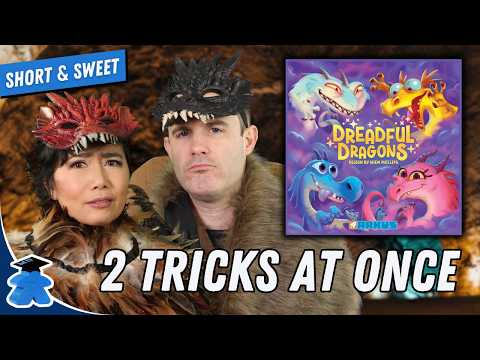
Reviewers see Dreadful Dragons as a compact trick-taking card game that packs a lot of decision-making into roughly 25 minutes. Meeple University frames the game around a simple goal: finish with the most gems. It praises the way every play carries several objectives at once, noting that "every card decision has several layers." The Brothers Murph came away describing a game with "kind of a lot going on," and their three-player session ended with the scores close enough that the final tricks decided the winner.
Not every take is enthusiastic. Meeple University's short clip uses the title as the punchline, with one table passing on the game because "the title says it's dreadful, so it's probably not a good one." The joke is aimed at the name rather than the mechanics, but it reflects how the game's branding invites a tongue-in-cheek response from people who have not yet played it.
Core Mechanics That Define Dreadful Dragons
Dreadful Dragons is published by Arkus Games and designed by Sham Phillips. Two mechanics shape nearly every decision in the game.
Two Tricks Resolved at Once
Each dragon card shows two colors, one on the top half and one on the bottom, and the two halves always total 15. The lead card sets two lead colors, so every trick is effectively two contests running side by side. The Brothers Murph explained that the top color is won by the highest card showing that color, and the winner earns gems equal to the value of the other half of their card. The player who wins the top color also takes the first player marker. The bottom color is then resolved the same way, but without the marker. Meeple University highlighted the resulting tension: a player might want to win one trick while avoiding the other, and the card that does one job well can easily ruin the second.
Crests and Crest Stealing
The second core system is the crest economy. When a player plays a card that matches a lead color with the lowest value of that color in the trick so far, they take the matching crest tile and gain gems equal to the total number of crests they now hold. Crests can change hands again, so an opponent who plays a lower card of that color can steal the crest and score from it as well. Meeple University described this as "crest-tiphery," a style of play where a player wants crests but also keeps opportunities to regain them. The Brothers Murph also noted that when a player cannot follow either lead color, they can play any card and claim a crest matching one of the colors they just played. At the end of the game, each player scores one more gem for every crest they still hold.
The Dreadful Dragons Experience
Tense Calculation
The dominant feeling in both reviews is constant calculation. Meeple University described each play as a balance between winning tricks for large gems and playing low to capture crests. The Brothers Murph repeatedly stopped to check which cards had already been played, since a lower card in a color could be stolen by an opponent a moment later. Their discussion of follow-suit decisions, and of whether a player who had already claimed a color should bother playing a lower card in it, shows how much of the game lives in remembering the table.
Swingy, Uncertain Endings
The horde adds a second layer of uncertainty. Cards in the horde are only playable from the top, and revealing a lower card can change a player's options mid-round. The Brothers Murph found that holding unknown cards made the late game feel like a gamble, and they described the final tricks as a race in which a player's scoring potential depended on cards they had not yet seen. Meeple University described the game's ramp of scoring as one where the winner is rarely clear until the last trick.
What Makes Dreadful Dragons Stand Out
Scaling Across Player Counts
Meeple University pointed to the way Dreadful Dragons adjusts to the table size. With two or three players, the trick is played with more cards per player, and in the two-player game, a crest must first move to the middle before it reaches a player. In a six-player game, players form three teams of two seated across from each other, and teammates cannot take crests from one another. Those rule changes keep the central idea intact across the range, so the game feels tailored to each group rather than simply shrunk or expanded.
The Horde
The horde is a pyramid of cards that players draw on alongside their hand. The Brothers Murph described it as a card pyramid from which players can freely play, and Meeple University noted that the hoard cards are playable only from the top until lower cards are revealed. Because the horde cards are not visible to opponents, the mechanic gives each player a private reserve that can change their options late in the game. The Brothers Murph credited the horde with giving the game a distinctive feel compared with standard trick-taking.
Potential Drawbacks
Bookkeeping and Math Load
Meeple University warned that the game asks players to "perform mathematics that will have your dragon considering hiring an accountant." Each crest's value rises as it is collected, each trick awards gems based on the opposite half of the winning card, and two tricks run at once. The Brothers Murph admitted they had forgotten the rule that each player should start with a dragon crest, a reminder that the crest bookkeeping is easy to get wrong during a first game.
Hidden Horde Cards Add Luck
The horde's hidden cards were the main source of frustration for The Brothers Murph. One player explained that the unknown cards left them without a clear plan, and reflected that "it was one of those things where with the not knowing what these were, I was just like, oo, this is going to be this could be great or it could be not good at all." Their broader sense was that the game can become a crapshoot when the largest cards are already gone and the remaining cards are a mystery.
If You Enjoy Dreadful Dragons
Meeple University used Bridge as the reference point for the genre, saying the two-trick structure is what makes Dreadful Dragons feel different from "otherwise it's bridge." Players who enjoy the traditional trick-taking core but want an extra layer of scoring in each trick will likely appreciate that twist. Meeple University also offered Dungeon Team, a cooperative trick-taking game from Japan that adds tile placement, as an alternative at the same table. Players who want the trick-taking rhythm without head-to-head competition may find that a useful companion, while players who enjoy the competitive crest stealing will find Dreadful Dragons the more direct match.
What Reviewers Are Saying
"Crests can travel around the table repeatedly during one round. Remember, whenever you gain a new crest tile, you also gain gems equal to the total number of crest tiles you now hold. So, you want to have them, but also have opportunities to regain them to score."
— Meeple University
"Okay, some of these big cards are out and this is kind of a crapshoot. Like, I have no idea what's down here."
— The Brothers Murph
"Every card decision has several layers. You may be trying to win one trick, avoid winning the other, collect a crest, deny someone else a crest."
— Meeple University